Squat, press and pull, twice a week, forever
A training plan built to survive teething, deadlines and a fortnight of flu, because the programme you keep beats the programme you admire.
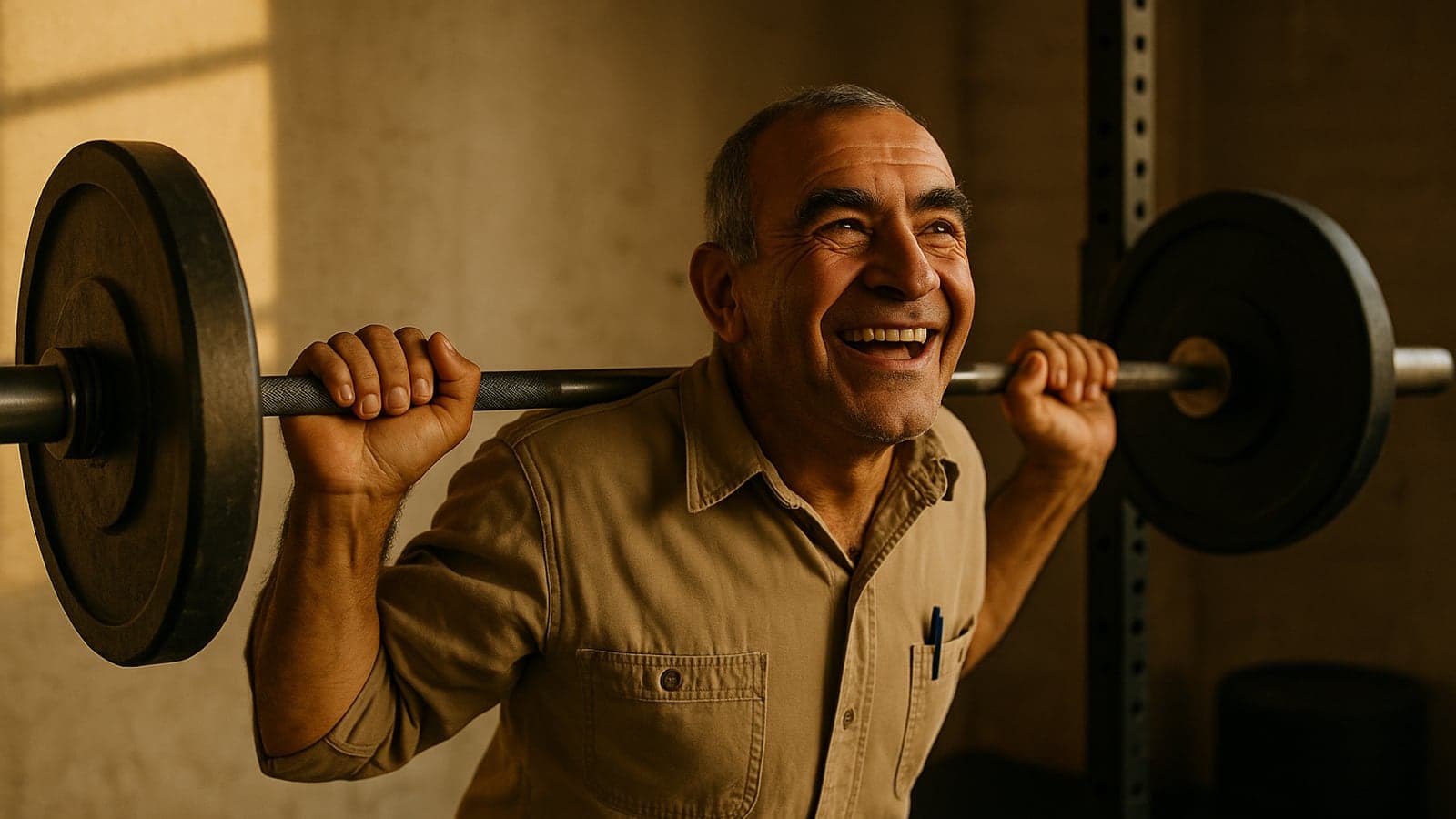
Two sessions a week. Forty-five minutes each. One squat, one press, one pull in every session, and you add 2.5kg when you earn it. Tuesday and Saturday works for most people with a job and small children, because Tuesday survives the week and Saturday survives the weekend.
That's the whole thing. What follows is how to run it so it's still running when your youngest starts secondary school.
The two sessions
Session A
- Back squat — 3 sets of 5
- Bench press — 3 sets of 5
- Barbell row — 3 sets of 8
Session B
- Deadlift — 1 set of 5, after two build-up sets
- Overhead press — 3 sets of 5
- Chin-up — 3 sets, as many as you get, stop one short of failure
Six exercises across the week. Three patterns. You squat something, you push something, you pull something, twice.
If choosing is the thing that derails you, delete session B's variations and do A twice a week. Same squat, same bench, same row. It's slightly worse on paper and considerably better in practice, because a decision you don't have to make is a decision you can't get wrong at 5:40 in the morning.
Why two and not four
The third session is the one that gets cancelled. Then the second one goes, because a two-session week already feels like failure and the brain would rather abandon the whole thing than run it at 50 per cent.
Build the week so there's nothing to cancel. Two is small enough that a sick child, a late meeting and a burst pipe can all happen in the same seven days and you still make one of them. One session in a bad week is not a failure. It's maintenance, and maintenance over ten years is an enormous amount of strength.
Four days a week genuinely is better if you can hold it. Someone with a flexible job and older kids should probably do it. I'm not pretending otherwise. But the man who trains twice a week for a decade ends up stronger than the man who trains four times a week for eight months, quits, restarts in January, quits again in March. That second man isn't lazy. He's just running a programme that has no slack in it.
Adding weight without wrecking yourself
Add 2.5kg to the squat and deadlift when every prescribed rep goes up cleanly. Add 1.25kg to the bench and the overhead press — buy a pair of 0.625kg micro plates, they cost less than a takeaway and they'll keep your press moving for two extra years.
The overhead press is the lift that stalls first. It's a small lift with small muscles doing the work and there's nowhere to hide. Expect to spend a month at the same weight. That's normal.
When you miss reps two sessions running, drop that lift by 10 per cent and walk it back up. Don't grind. Don't add a fourth set to compensate. Take the step back and you'll be past the old number in five weeks.
The arithmetic is the point. Add 2.5kg to your squat every fortnight and you'd be squatting an absurd number within two years, which tells you the progress won't be linear. Fine. Even a handful of successful jumps a year, compounded, puts you somewhere you'd never get to by training hard in bursts.
The warm-up short enough to actually do
Eight minutes. Five on a bike or a brisk walk to the garage, then the bar itself as the warm-up.
For the squat: empty bar for 8, then 40 per cent for 5, 60 per cent for 3, 80 per cent for 2, then work. Four sets, none of them hard, about four minutes. Do the same for the deadlift and the press.
Skip the mobility routine you saved from somewhere. If you've got a specific problem — a shoulder that clicks and hurts, a hip that won't let you get below parallel — that's a physiotherapist's job, not a YouTube video's. Book the appointment. Pain that changes how you move is worth a professional opinion and it is not something to train through.
What goes wrong, and what it costs
You'll miss a fortnight. Flu goes through the house, or you travel for work, or the baby stops sleeping and you make the sensible call that lifting heavy on five broken hours is a poor trade.
Coming back, everybody makes the same mistake. They load the bar where they left it, have a bad session, feel awful, and don't return for another three weeks.
Take 15 per cent off everything for your first session back. You'll be back to your old numbers inside three weeks and you won't have spent those three weeks dreading it.
The other failure is the phone. Forty-five minutes turns into seventy because you stood between sets reading something. Set a timer — three minutes between heavy sets, ninety seconds between rows and chins — and leave the phone face down on the windowsill.
Recovery that fits around a household
Sleep is the lever. Everything else is a rounding error next to it, and it's also the thing you have least control over when there's a toddler in the house. So don't pretend a supplement fixes it. On a bad sleep week, run the same session at the same weight instead of adding. That's it. That's the adjustment.
Eat protein at every meal. Eggs, yoghurt, mince, chicken thighs, tinned fish. If you're doing the cooking anyway, cook 50 per cent more than tonight needs and put the rest in the fridge.
Walk. A twenty-minute walk with the pushchair on a Sunday does more for how you feel on Tuesday than any foam roller. It costs nothing and it's the only recovery work that doubles as time with your family.
The kit
A second-hand Olympic bar, a set of plates, a squat rack with safety pins, a flat bench. Buy the rack with pins so you can bench alone without a spotter. Everything else is optional for a decade at least.
If it's a gym instead, pick the one you drive past on the way home, not the good one twelve minutes further on. Twelve minutes each way, twice a week, is nearly an hour a week of pure friction and it's the reason your membership lapses.
My garage has a bar, a rack, a bench and a chin-up bar bolted into the joists. There's usually a scooter in the way and a half-deflated football under the bench. It's not a nice gym. I've never once failed to train because of it.
Ten years out
Run this and you won't have a training log full of personal bests. You'll have something better and much duller — a body that still does what you ask it to at fifty, a back that tolerates a day of carrying boxes, and the specific, unremarkable competence of being the person who can lift the heavy end.
Your children will remember that you went. Not what you lifted.
The bar's in the garage. Put four minutes of warm-up on it on Tuesday.
Marcus Vale
Editor-in-Chief
Twenty years in magazines, most of it deciding what to cut. Writes about work, discipline and the decisions that compound.

Read next