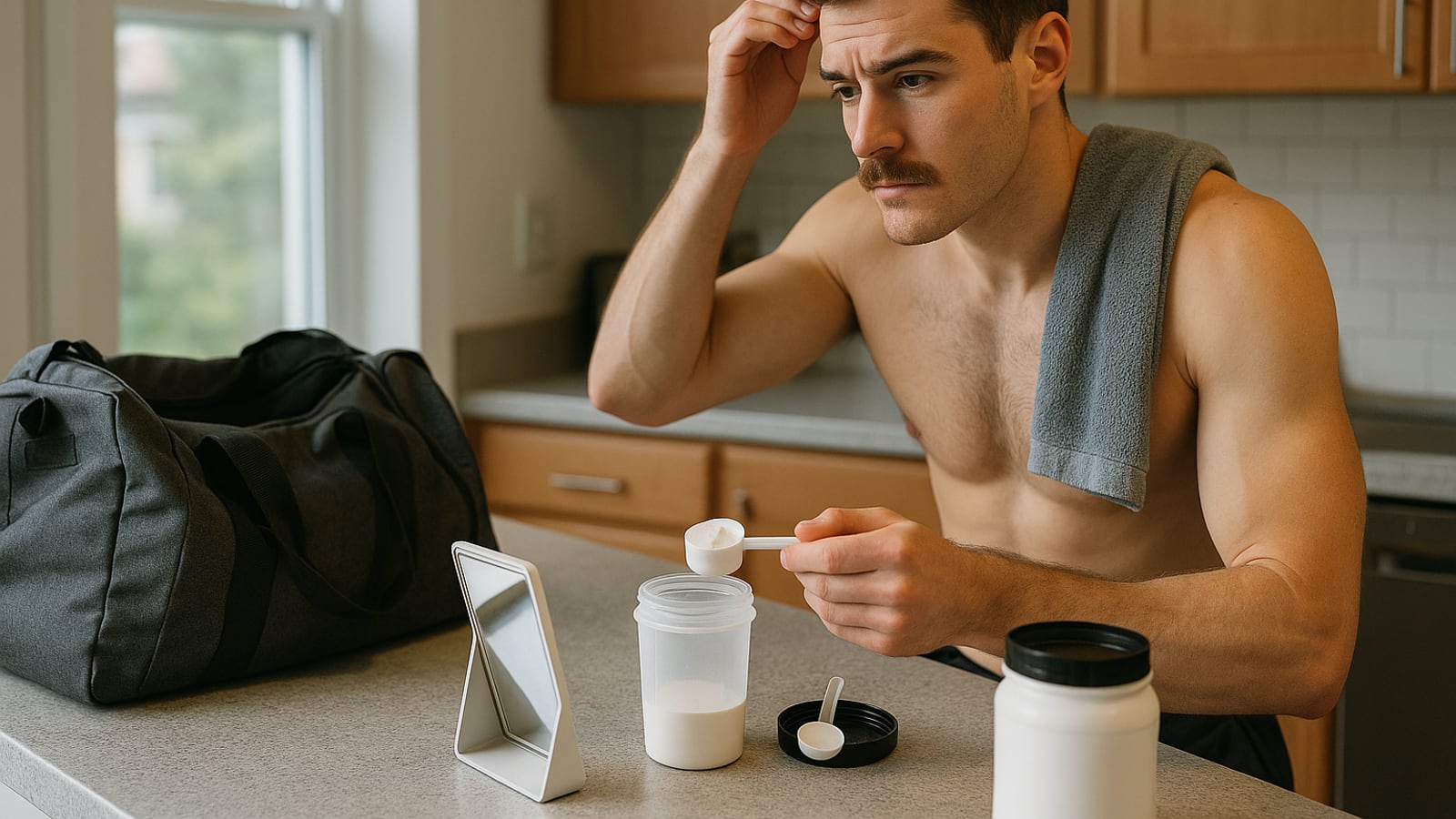
The entire "creatine makes you go bald" idea rests on one small trial from 2009. Twenty male college rugby players in South Africa. Seven days of loading at 25 grams a day, then fourteen days at 5 grams. DHT — dihydrotestosterone, the androgen most closely tied to male pattern hair loss — went up by roughly half after the loading week and was still around 40 percent above baseline at the end. Testosterone didn't move.
That's it. That's the whole evidentiary basis for a claim you'll see repeated forty times a day on the internet.
Nobody in that study lost any hair, because nobody looked. Hair wasn't measured. Not counted, not photographed, not graded on any scale. The researchers were looking at hormones in blood, over three weeks, in twenty young men. Hair loss takes months to become visible and years to become obvious. A three-week hormone study can't tell you anything about it either way.
What the study is actually good for
It's a mechanism hint. A plausible one. DHT drives androgenetic alopecia in men who carry the genes for it, and if a supplement nudges DHT up, that's worth a second look.
But two things sit awkwardly with the panic. The first is the dose. The loading protocol was 25 grams a day, five times what a sensible adult takes, and the percentage rise was biggest during exactly that week. The second is that the absolute values were reported as staying inside the normal range. A 40 percent rise from the low end of normal is still normal.
And in the years since, as far as I'm aware, nobody has reproduced that DHT finding. The International Society of Sports Nutrition's position stand on creatine addresses hair loss directly and puts it in the bucket of claims the evidence doesn't support. Creatine monohydrate is one of the most studied supplements that exists, in thousands of people, some of them for years. If it reliably thinned hair, the signal would have turned up by now.
Why so many men are certain it happened to them
Because of when men start taking it.
Think about the typical story. A man gets serious about lifting somewhere between 22 and 30. He buys a tub of creatine at the same time, because that's what you buy. Over the next two or three years his hairline moves back a centimetre.
That window is also precisely when male pattern hair loss most commonly announces itself. Most men who are going to lose hair start losing it in their twenties. The supplement and the shedding arrive together, and the supplement is the thing you can blame, because you can't send an email to your grandfather's genome.
There's a second confounder nobody mentions. Men who start lifting hard also start sleeping worse, dieting, cutting weight, training through stress, washing their hair more because they sweat more, and looking at their own head in gym mirrors under overhead lighting for the first time in their lives. Noticing isn't the same as causing.
What genuinely decides your hairline
Genetics, mostly, and then age. Androgenetic alopecia is a sensitivity of particular follicles to normal androgen levels. Either those follicles are sensitive or they're not. Men with high DHT and the wrong genes go bald; men with high DHT and the right genes don't.
That's the part the creatine argument keeps skipping. The question isn't whether DHT matters. It obviously does. It's whether 5 grams of creatine a day moves your DHT enough to change the trajectory a body of genetic evidence already set. There's no data showing that it does.
My read, and I'll flag it as a judgement rather than a finding: if you're losing hair while taking creatine, you were almost certainly going to lose it anyway, and stopping the creatine will change your timeline by approximately nothing.
How to settle it for yourself
You don't need to take my word for it, and you don't need to guess. You can run the only test that matters to you.
- Take a photo. Crown from directly above, hairline straight on, same light, same dry hair, phone at the same distance. Do it today.
- Stop the creatine for four months. Not four weeks. Hair cycles are slow, and a shed that started in February shows up in May.
- Retake the photos. Same spot, same light. Compare side by side, not from memory. Memory is useless for this.
- Count what comes out. Somewhere in the region of fifty to a hundred hairs a day is normal shedding. A handful in the shower after three days of not washing isn't a crisis.
You'll lose a modest amount of strength and a couple of pounds of intramuscular water over those four months. You'll get it back within a month of restarting. That's the whole cost of knowing.
If the photos look the same, stop thinking about it. If your hair is going regardless, then the useful conversation is with a GP or a dermatologist about the treatments that actually have evidence behind them, not with a tub of white powder. Those are prescription decisions with real trade-offs, and they're not mine to make for you.
And if you'd rather just not risk it
Fine. Genuinely. Creatine isn't compulsory.
It's the best-supported supplement for strength and repeated-effort work, and the effect is real, but it's not enormous. Nobody's marriage, career or bodyweight ever turned on 5 grams of monohydrate. If the worry would sit in the back of your head every time you scooped it, the anxiety costs more than the supplement earns. Train, sleep, eat enough protein, and skip it.
What you shouldn't do is go looking for a "DHT-free" creatine. There isn't one. Every form of creatine produces creatine in your muscle, and the fancy versions — HCl, buffered, liquid, ethyl ester — are the same compound with a worse price and thinner evidence. Plain monohydrate is usually the cheapest tub on the shelf, and a kilo lasts around two hundred days at 5 grams. Buy that or buy nothing.
The practical dosing bit
Skip loading. The 25-gram protocol from that 2009 study exists to saturate muscle in a week, which matters if you're an elite athlete with a competition date. It doesn't matter to a man with a job, two children and three training sessions a week.
Take 3 to 5 grams a day, every day, including rest days. You'll be fully saturated in three to four weeks instead of one. Same destination. Much less stomach discomfort, and if the DHT rise in that trial was dose-driven, you've avoided the dose that drove it.
Timing is irrelevant. Take it with whichever meal you never skip. Mine goes in the morning coffee, where it dissolves badly and tastes of nothing, which is exactly what you want from a supplement.
If you have kidney disease, liver disease, or you're on medication that affects kidney function, ask your doctor before you start. That's the real caution with creatine, and it's the one the internet never argues about.
Ten years from now you'll have the hairline your father and his brothers have. What you get to decide is whether you're also still strong enough to carry a sleeping seven-year-old up the stairs.
Marcus Vale
Editor-in-Chief
Twenty years in magazines, most of it deciding what to cut. Writes about work, discipline and the decisions that compound.

Watch
Worth an hour of your evening
More from Fitness.
From channels we rate. Plays on YouTube.
Read next