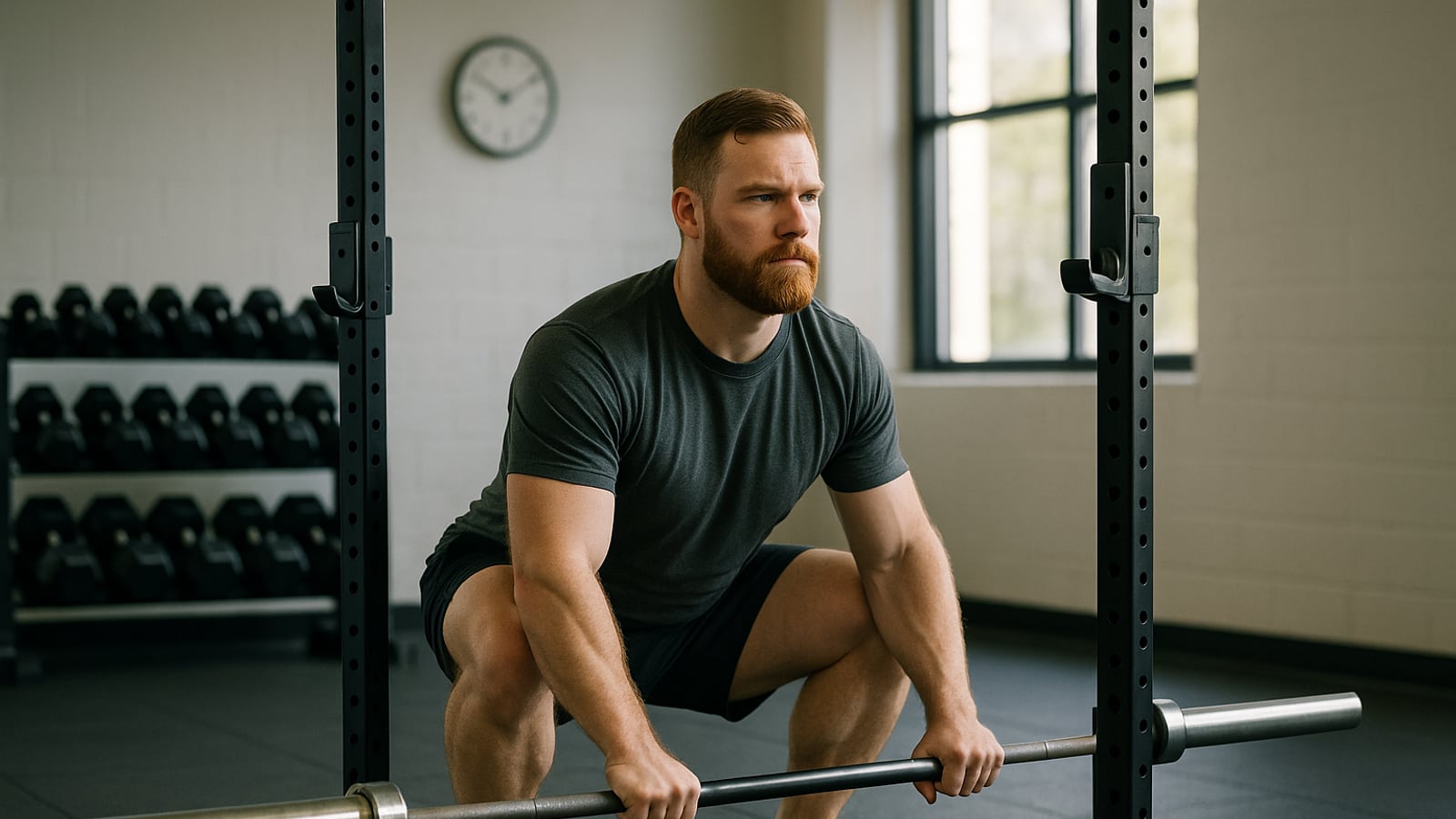
The empty barbell weighs 20kg. That's where week one starts, and if that sounds embarrassing, good. Nobody who has been lifting for ten years will look twice, and the man who loads 60kg on day one because it "feels light" is the man who tweaks his lower back in week two and tells people for the next decade that squats are bad for you.
Twelve weeks. Three sessions of about forty-five minutes. Two lifting days if the week falls apart, which it will, roughly twice.
The shape of the week
Two workouts, alternating. Call them A and B. Monday, Wednesday, Friday one week; Monday, Wednesday, Saturday the next. You'll do A, B, A, then B, A, B. Don't overthink which one lands on which day.
Session A
- Back squat or goblet squat — 3 sets of 5
- Bench press or dumbbell press — 3 sets of 5
- One-arm dumbbell row — 3 sets of 8 each side
- Farmer's carry — 3 trips of about 30 seconds
Session B
- Trap-bar deadlift or Romanian deadlift — 2 sets of 5
- Overhead press — 3 sets of 5
- Lat pulldown or assisted chin-up — 3 sets of 8
- Plank or dead bug — 3 sets
That's it. Eight working sets in a session. You'll be done in forty minutes once you stop reading your phone between sets, which is where most of the missing time goes.
If your gym has no barbell, or the squat rack has a queue of teenagers filming each other, dumbbells and machines work. A leg press isn't a moral failure. The goal in twelve weeks is to get stronger and stay uninjured, and a machine you actually use beats a barbell you avoid.
Weeks one to three: go too light on purpose
Pick weights that let you finish every set with two or three reps still in the tank. On the squat that might be the bar alone. On the bench it might be 30kg. On the overhead press, genuinely, it might be 20kg and that's fine, because the press is the lift where everyone is weaker than they expect.
Add 2.5kg to upper-body lifts each session and 5kg to lower-body lifts each session. From a very light start, that ramp works for weeks. You're not testing anything yet. You're building tendons, learning where your feet go, and teaching yourself that Wednesday at 6am is a thing that happens now.
The part nobody warns you about: you'll be sore in the glutes and hamstrings for about four days after the first squat session, and it'll be worst on day two. Walking downstairs will be comedy. It gets dramatically better by session three and it doesn't come back at that intensity again. Don't skip the second workout because you're sore from the first. Go and do the light version.
Weeks four to six: the weight starts to mean something
By now the squat might be 50 or 60kg, the bench somewhere in the 40s. The jumps start to bite. Keep adding, but switch to a rule instead of a feeling.
The rule: if you completed all prescribed reps last session with clean technique, add weight. If you missed a rep, repeat the same weight next time. If you miss at the same weight twice in a row, drop it by 10 percent and build back up.
Write it down. Phone notes, a paper diary, whatever you'll actually open. The logbook is the program. Without it you'll drift, pick weights by mood, and eight weeks later you'll be lifting roughly what you were in week four wondering why nothing's changed.
Somewhere around week five you'll notice something odd. Carrying both bags of shopping in one trip stops being a decision. That's the first real return, and it arrives long before anything visible does.
Weeks seven to nine: the first stall
You'll miss reps. Probably on the overhead press first, because it progresses slowest, then on the bench. This is normal and it's not a sign you've done it wrong.
Drop the upper-body increments to 1.25kg using fractional plates if your gym has them, or to 2.5kg every second session if it doesn't. Keep the squat moving. Legs usually keep progressing for a while after the upper body has slowed down.
This is also where life interferes properly. A child gets a temperature. A work trip. A weekend at the in-laws. Two sessions a week keeps almost all of your progress; zero sessions for three weeks doesn't. When the week collapses, cut the program to the first two exercises and get out in twenty-five minutes. Squat and bench. Deadlift and press. That version of the workout is worth about eighty percent of the full one and takes less time than the drive.
If you miss a full week, go back to the last weight you completed cleanly and work up again. It'll take about ten days to get back. It's not a disaster, it's a Tuesday.
Weeks ten to twelve: prove it
No new exercises. Same four movements, same sets. The only change is that you finish the last set of each lift with maybe one rep left, not three. You're closer to your limit now, and that's earned rather than assumed.
Take a deload in week eleven if you're beaten up: same sessions, 80 percent of the weight, every rep fast and easy. You'll come back in week twelve and put 5kg on lifts that had been stuck. Most beginners refuse to deload because it feels like going backwards. It isn't.
At the end of twelve weeks, a man who started from nothing and didn't miss much is often squatting somewhere around bodyweight for reps, deadlifting a bit more, and pressing considerably less than he hoped. Those numbers vary enormously by height, age and starting point, so don't measure yourself against them. Measure yourself against your week-one logbook.
Sleep and food, without the sermon
Protein at every meal is the one dietary change worth making while you're doing this. Eggs at breakfast, meat or fish or beans at lunch, the same at dinner. You don't need shakes, though they're a convenient way to hit the target when the day gets away from you.
Sleep is the thing that determines whether week nine feels manageable or grim. Six hours and a 5am alarm works for a fortnight and then stops working. If the only slot you have is before the house wakes up, the bedtime has to move too. That's the actual cost, and it's worth saying out loud rather than pretending the hour comes from nowhere.
Skip alcohol the night before a session where you're due to attempt a new weight. Not a rule for life. Just useful information.
When to stop and ask someone
Sharp pain, pain that's worse the next morning, numbness or tingling down a limb, or anything that changes how you walk. That's a physiotherapist or your GP, not a forum, and not a heavier belt. Dull muscle soreness that fades over two or three days is a different animal entirely.
If you've got an existing back, shoulder or knee problem, get cleared before week one rather than diagnosed in week six.
The bit that matters after week twelve
The program is designed to run out. Linear progression stops working for everyone eventually, usually between three and six months in, and at that point you'll want a plan with heavier and lighter days rather than one where every session is a personal best attempt.
But the reason to finish all twelve weeks has almost nothing to do with the numbers. It's that on some Wednesday in week eight you'll be tired, the toddler will have been up at 4am, and you'll go anyway. Then you'll do it again the following week.
That's the habit. The strength is a side effect.
Marcus Vale
Editor-in-Chief
Twenty years in magazines, most of it deciding what to cut. Writes about work, discipline and the decisions that compound.

Watch
Worth an hour of your evening
More from Fitness.
From channels we rate. Plays on YouTube.
Read next