Start with the short version. Almost everything anybody knows about BPC-157 and TB-500 comes from animals. Rats, mostly. The human evidence is close to nonexistent, neither compound is an approved medicine, and what you can buy online is sold with a label saying it isn't for human consumption. That doesn't automatically mean they don't work. It means nobody can honestly tell you they do, at what dose, or what happens if you use them for three years.
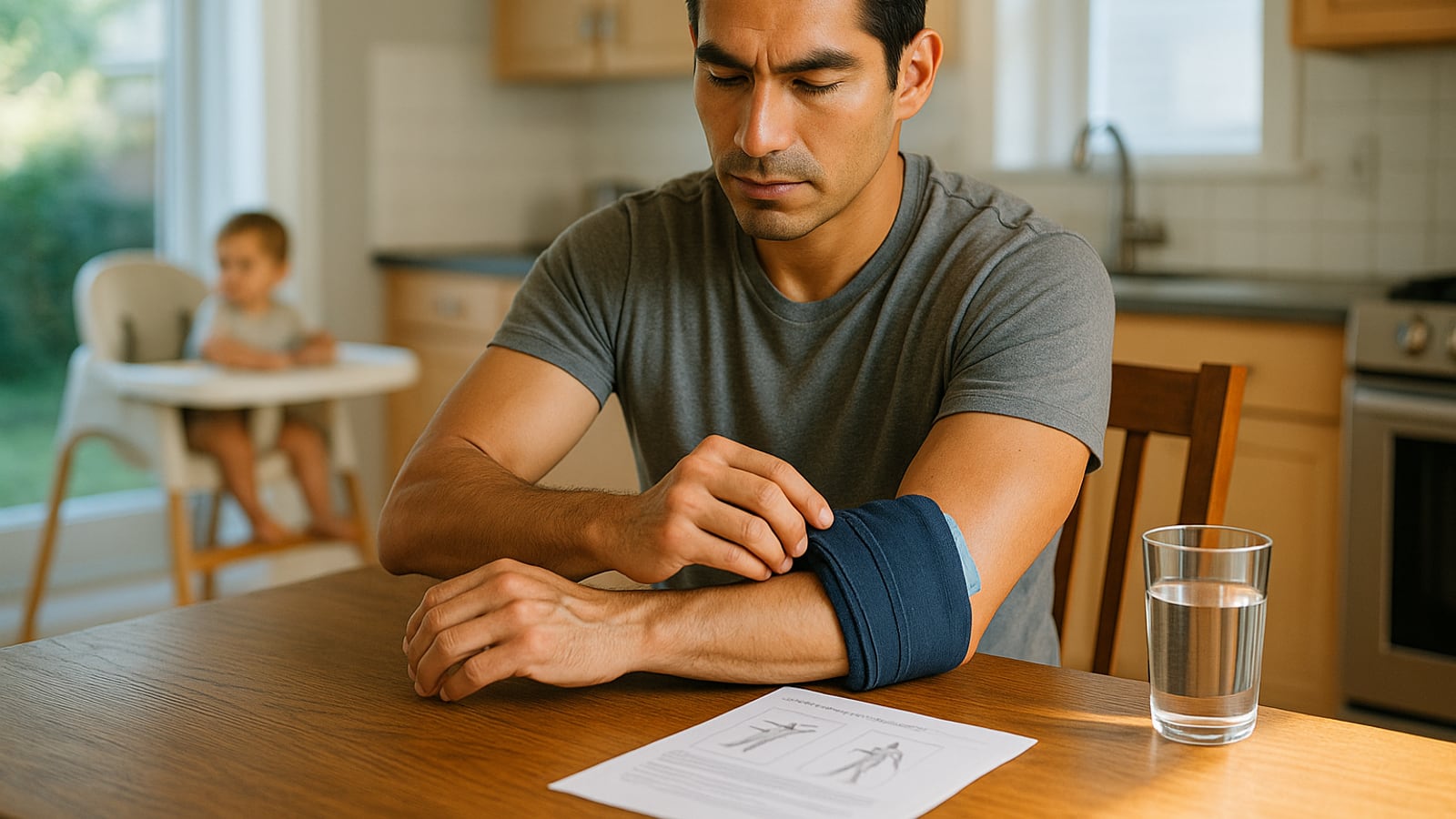
If you're 38 with two kids, a job, and a golfer's elbow that's been grumbling since March, that matters. You're not looking for a performance edge. You're looking for your arm to stop hurting when you pick up a toddler. Worth knowing what you'd actually be buying.
This is general education, not medical advice. If you've got a persistent injury, the person to talk to is a sports physician or a physical therapist, and if you're considering any injectable, a doctor who knows your history.
What these things actually are
BPC-157 is a short synthetic peptide. The sequence was identified from a protein found in gastric juice, which is where the "body protection compound" name comes from. It doesn't occur in that stable 15-amino-acid form in your body. It's a lab construct.
TB-500 is usually a seven-amino-acid fragment associated with thymosin beta-4, a protein involved in cell migration and wound repair. Thymosin beta-4 itself is 43 amino acids. Sellers often use the names interchangeably. They're not the same molecule, and any evidence about the full protein doesn't transfer cleanly to the fragment in the vial.
That distinction gets glossed over constantly in forum posts and podcast segments. Somebody cites work on thymosin beta-4 and wound healing, and three steps later it's presented as proof that the peptide you bought will fix your rotator cuff.
What the animal research shows
There's a real body of rodent work on BPC-157, much of it from a small number of research groups. Achilles tendon transection models, ligament injury, muscle crush injury, gut damage from anti-inflammatories. In those models, treated animals often heal faster on the measures the researchers chose.
The proposed mechanisms are plausible enough. Increased blood vessel formation at the injury site, upregulation of growth factor signaling, effects on nitric oxide pathways. Nothing about the biology is absurd.
But rodent healing models are a graveyard of promising compounds. A rat Achilles cut with a scalpel and left to heal in a cage isn't a human tendon that's been degenerating for eighteen months under load from bad technique and too much volume. Tendinopathy in a 40-year-old isn't an acute wound. It's a chronic tissue problem with a different biology, and the animal work mostly doesn't model it.
The other issue is publication concentration. When most positive findings on a compound trace back to a narrow research base, independent replication carries a lot of weight, and there isn't much of it.
What human evidence exists
For BPC-157, there's been early exploratory work related to inflammatory bowel disease going back years. It never produced an approved product, and there are no substantial published controlled trials in humans for tendon, ligament, or muscle injury. Not small ones with weak results. None worth building a decision on.
For thymosin beta-4, there have been human trials in other areas, including wound healing and eye surface conditions. Those trials used the full-length protein under clinical supervision, and again, no approved product came out of them. TB-500 as sold online has no meaningful human trial evidence at all.
So when somebody tells you it's "well studied," ask what species.
The regulatory picture
Neither compound is approved as a drug for general medical use in the US, the UK, or the EU. BPC-157 has been flagged by US regulators as unsuitable for use in compounded medicines on the basis of insufficient safety data, which is why legitimate compounding pharmacies stopped supplying it.
Both sit on the World Anti-Doping Agency's prohibited list. If you compete in anything tested — masters athletics, powerlifting federations, jiu-jitsu under IBJJF rules, collegiate sport — using either will cost you. So can a military or law enforcement drug screen, depending on the panel and your command's policy. Check before, not after.
The vials themselves are sold as research chemicals. That phrasing isn't a wink. It's the legal structure that lets an unregulated product ship to your door without anybody taking responsibility for what's in it.
What you're actually buying
This is the part that gets underweighted. You're buying from a supplier with no regulatory oversight, no batch release testing you can verify, and no recourse.
The realistic failure modes:
- Underdosed or wrong content. You paid for a peptide and got mostly mannitol.
- Purity problems. Residual synthesis byproducts, related peptide impurities, heavy metals.
- Sterility problems. You're injecting this. Reconstituted with bacteriostatic water, stored in a fridge with the kids' yogurt, drawn up in a bathroom.
- Mislabeling. Independent testing of gray-market peptide products has repeatedly found contents that don't match labels. That's a general pattern across this market, not a claim about a specific vendor.
Third-party certificates of analysis supplied by the seller are worth roughly what you'd expect from a document the seller paid for and could have photocopied from a different batch.
Why people are certain it worked
Tendinopathy improves. Slowly, unevenly, with good weeks and bad ones, but the natural history of most overuse injuries is improvement over months once the aggravating load changes.
People generally start a peptide protocol at their worst point. That's when you're desperate enough to order something off the internet. From the worst point, the next direction is usually up. Add the fact that anyone spending $200 on vials also tends to start sleeping better, eating more protein, and actually doing their rehab, and you've got four reasons for improvement running at once.
That's not an argument that the peptide did nothing. It's an argument that a single person's experience, including yours, can't tell the difference.
The boring stuff with the actual evidence
Progressive loading is the intervention with the strongest support for tendon problems. Heavy, slow resistance work through a controlled range, loaded to a tolerable pain level rather than avoided. Isometric holds when it's too irritable to move. Three sessions a week, small increases, measured in months not weeks.
Twelve weeks is a reasonable first checkpoint. Six months is a normal timeline for a stubborn tendon. Nobody wants to hear that, which is precisely why the peptide market exists.
Around it, the unglamorous levers. Enough protein spread across the day. Seven hours of sleep if you can find them, which with young children is a negotiation rather than a decision. Cutting the specific movement that lights it up while keeping everything else. And a physical therapist who'll watch you lift and tell you what you're doing wrong, which will probably do more for your elbow than any vial.
If the evidence firms up in ten years, it'll still be there. Your forties, spent unable to lift your own kids, won't be.
Cal Brennan
Fitness
Strength coach. Trains fathers, tradesmen and desk workers, which means programmes that survive a bad week.

Watch
Worth an hour of your evening
More from Fitness.
From channels we rate. Plays on YouTube.
Read next