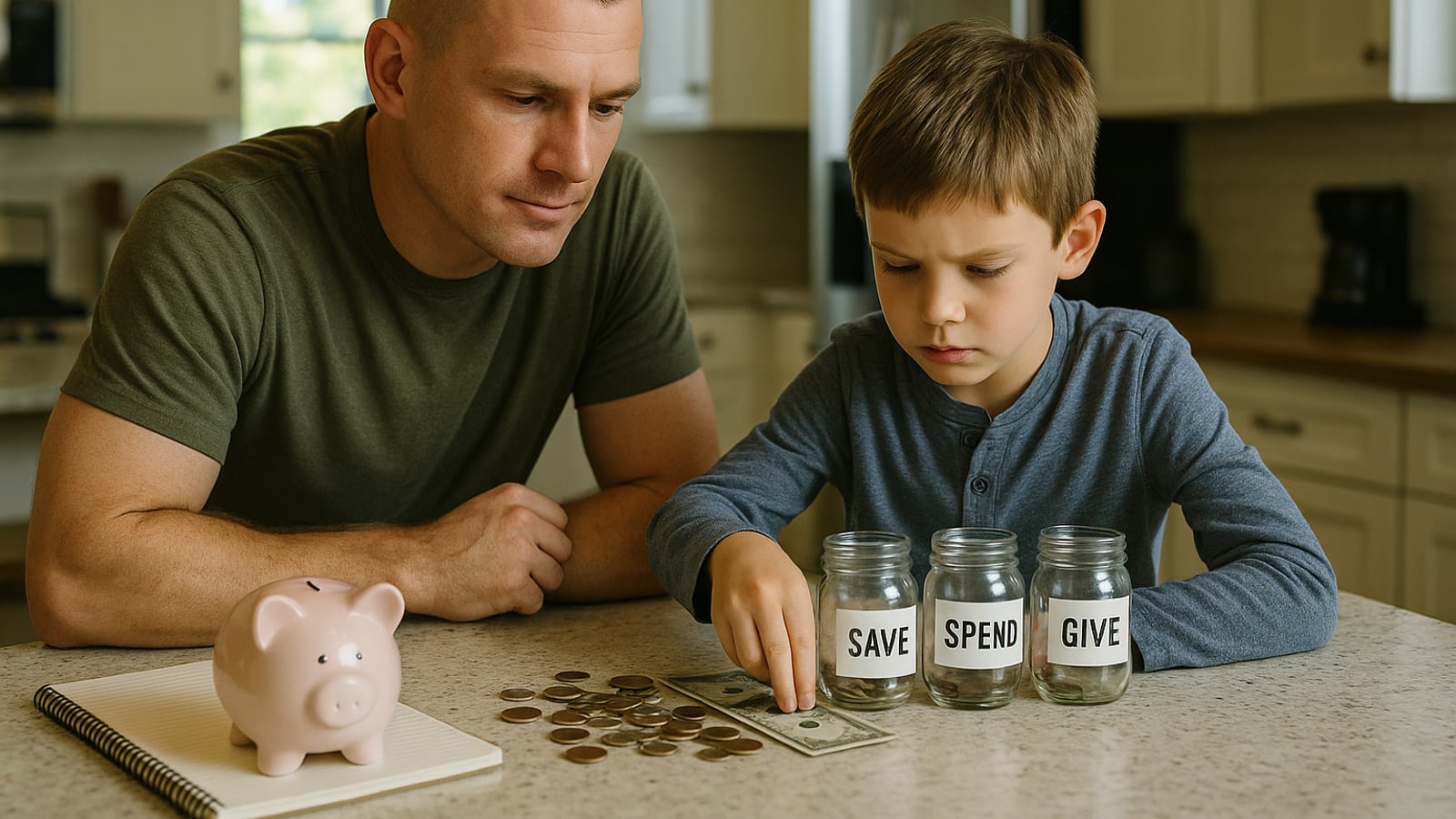
Hand a seven-year-old twenty dollars and they'll tell you it's a lot of money. Hand them two hundred and they'll say the same thing. That's not bad math. It's a missing denominator. They've got no unit to measure against, so every amount lands in the same bucket marked "grown-up money," and nothing you say about saving, budgeting or value has anywhere to stick.
So stop explaining. Start giving them a unit.
Give them a number that's actually theirs
A kid needs a small, predictable, recurring amount of money they control. Not money you supervise. Money they control, including the right to waste it.
The amount matters less than the rhythm. Weekly works better than monthly for younger kids because the wait is comprehensible. Something in the range of a dollar per year of age is a common starting point, and it's fine to start lower if that's where your family is. What you're building isn't wealth. It's a ruler.
Once that ruler exists, prices become legible. A toy isn't "twelve dollars," it's three weeks. A video game isn't "sixty dollars," it's most of a summer. You'll hear the shift happen in their voice the first time they say "that's a lot" and actually mean it.
Until they have that number, every conversation about money is you talking about a language they don't speak.
Chores, or an allowance, and why it matters which
Two camps here, and both have a real argument.
Pay for chores. Work produces money. Clean, simple, and it's how the world runs. The risk is that your kid starts negotiating. Trash goes out when there's a fee attached, and the family stops being a family and starts being a small business with a labor dispute.
Unpaid chores, separate allowance. Chores are what members of a household do, full stop. The allowance is training money — it exists so they can learn to handle it, the same way you'd hand them a knife to learn to cut.
I'd run the second, with a third lane bolted on: paid work that's outside the normal load. Stacking a cord of wood. Scrubbing the garage floor. Washing the car properly, not a rinse. Priced up front, inspected before payment, and yes, rejected if it's half done. That's the closest thing to a job a nine-year-old can have, and the part that teaches most is the inspection.
Don't pay for grades. You want a kid who reads because reading is good, not a kid who's calculated the hourly rate on an A.
Let them buy the bad thing
Your kid will save for four weeks and spend it all on something loud, cheap and broken by Sunday. Let them.
This is the cheapest tuition you'll ever pay. A twelve-dollar disappointment at eight years old is the same lesson as a four-thousand-dollar disappointment at twenty-four, delivered at a survivable scale. Say nothing. Don't buy a replacement. Don't say "I told you." Don't even give the look.
What you can do, a few days later, is ask an honest question. "Was that worth it?" Not rhetorically. Actually curious. Let them answer. Sometimes the answer is yes, and that's a legitimate result too — they learn what they actually value, which is most of what money skill is.
The father who rescues every bad purchase is teaching one thing very effectively: that decisions don't have consequences, because Dad absorbs them. That's a lesson with a long tail.
Cash, in their hand, on the table
Under about twelve, use physical money. Digital balances are a number on a screen and a number on a screen is an abstraction on top of an abstraction.
Three envelopes, or three jars, or three coffee cans. Spend, save, give. They see the give envelope thin out. They see the save envelope get fat slowly, and they feel exactly how slowly.
The visible part is the point. When they pull a crumpled ten out of the spend envelope and hand it to a cashier, something registers physically that a tap on a card never will. They hesitate. That hesitation is the whole skill.
Later, once the habit's formed, move them onto a debit card or a kid account with you as joint holder. They'll need the digital fluency. But build the instinct on paper first, because the instinct is the part that transfers.
Say the quiet part out loud in the store
Kids learn far more from overhearing your decisions than from receiving your lectures.
So narrate. Out loud, in the aisle. "That's the same thing as this one but eight dollars more for the name. We're getting this one." Or, just as importantly: "This one's more expensive and it's worth it, because the cheap one falls apart and I'd have to buy it twice."
Draw the distinction between can't afford and choosing not to. Most families can technically afford the thing in the cart. The reason it's not going in the cart is usually a priority, not a wall. Say that. "We could. I'd rather put it toward the trip." That sentence teaches a child that money is directed, not just rationed.
And mind your tone. Kids absorb financial anxiety with terrifying efficiency. A father who says "we can't afford it" through gritted teeth is transmitting dread, not economics. Calm and matter-of-fact is the entire delivery method.
The waiting list
Get a notebook or a note on your phone. When your kid wants something badly, don't argue and don't buy. Write it down with the date and the price.
Revisit it in two weeks.
Roughly half the time, they'll have forgotten it exists. That's not a trick you're playing on them, it's information you're giving them about their own wanting. The item that survives two weeks is the one worth saving for, and now they know the difference from the inside.
You'll notice this works on you too.
What you tell them about your own money
Age-appropriate, and honest in that order.
An eight-year-old doesn't need your salary. They do need to know that the house costs money every month, that the money comes from your work, and that nobody is giving it to you.
A sixteen-year-old should see more. Show them a mortgage statement and where the interest goes. Show them a pay stub with the withholding taken out, because the gap between the number they're offered and the number that lands is the single biggest shock of a first job. Let them see the insurance bill. Real numbers, real trade-offs, calmly presented.
If your family's finances are genuinely tight, say so simply and then stop. "Money's thin right now, we're handling it, it's not your problem to solve." Kids can carry hard facts. They can't carry your fear.
Giving comes off the top
If faith is part of your house, this one's straightforward: the giving portion comes out first, before the spending decision, not from whatever's left. A kid who gives from the remainder learns that generosity is what happens after you've been satisfied. A kid who gives off the top learns something else entirely about where he sits in the order of things.
Let them choose where some of it goes. Let them hand it over in person if you can arrange it.
The day your son stands in a store, holding his own money, and puts the thing back on the shelf without you saying a word — that's the day the work paid. He won't announce it. You'll just see him pause, do the math, and walk away.
Cal Brennan
Fitness
Strength coach. Trains fathers, tradesmen and desk workers, which means programmes that survive a bad week.

Watch
Worth an hour of your evening
More from Dads.
From channels we rate. Plays on YouTube.
Read next