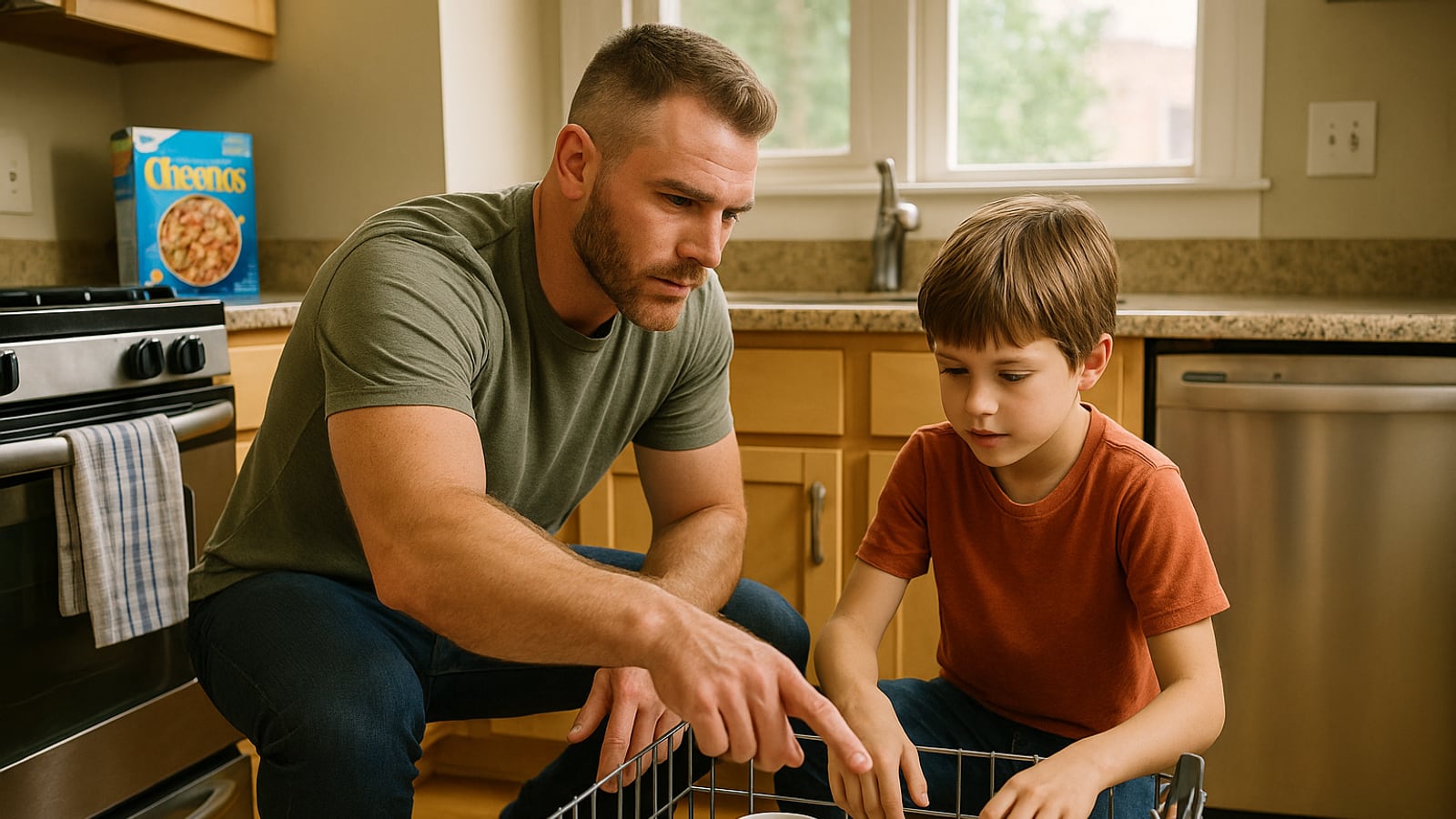
Saturday, about half nine. My seven-year-old had been sent to empty the dishwasher and came back in four minutes, which is roughly three minutes faster than the job takes. The plates were in. The cutlery drawer was a jumble. Two mugs were still on the bottom rack, hidden behind the tray, which is where mugs go to be forgotten.
The instinct is to sigh, say thanks, and quietly redo it after he's gone outside. Don't. That's the single move that undoes everything else you're trying to build, because it teaches him that his standard is good enough and yours is a separate private thing he'll never have to meet.
Call him back. Show him the two mugs. Then leave the room again.
Work is rent, not a transaction
Decide early what money has to do with chores, because the answer shapes everything after it.
My position: the baseline work of a household isn't paid. You live here, you eat the food, you generate the washing, so you do a share of the work that keeps it running. That's not a job. That's membership. The moment you attach fifty pence to wiping the table, you've given a child the right to decline for fifty pence, and some days they will, and they'll be right to.
Pay for the extra. Washing the car properly, clearing the gutters, stacking a delivery of logs, weeding the bit behind the shed nobody's touched since spring. Those are jobs. Agree a price beforehand and a standard beforehand, and pay on the standard, not the effort.
A sensible person could run it the other way. Plenty of families pay a flat weekly amount tied to chores and use it to teach budgeting, and their kids turn out fine. If you go that route, just make sure some work stays unpaid and non-negotiable, or you've raised a contractor rather than a son.
Teach the finish, not the task
Most kids can do the middle of a job. They can't do the end.
They'll wash up and leave the sink full of scraps. Mow the lawn and leave the mower out in the rain. Make a sandwich and leave the butter, the knife and the breadboard exactly where gravity put them. The task is done. The job isn't.
So define "done" out loud, once, in plain words, and keep it the same every time.
- Washing up is done when the sink's clear, the draining board's wiped, and the tea towel's hung, not balled.
- The bin is done when the new liner's in.
- The lawn is done when the mower's back in the shed and the clippings are off the path.
Say it the same way for six months and you'll stop having to say it. Change the definition depending on your mood and you'll be saying it for a decade.
The handover ladder
Nobody learns a job by being told it. Four stages, and you can't skip one.
Watch me do it, and I'll talk while I work. Do it with me, both pairs of hands. Do it while I'm in the room reading something else. Do it alone while I'm nowhere near.
The gap between stage three and stage four is where dads lose patience, because stage four is when the job gets done badly and you're not there to catch it. That's the point. A child who has never done a job badly and lived with the result hasn't learned the job, they've learned to be supervised.
Inspect once. Not four times. Hovering is just doing it yourself with extra steps and a worse atmosphere.
What they can actually do, by age
Rough bands. Kids vary wildly and you know yours.
Three to five. Carrying their own plate to the counter. Putting shoes on the rack. Feeding the dog with a pre-measured scoop. Sorting socks into pairs, badly. The work here's almost worthless in output terms and that's fine, because you're buying the habit, not the labor.
Six to nine. Emptying the dishwasher. Making their own breakfast, including the clear-up. Stripping a bed. Hoovering one room. Taking the bins out. Watering plants on a rota they can actually remember.
Ten to thirteen. A full load of washing, start to finish, including hanging it out and bringing it in. Cooking one whole meal for the family, once a week, same meal until they can do it without the recipe. Basic bike maintenance. Mowing, if the mower's safe for their size and you've stood over them for the first three goes.
Fourteen and up. Anything you do, more or less, minus the things that need a license. This is the age to hand over a job permanently rather than task by task. The bathroom is yours. The bins are yours. I'm not asking again, and I'm not doing it if you forget.
The skill you're actually teaching
Doing a job you've been given is the easy half. The thing that makes an adult worth employing, and worth marrying, is noticing the job before anyone names it.
You can train it. Walk into a room with them and ask, "What needs doing in here?" Wait. Don't answer for them. The first dozen times you'll get shrugs and a wrong guess. Around the twentieth time you'll get "the recycling's overflowing," and that's the moment the whole thing starts paying.
The other half is company. Kids work far better alongside somebody than alone, and so do most adults. Saturday jobs done together at nine in the morning get done. The same jobs assigned from the sofa turn into a two-hour negotiation.
What this costs you
Be honest about the first year. Everything takes three to four times longer. The bathroom gets cleaned worse than you'd clean it. You'll mop up after a spilled bucket, rewash a load that went in with a red sock, and find the hammer left out on the grass.
It's a net loss of your time for months. You're paying now for a fourteen-year-old who can run the house for three days while you're away.
And you will want to snap. When the job's done badly for the fifth time and you've explained it clearly, the temptation is to make it about character. Don't. Say what's wrong, point at it, walk away. "Mugs." Not "you never finish anything." One of those fixes the dishwasher. The other one they'll still be carrying at thirty.
Let the consequence do the teaching
If the football kit doesn't get washed, the kit isn't clean on Saturday, and they explain that to the coach, not you.
This is harder than it sounds because the consequence usually lands somewhere mildly embarrassing for you too. Hold anyway. One cold, damp shirt teaches more than a month of reminders, and you only have to do it once or twice.
The only thing you need to be rigid about is your own consistency. Kids don't test the rule. They test whether the rule is real.
Last month a friend mentioned that my lad had cleared the plates at their kitchen table without being asked, and stacked them by the sink. Nobody at home had seen it. That's the whole game. Not the chores chart on the fridge, not the argument about the bins. The bit that happens when you're not in the room.
Cal Brennan
Fitness
Strength coach. Trains fathers, tradesmen and desk workers, which means programmes that survive a bad week.

Watch
Worth an hour of your evening
More from Dads.
From channels we rate. Plays on YouTube.
Read next