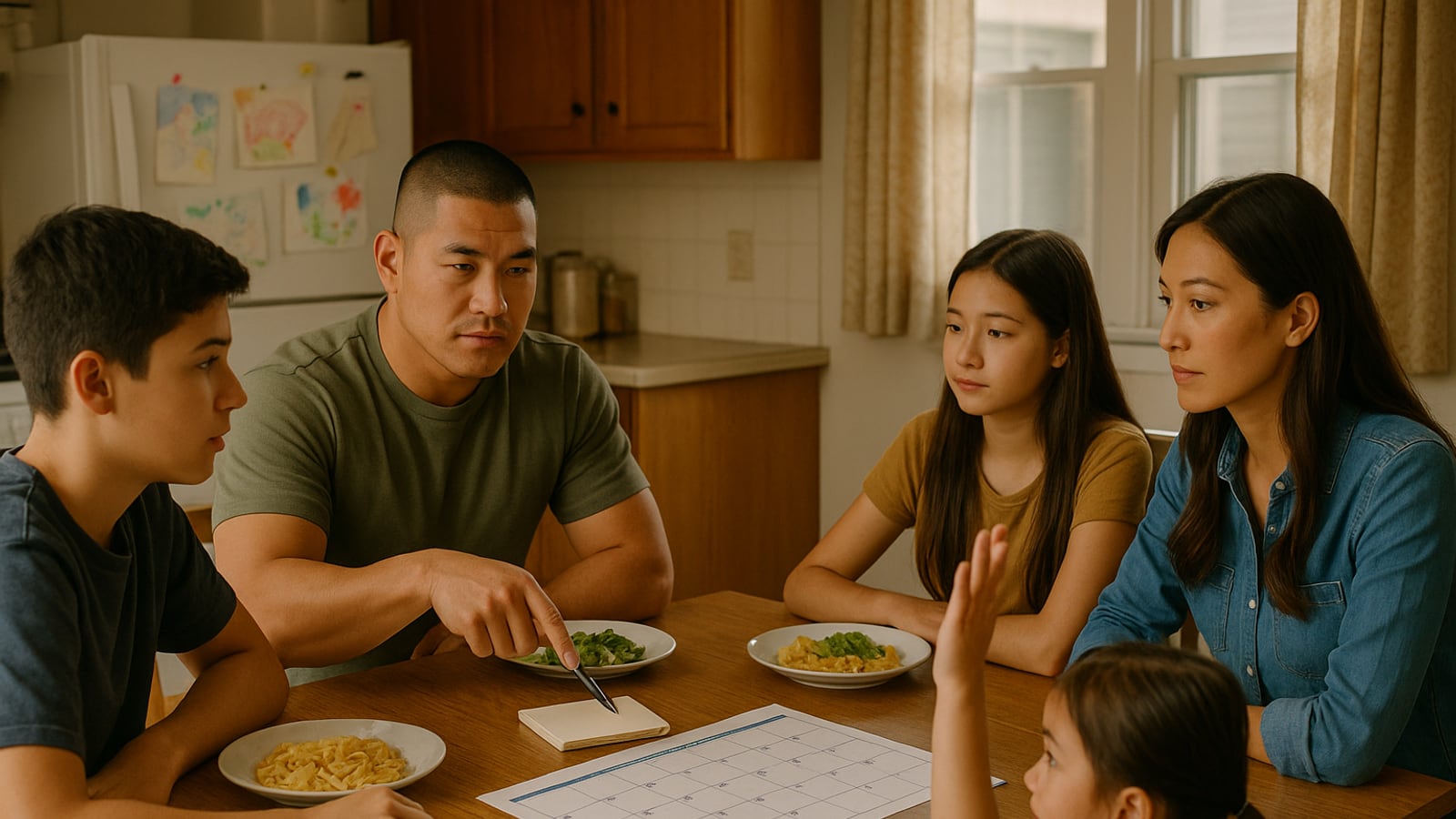
Twenty minutes. Same night every week. Same four things, in the same order, with something to eat on the table. That's the whole format, and if you run it that way for three months you'll wonder how you managed a household without it.
The reason most family meetings collapse isn't that families are too busy. It's that the first one turns into a forty-minute reckoning about the state of the bathroom, and nobody wants a second.
So the format has to protect everybody, including you.
The four slots
Keep the agenda fixed. Predictability is what makes people willing to show up.
Wins. Go around the table. Everyone says one good thing from the past week — theirs or somebody else's. It takes three minutes and it sets the temperature. A nine-year-old who's just been thanked for something is a nine-year-old who'll sit through the boring part.
Calendar. What's happening in the next seven days that affects somebody else. Away games, late shifts, a dentist appointment that needs a driver, the in-laws arriving Saturday. This is the slot that actually saves your week. Half of household conflict is logistics failure wearing an emotional costume.
Money. One item. Not the whole budget. Something concrete: the grocery number, what the vacation fund looks like, whether the new cleats fit this month or next.
One thing we're working on. A single issue. Not a list. Mornings are chaos. The dog isn't getting walked. Everyone's phone ends up at the dinner table. You pick it, you talk about it for five minutes, you agree on one change, and you check it next week.
Then you stop. Even if it's going well. Especially if it's going well.
Twenty minutes, and mean it
Set a timer where people can see it. When it goes, the meeting's over.
This feels arbitrary until you've done it a few times. The hard stop is what keeps the meeting from becoming the place where all unresolved household tension gets dumped. It also teaches everyone to be efficient. If your fourteen-year-old knows he has ninety seconds to make his case for a later curfew, he'll actually prepare one.
Anything that doesn't fit goes on a parking list. A sheet of paper on the fridge, or a note on the shared calendar. It gets picked up next week, or it gets handled one-on-one, which is usually where it belonged anyway.
Food helps more than it should. Not a full meal — dessert, chips, something small. It gives hands something to do and it signals that this isn't a disciplinary hearing.
The meeting before the meeting
Two minutes with your spouse beforehand, ideally the night before.
Agree on the money item. Agree on the one thing you're working on. Most importantly, agree on anything you disagree about, so you don't discover it live in front of the children.
This isn't about presenting a false front. It's about not using the family meeting as a proxy war. If you're at odds over spending or screen time or how much freedom the oldest gets, the family meeting is the worst possible venue to work it out. Kids read that instantly, and they learn that the meeting is a place where mom and dad fight with witnesses. You'll never get them to open up again.
Settle it in the kitchen at ten o'clock. Bring the settled version to the table.
And if you genuinely can't settle it, say so plainly and briefly: "Your mother and I are still talking about that one. We'll have an answer by next week." That's honest, and it models something worth modeling.
Let them actually decide something
The fastest way to kill a family meeting is to run it as a briefing where the kids receive instructions and the parents pretend to consult.
Give away one real decision every week. Small is fine. What's for dinner on Friday. Where the family walk goes on Sunday. Which chore rotates to whom. The point isn't the decision, it's that the kids learn their input changes outcomes.
Some things aren't up for a vote, and you should say which. Bedtimes, safety, faith practice in your home, whatever you've decided isn't negotiable. Naming the boundary clearly is better than pretending everything's open and then vetoing.
Rotate the chair, too, once the kids are old enough to read an agenda. A ten-year-old running the meeting — calling the slots, watching the timer, telling dad his turn is over — learns more in twenty minutes than any lecture would deliver.
Age by age, roughly
Three to five. They come for the wins and the snack, then they're released. Two minutes of participation is a win. Don't force it.
Six to ten. Full participation, short attention. Give them the chore decision and the Friday dinner vote. Let them draw the parking list.
Eleven to fourteen. This is where the money slot starts earning its keep. Show them the actual grocery number. Show them what the phone bill costs. Not to guilt them — to make the abstract concrete before they have their own bills.
Fifteen and up. They'll try to skip. Some weeks, let them. Some weeks, hold the line. The meeting is one of the few remaining places a teenager has to say something to the whole family without being singled out for a Talk, and that's worth protecting even when they act like it isn't.
What goes wrong
It becomes a lecture. You notice you're talking for eleven of the twenty minutes. Fix it by making the wins slot longer and the fixing slot shorter.
It gets canceled three weeks running. It dies. Rebuilding takes longer than starting. Protect the slot the way you'd protect a work meeting with your boss — it's the same principle and considerably higher stakes.
Someone gets ambushed. A grievance surfaces that the person hasn't heard before, in front of everyone. Rule: nothing goes on the agenda that hasn't been said privately first. No surprises.
It gets too serious. If the last four meetings were all about a problem, spend one just planning something good. The summer trip. Christmas. What you're doing for a birthday.
Faith, and the annual version
If prayer is part of your household, open with one. Thirty seconds. A verse, a thanks, a request for the week ahead. It reframes the whole thing from management to stewardship, and children remember the shape of it long after they've forgotten what you discussed.
Once a year, run a longer version. Ninety minutes, somewhere that isn't the kitchen table. Look back at the year honestly — what went well, what didn't, what you said you'd do and didn't. Set one family goal, not five. Put the big dates on the calendar while everyone's in the room.
Write it down. Read last year's out loud before you start this year's. That single habit will tell you more about your family than any amount of theorizing.
A household runs on a thousand small negotiations, and most of them happen badly, late at night, when somebody's tired and something's already gone wrong. The meeting just moves the negotiation earlier, into daylight, with everyone fed.
Your kids won't thank you for it. Their kids might.
Cal Brennan
Fitness
Strength coach. Trains fathers, tradesmen and desk workers, which means programmes that survive a bad week.

Watch
Worth an hour of your evening
More from Family.
From channels we rate. Plays on YouTube.
Read next