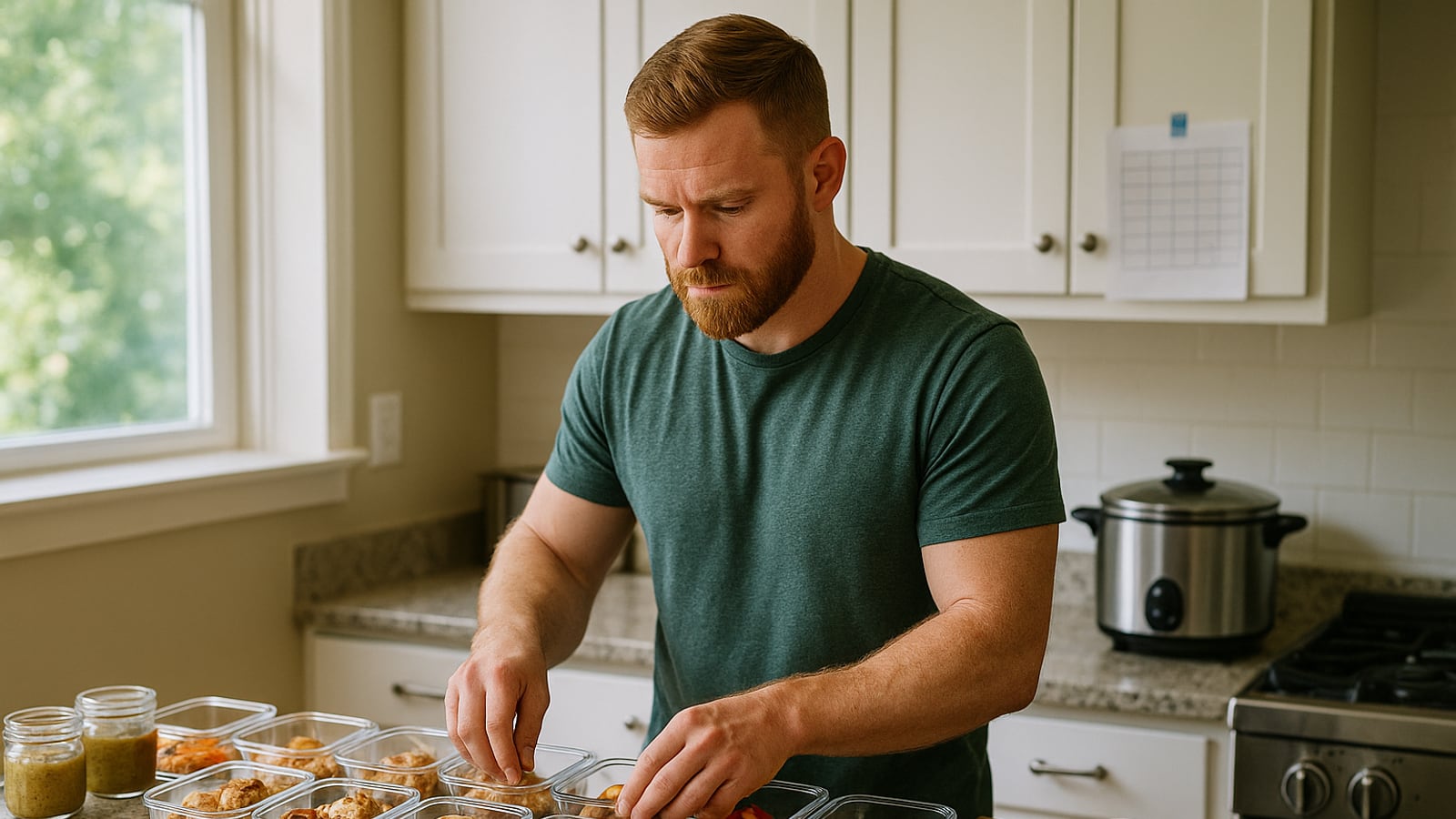
Stop cooking meals on Sunday. Cook parts.
That one change is the whole thing. When you make five identical containers of chicken, rice and broccoli with the sauce already on it, you've made five copies of one dinner and you've committed your future self to eating it whether he wants to or not. By Wednesday he doesn't want to. He orders something. The containers go in the bin on Friday and you decide meal prep isn't for you.
Cook two proteins, two or three starches, a pile of vegetables and three sauces, all stored separately, all seasoned lightly. Then assemble at the last minute. Same three hours of work. Same shopping list, more or less. But you get twelve or fifteen genuinely different plates out of it instead of five of the same one.
Build the grid before you shop
Write down four columns: protein, starch, vegetable, sauce. Fill them in before you go near a store.
A week that works: chicken thighs and a pork shoulder or a big batch of seasoned ground beef. Rice and either potatoes or a tray of roasted squash. Then vegetables in two categories — roasted (broccoli, carrots, onions, peppers) and raw (cabbage, cucumber, tomatoes, whatever herbs are cheap).
The sauces are where the variety actually lives, and most people skip them entirely. Three is the number. Something creamy, something herby and sharp, something with heat and sweetness. Garlic and lemon stirred into yogurt. Parsley, olive oil, red wine vinegar, chili flakes. Peanut butter loosened with lime juice, soy and hot water.
Chicken, rice and roasted broccoli under yogurt sauce is a Mediterranean plate. The same three under peanut sauce with raw cabbage is something else entirely, and your mouth believes it. That's not a trick. Acid and fat and fresh texture do most of the work your brain uses to decide whether it's eating the same thing twice.
Season the protein plain and finish it late
This is the part people get wrong first. They marinate everything on Sunday in one big flavor direction, and now the chicken is teriyaki chicken forever. It can't become anything else.
Cook proteins with salt, pepper, and fat. That's it. Maybe garlic. A plain, well-salted, well-browned chicken thigh is a blank slate that can go in a taco, a rice bowl, a salad, a sandwich or a soup. A teriyaki chicken thigh goes in a teriyaki bowl.
Brown properly, though. Dry the meat with paper towels, hot pan, don't crowd it. Crowded meat steams, releases water, and goes gray. Gray meat reheated four days later is bleak. Sear in batches even though it takes longer. Chicken thighs are forgiving — pull them around 175°F and they stay juicy. Breast dries out fast and doesn't survive reheating well, so if you're using breast, cook it to 165 and slice it thin against the grain at the moment you eat it, not on Sunday.
Undercook everything you plan to reheat
Reheating is a second cook. Anything you cook fully on Sunday gets cooked twice, and the second time is the one that ruins it.
Pull roasted vegetables while they still have some bite and a little color left to gain. Cook rice a minute or two short. Boil potatoes until a knife just goes in, not until they're falling apart. Green vegetables are the worst offenders — broccoli that was perfect on Sunday is olive-drab mush on Thursday, and nobody eats it.
Better still: keep some vegetables raw all week. Shredded cabbage lasts for days in a container and gives you crunch you can't get from anything reheated. Sliced cucumber, halved tomatoes, a bunch of parsley or cilantro in a jar of water like flowers. The plate that feels fresh almost always has something raw on it.
Cool it fast and store it shallow
Hot food in a deep container stays warm in the middle for hours, and warm is where bacteria live. Spread food out in a shallow layer so it drops temperature quickly, then get it into a fridge at 40°F or below. Don't stack hot containers on top of each other and don't jam them into a packed fridge where air can't move.
Standard food-safety guidance is three to four days for cooked leftovers in the fridge. Plan around that honestly. Cook Sunday for Monday through Wednesday, and either freeze Thursday's portion on Sunday or do a short second cook midweek. If you're unsure whether something's still good, throw it out. That's not waste, it's cheap insurance.
Glass containers cost more and are heavier, but they don't stain, don't hold onto curry smell, and go from fridge to oven. Store sauces in small jars, not in the container with the food. Wet sauce on rice for four days makes glue.
The two-cook week beats the one-cook week
A big Sunday and nothing else sounds efficient. It isn't, because food quality falls off a cliff and your appetite changes.
Do a long Sunday — two hours, maybe three — and a twenty-minute Wednesday. Wednesday isn't a full prep. It's browning a pound of ground beef, boiling a pot of rice, or roasting one tray of vegetables to restock whichever column emptied first. Twenty minutes buys you Thursday and Friday at Monday's quality.
The rhythm also matters for cooking on the day. If everything's in parts, dinner on a Tuesday is five minutes: skillet on medium, splash of oil, meat in, splash of water, lid on for ninety seconds. The water steams the meat back to life instead of drying it out. Then rice, then vegetables, then sauce, then something raw on top. That's a real meal and you didn't cook it.
Microwave reheating works fine for rice and stews — add a spoonful of water, cover it, stop it short and stir. It's poor for anything that had a crust on it. Meat and roasted potatoes want a hot pan for two minutes.
What goes wrong and why
One giant pot of chili. Chili's great. Five nights of chili is a sentence. If you make one big braise, freeze half of it immediately, on Sunday, before you've eaten any.
Prepping food you don't actually like. You won't eat a container of steamed cod and plain quinoa on a Thursday because a spreadsheet said it was optimal. Prep the food you'd choose.
No fat, no salt, no acid. Meal-prepped food tastes flat mainly because it's underseasoned and eaten cold-ish. A squeeze of lemon and a spoonful of olive oil at the table fixes more than people expect.
Overbuying on the first week. Ambition is high on Sunday morning and low on Wednesday night. Start with two proteins and two starches. Scale up when you've actually finished a week.
No portion discipline in the container. If you're prepping to manage how much you eat, decide the portion when you pack it, not when you're hungry and standing at the fridge at nine at night.
A week that actually holds up
Sunday: roast two trays of chicken thighs and a tray of mixed vegetables in the oven while you brown ground beef on the stove and cook a big pot of rice. Boil some potatoes. Make three sauces while things roast. Shred a cabbage.
Monday is a rice bowl with chicken, roasted vegetables and yogurt sauce. Tuesday is beef with potatoes and herb sauce. Wednesday is beef tacos with raw cabbage and the peanut-lime thinned with more lime. Thursday you brown a second pound of beef in twenty minutes and turn it into a skillet with the last of the potatoes and two eggs on top. Friday you eat out, because you've earned it and you didn't waste any food.
Nobody in the house knows you cooked once.
Wes Dunbar
Country & Skills
Grew up on an acreage and never quite left. Covers trucks, trades, land, and how to do the thing yourself.

Watch
Worth an hour of your evening
More from Food.
From channels we rate. Plays on YouTube.