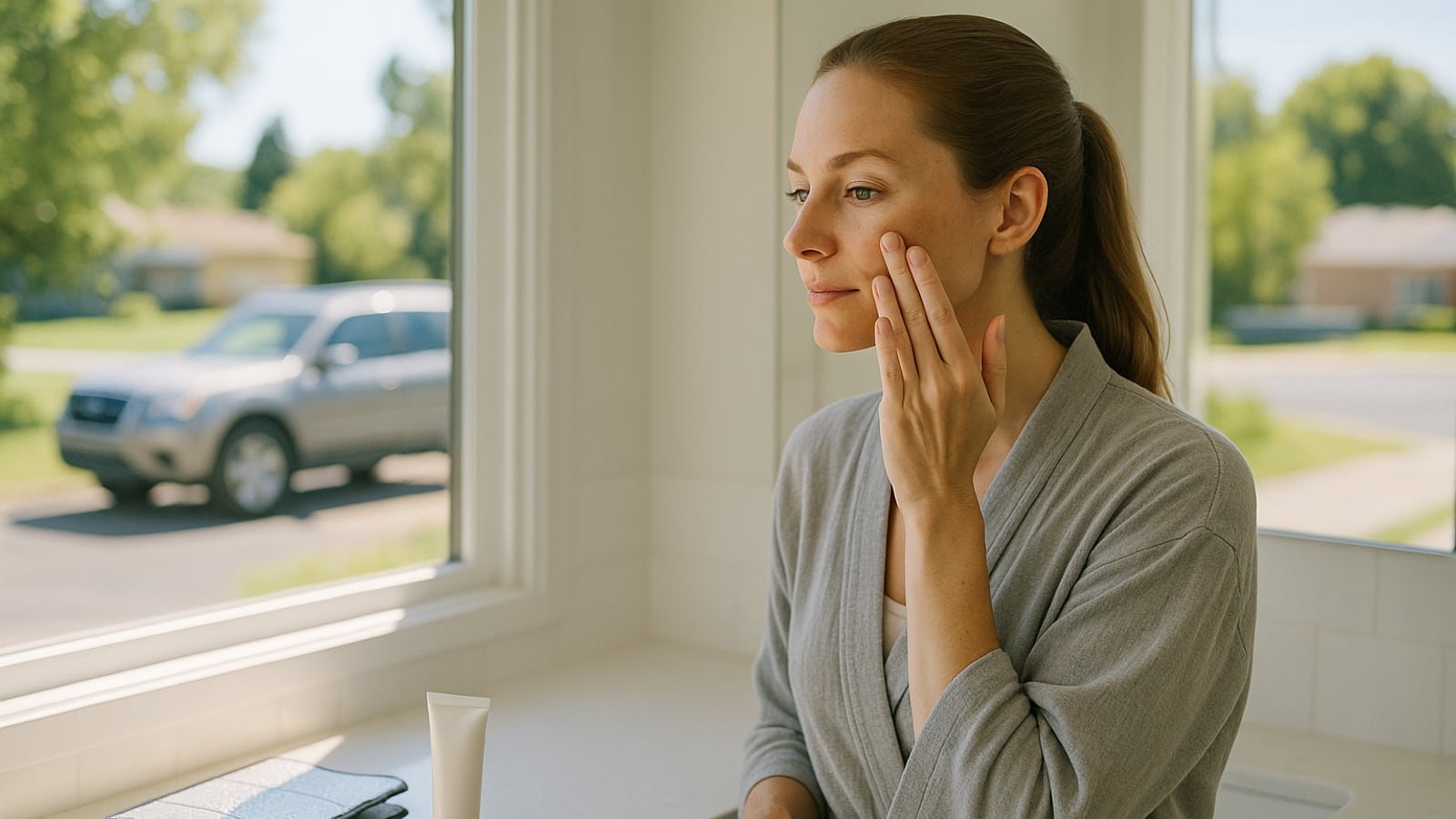
Look at the ingredient list on your sunscreen. If it doesn't say iron oxides, it isn't doing the main job that melasma requires. Zinc and titanium handle UV. Iron oxides are what block visible light, and visible light is a driver of melasma the way sunlight is a driver of a sunburn. That's the whole reason tinted mineral sunscreens outperform clear ones for this specific condition, and it's the cheapest fix on the list. A tinted mineral formula runs about $15 to $40.
Second thing, and it's the one nobody mentions: your left cheek is probably worse. Car side windows filter most UVB and let UVA through. If you commute, you've been getting a daily dose on the driver's side for years.
Know which brown thing you're looking at
Three different problems get called "dark spots," and they don't respond to the same treatment.
Melasma shows up as symmetrical patches with soft, blurry edges. Cheekbones, forehead, upper lip, jawline. It comes on gradually, darkens in summer, fades some in winter, and it's tied to hormones and light. It's far more common in women, and more common in medium to deep skin tones.
Post-inflammatory hyperpigmentation is the brown mark left behind by something that happened. A breakout, a burn, a scratch, a bad wax. It's shaped like the injury that caused it, it isn't symmetrical, and it will usually fade on its own over months if you stop re-injuring the spot.
Solar lentigines are your standard sun spots. Small, sharply defined, flat, tan to brown, on the hands, chest and face. These are the ones that actually respond well to lasers and cryotherapy.
A dermatologist can shine a Wood's lamp on the patch to get a sense of how deep the pigment sits. Epidermal pigment lights up under it. Dermal pigment doesn't. That distinction matters, because deeper pigment responds more slowly to everything, and it tells you whether to expect real clearing or just lightening.
And one hard rule: a single dark spot that's new, growing, asymmetric, multicolored or has a ragged border isn't a cosmetic question. That gets looked at by a doctor, not treated with a serum.
The triggers you can actually control
Melasma runs on estrogen and light. Pregnancy sets it off, which is why it's called the mask of pregnancy. Combined oral contraceptives can set it off or keep it going. So can hormone therapy. If your melasma started within a few months of a new pill, that's a conversation worth having with your doctor about other options, though be realistic: stopping the trigger doesn't automatically clear what's already there.
Heat is the underrated one. Not sunlight, heat. Standing over a hot stove, a hot yoga class, a steam shower, a sauna. Blood vessel activity in the skin appears to play a role in melasma, and infrared heat drives it. You don't have to give up cooking dinner. But if you've been running the hottest possible water on your face twice a day, stop.
Friction counts too. Scrubbing, aggressive cleansing brushes, waxing the upper lip, picking. Any of those can make the patch angrier and darker.
What has the evidence behind it
Sunscreen, done properly. SPF 30 or higher, broad spectrum, tinted with iron oxides, every single morning, all year. Reapply mid-day if you're outside. A wide-brim hat does more than another layer of product. This isn't the optional part of the plan. Skip it and everything else below fails.
Hydroquinone. Still the standard against which the others are measured. In the United States it now requires a prescription, so the drugstore versions you remember are gone. It's used in cycles, typically a few months on and then a break, because long-term uninterrupted use carries a risk of ochronosis, a bluish-gray discoloration that's much harder to treat than what you started with. Your doctor sets the schedule.
Triple combination cream. Hydroquinone plus a retinoid plus a low-potency steroid, in one prescription formula. It consistently beats hydroquinone alone in clinical use. It's also the most likely to irritate, and irritation in melasma-prone skin means more pigment, so you start every other night.
Azelaic acid. Prescription at 15 to 20 percent, weaker over the counter. Well tolerated, safe in pregnancy, which makes it the practical first choice when you're expecting or nursing and hydroquinone and retinoids are off the table.
Tretinoin. Works, works slowly, and works better in combination than alone. Months, not weeks. Not during pregnancy.
Topical tranexamic acid, cysteamine, niacinamide. Real supporting players with published support behind them, gentler than hydroquinone, less dramatic. Cysteamine smells unpleasant and people quit over it. Niacinamide is the easy add-on that rarely irritates anything.
Vitamin C. Mild. Fine as an antioxidant under sunscreen. Don't expect it to carry the program.
Oral tranexamic acid. Used off-label for stubborn melasma, and the results in the literature are good. It also affects clotting, so it isn't for everyone. Anyone with a history of clots, a clotting disorder, active smoking, or who's on estrogen-containing contraception needs a real screening conversation first. This is a prescription your physician evaluates you for, not a supplement you order.
Procedures, and the part where people get hurt
Melasma is the condition where lasers most often backfire. Aggressive settings, intense pulsed light, and any heavy resurfacing can trigger a rebound that's darker than the original patch, especially in medium and deep skin tones. Sun spots love IPL. Melasma frequently punishes it.
That doesn't mean no procedures. Superficial chemical peels, done conservatively by someone who treats melasma often, help move things along. Low-energy laser protocols exist and some people do well on them. But the sequence matters: get the topical routine and the light protection working for several months first, then consider a procedure as an accelerator. Never as the opening move, and never from someone who's offering you a package deal before they've examined the skin in daylight.
Ask any provider directly how many melasma patients with your skin tone they treat in a month. If the answer is vague, leave.
A schedule that works
Weeks 1 through 4: tinted mineral sunscreen every morning, gentle cleanser, moisturizer, hat. Nothing else. You're establishing the floor.
Weeks 2 through 4: see a dermatologist and get the diagnosis confirmed before you spend money on actives.
Weeks 4 through 12: add the prescription, at whatever frequency your skin tolerates without redness. Take a photo in the same spot, same light, same day of the week. Your memory is a bad judge of gradual change. The photo isn't.
Week 12: evaluate. Twelve weeks is the honest minimum before you decide whether something's working.
After that: maintenance, forever. Melasma is managed, not cured. Summer will test you. One beach weekend without reapplying can undo four months of work, and that's not a scare tactic, it's just how the pigment cells behave.
The women who do best with this aren't the ones with the most expensive routine. They're the ones who kept a hat in the car.
Nina Castellan
BRO for Her
Runs the women-facing desk. Same standard, same tools, written for a different reader — not a softer one.

Watch
Worth an hour of your evening
More from BRO for Her.
From channels we rate. Plays on YouTube.
Read next