Three sessions a week. Roughly fifty minutes each. Five movements in total, two of which you'll do every single time. That's the whole thing, and it fits on an index card.
The barbell in most gyms weighs 20kg. There's usually a shorter 15kg bar racked next to it, and in a lot of places nobody touches it, which means it's free when the rack isn't. Start there if 20kg on your back feels like a lot on day one. The smallest plates on the rack are normally 1.25kg, and those little ones are the whole secret of the next twelve weeks.
The five movements
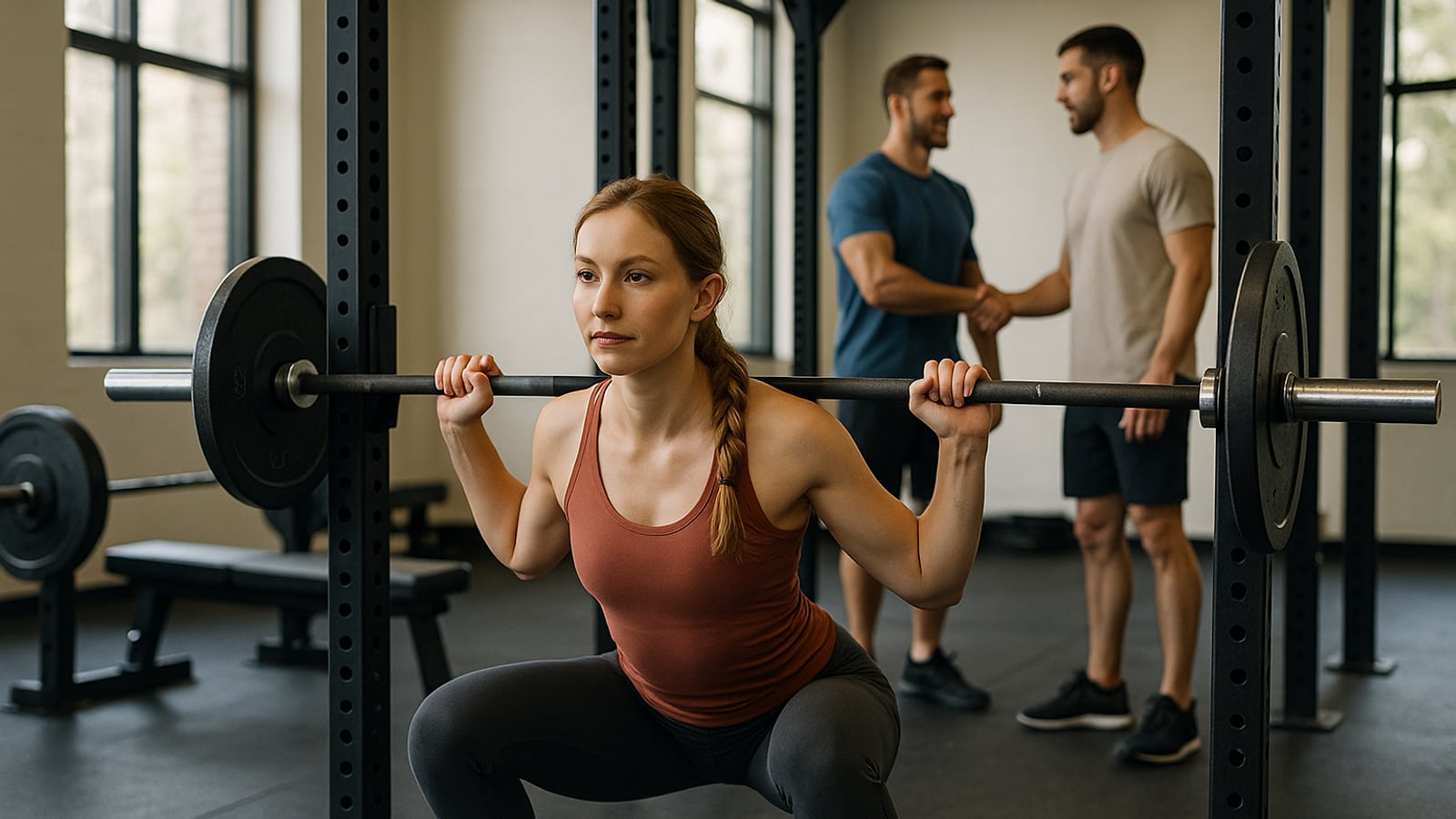
Squat. Barbell on your upper back, feet about shoulder width, sit down between your knees until the crease of your hip drops below the top of your kneecap. Stand up.
Deadlift. Bar over mid-foot, grip outside your knees, chest up, push the floor away. Set it back down under control instead of dropping it.
Bench press. Flat bench, bar to the lower chest, elbows at maybe 45 degrees from your ribs, not flared straight out.
Overhead press. Bar at collarbone height, squeeze your backside, press it up and slightly back so it finishes over the middle of your feet.
Row. Barbell bent-over row, or a chest-supported machine row, or a single-arm dumbbell row with your other hand on a bench. All fine. Pick one and keep it.
Session A is squat, bench, row. Session B is squat, overhead press, deadlift. Alternate them. Monday, Wednesday, Friday works, or Tuesday, Thursday, Saturday. Never two days in a row for the first month.
Warm up by doing the movement itself with less weight. Two sets with the empty bar, then a set at roughly half your working weight, then go. Five minutes on a bike beforehand if your gym is cold. You don't need a twenty-minute mobility routine, and if you build one now you'll use it as an excuse to skip sessions later.
Weeks one to four
Sets of five. Three sets of five for squat, bench, row and press. Deadlift is one set of five once you've warmed up, because it takes more out of you than anything else and three heavy sets of it will wreck your week.
Start absurdly light. Empty bar for squat, bench and press. If the empty bar genuinely can't be done for five reps, use a goblet squat with an 8kg dumbbell and push-ups with your hands on a bench, and come back to the bar in week three. Deadlift starts at 40kg for most people, not because that's easy, but because a 20kg bar with the small plates on sits too low to the ground and the pull starts in an awkward position.
Then add weight. Every session. 2.5kg on the squat and deadlift, 1.25kg on the bench and press. That's the program. It looks slow on paper and it isn't: 2.5kg a session, three sessions a week, and by week four your squat has moved 30kg.
Weeks one and two will feel pointless. You'll be lifting weights you could carry up a flight of stairs and wondering why you drove there. Do it anyway. You're not training your muscles yet, you're teaching your hips and your spine what the shape is meant to feel like under load, and that's a lot easier to learn at 25kg than at 60kg.
The first four sessions will make you sore in places you didn't know were involved. Your inner thighs after squats. The back of your ribs after deadlifts. It fades by about session six and mostly stops happening after week three.
Weeks five to eight
This is where it gets good and where most people quit.
Good, because the bar starts to feel like something. There's a moment somewhere around week five where you unrack a squat and it presses down on your traps with real weight, and you walk it out, and you get five, and you understand for the first time why people do this.
Where it goes wrong: your upper body lifts stall before your lower body ones. The bench press adds 1.25kg a session and eventually you'll miss the fifth rep. That's normal and it's not failure. When you miss reps on the same lift twice in a row, take 10 percent off, build back up at the same rate, and it usually goes straight past the old number.
Second problem: the jumps get too big for pressing. If your gym has 0.5kg plates, or you can buy a pair of small fractional plates, your overhead press will keep climbing for months longer than it otherwise would. It's the single cheapest thing you can spend money on in your first year.
Third problem: week six is when the novelty has gone and the results aren't visible yet. Your clothes fit roughly the same. You've been at this for a month and a half and the mirror is being unhelpful. The only defense against this is the logbook. Write every set down. Look at week one. You squatted an empty bar and now you're squatting 50kg for three sets of five. That's not nothing, and no photograph will tell you.
Weeks nine to twelve
The linear run ends somewhere in here for almost everyone, and it ends on the squat last.
By now, adding 2.5kg three times a week means adding over 7kg a week to a lift that's getting heavy. At some point your recovery can't keep up. Two options. Either drop to adding weight twice a week and go light on the middle session, or move the squat to a heavy day and a light day and keep the third session moderate.
Take a deliberate easy week around week ten if your sleep is poor or your joints are complaining. Same lifts, same sets, 80 percent of the weight. You won't lose anything. You'll come back and put 5kg on.
Finish week twelve with a single heavy set of five on the squat and the deadlift. Not a one-rep max. A hard set of five you could not have done a thirteenth time. Write it down and put the card in a drawer.
Eating and sleeping, briefly
You can't add weight to the bar three times a week on 1,400 calories and six hours of sleep. Protein at every meal, enough food that you're not hungry walking into the gym, and seven to eight hours in bed. If you're training to get smaller and stronger at the same time, expect the strength to come slower. That's a real trade-off and nobody gets to skip it.
If you're pregnant, postnatal, coming back from an injury, or managing any condition that affects your joints, heart or blood pressure, get a doctor or a physio to look at the plan before you start it. Not as a formality. They'll change things, and the changes will be worth having.
If there's no barbell
A leg press, a chest press, a lat pulldown, a seated row and a Romanian deadlift with dumbbells will get you a long way. Same structure: three sets of eight, add the smallest increment available whenever you hit eight on all three sets. You'll build less absolute strength than you would with a bar. You'll still be dramatically stronger than you're today, and a program you actually attend beats a better one you drive past.
One last thing about the rack. You'll feel watched the first few weeks. Almost nobody is watching, and the ones who are will be the ones who come over in week eight and ask what program you're running, because your squat has gone up more in three months than theirs has in two years.
Nina Castellan
BRO for Her
Runs the women-facing desk. Same standard, same tools, written for a different reader — not a softer one.

Watch
Worth an hour of your evening
More from BRO for Her.
From channels we rate. Plays on YouTube.
Read next