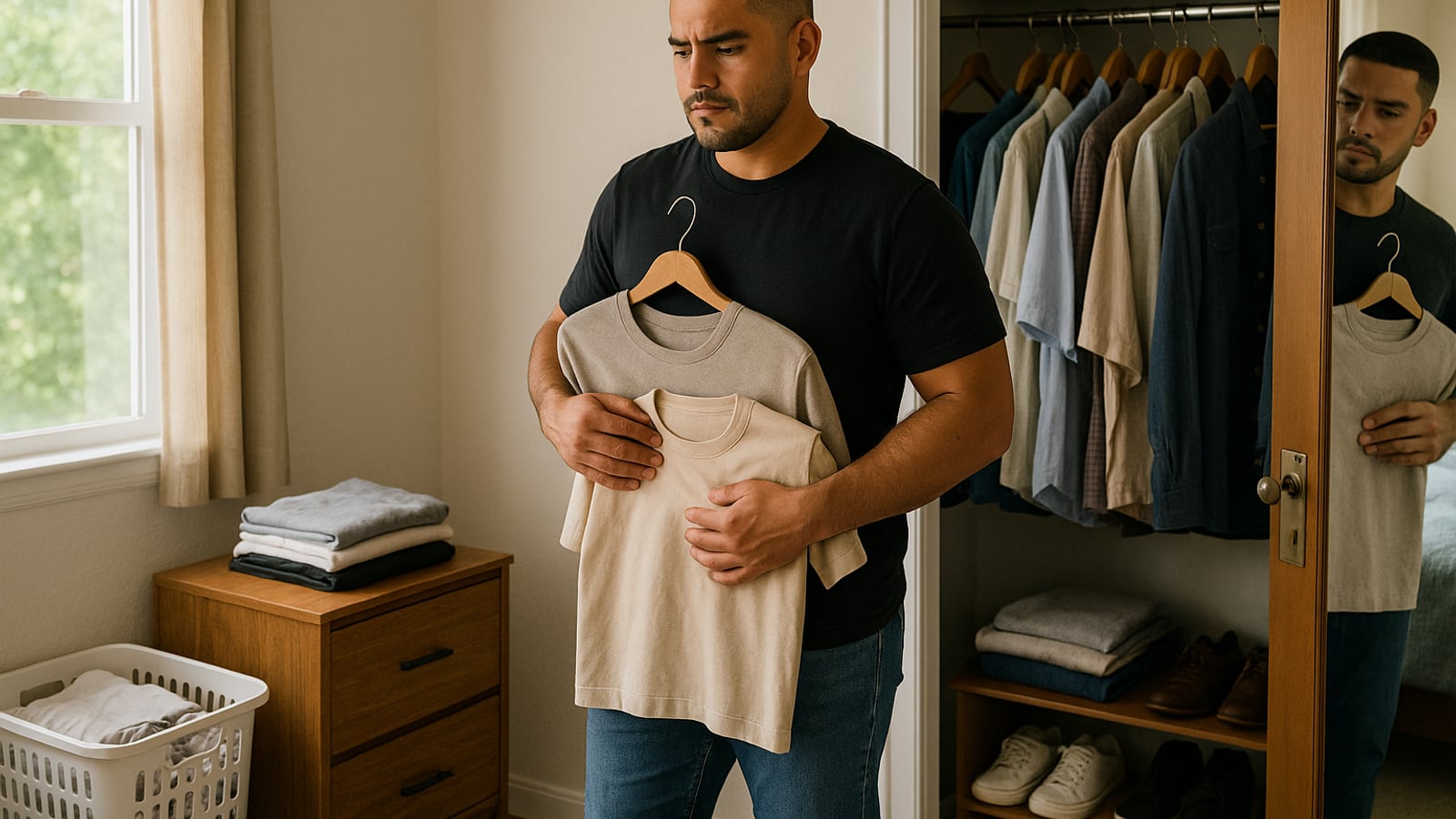
Go stand in front of your closet and count the things you've worn twice in the last month. For most guys in their twenties the number is five or six. Everything else is a souvenir: the jacket from the sale rack, the shirt you bought for a party, the sneakers that looked incredible on somebody with a different build. You own forty garments and dress out of six.
Fixing that costs less than you think. A hem at a decent alterations shop usually runs somewhere in the fifteen-to-twenty-five-dollar range, and taking in a shirt's body isn't much more. Which means the cheapest upgrade available to you isn't a purchase at all. It's a trip with three things you already own.
Fit beats fabric, fabric beats the label
A thirty-dollar oxford shirt that hits your shoulder seam at the actual corner of your shoulder looks better than a hundred-and-forty-dollar one that doesn't. This isn't a moral position, it's just how eyes work. People read the outline of you first. The tag is invisible from six feet away and always will be.
So the order goes: does it fit, is the material any good, and then, a distant third, whose name is on it. In your twenties that third item should be close to irrelevant. Nobody at the office or the wedding is clocking your brand. They're clocking whether your pants puddle over your shoes like a curtain.
The shoulder is the check that matters most, because it's the one thing a tailor genuinely can't fix without charging you more than the garment's worth. Sleeves, hems, waist, shirt body — all adjustable. Shoulders, no. Buy for the shoulder and pay somebody to handle the rest.
The five things you'll actually wear
Build outward from what your week looks like, not what your Saturday night fantasy looks like.
- Dark, straight-leg jeans with no distressing. Rigid or lightly stretched denim in a deep indigo. They go to dinner, to the office on Friday, to your cousin's rehearsal dinner if you put a real shoe on. Hem them. Almost nobody's inseam is the number printed on the tag.
- Two chinos, one stone and one olive or navy. Flat front. Not skinny, not billowing.
- Oxford cloth button-downs in white and light blue. Wrinkle a little, and that's the point. They look intentional slightly rumpled, which a poly-blend dress shirt never does.
- A crewneck sweater in gray or navy, merino if you can swing it. Over a shirt, over a tee, under a jacket.
- One leather shoe that isn't a dress shoe. A brown derby, a chukka, a clean leather sneaker with a slim sole. Something you can wear with denim and with chinos and not feel like you're in costume either way.
That's a week. Add a couple of white or gray tees, whatever outerwear your winter demands, and you've covered roughly everything a twenty-five-year-old does.
The temptation is to skip this and buy the interesting stuff first, because the interesting stuff is what's fun to shop for. The base is boring to buy and invisible when it works. That's exactly why so few guys own it.
Don't buy for the body you're going to have
Somewhere between twenty-two and twenty-nine your frame moves. Guys who lifted in college soften. Guys who never lifted start, and go up a jacket size in the chest. Desk jobs do what desk jobs do.
Practical consequence: don't buy anything so tightly fitted that three pounds ruins it. A trouser with an inch of fabric in the seat seam can be let out. A jacket with a real seam allowance can be adjusted. Sprayed-on slim fit has no give and no future.
The other practical consequence: stop buying the expensive version of anything until your size has held still for a year. Blow your money on a beautiful suit at twenty-three and there's a fair chance it fits like a borrowed costume at twenty-seven. Cheap and correct beats excellent and wrong.
The one-trend rule
You're allowed to chase things. You should. Twenty-six is the right age to wear something a little loud, and a wardrobe of nothing but navy and gray at that age reads like you gave up early.
Just run it through one filter before you pay. Can you wear it twice in the next month with clothes you already own? If making the new thing work requires a second new thing, you're not buying a garment, you're buying an outfit. Outfits are how closets fill up with orphans.
Buy the trend cheap, too. You don't know yet whether you like it or whether you liked it on the guy in the photo. Give it a season. If it's still in the rotation in six months, buy the good version then.
And cap it at one at a time. One loud thing with five quiet things is style. Five loud things at once is a scavenger hunt.
Where the money actually goes
Spend on the stuff that touches the ground and the weather. Shoes and outerwear take the abuse, last the longest, and are the most obviously cheap when they're cheap. A hundred-and-eighty-dollar shoe you resole twice outlives four pairs of the forty-dollar kind, and looks better the whole time.
Save on tees, on anything trend-driven, on anything you'll sweat through. Uniqlo and Target will handle your basics without complaint. Nobody has ever been busted for an affordable white tee.
The move that gets skipped: budget for alterations as part of the price. A sixty-dollar pair of trousers plus twenty in tailoring is an eighty-dollar pair of trousers that fits, and it will beat the untouched hundred-and-forty every time. Find one shop near you, go there three times, and they'll start remembering your numbers.
What goes wrong
You buy the mannequin. The whole look, head to toe, because it worked in the store lighting. It never survives contact with your actual life.
You size up because it's on sale. There's no sale price on a shirt that doesn't fit. The correct price of that shirt is zero dollars.
You believe someone who says it'll shrink to fit. It'll shrink somewhere, sure. Rarely where you need it to.
You buy a thing online at midnight and don't return it because returns are annoying. Set a rule: if it's not right, it goes back inside a week, no negotiating with yourself. The pile of almost-right clothes is the whole problem in physical form.
And you wash everything after one wear on hot. Denim doesn't need it. Sweaters really don't. Air things out, spot-clean, wash cold, hang more than you tumble.
Give it three years
You don't build this in a weekend and you shouldn't try. Two or three good purchases a season, with the tailoring included, and by thirty you'll have a closet where the top-left thing goes with the bottom-right thing and getting dressed takes ninety seconds.
The guys who get there aren't the ones who shopped the most. They're the ones who stopped buying things they already had a worse version of.
Dean Shaw
Gear & Garage
Tests things until they break, then reports what broke first. Trucks, tools, watches, and the cheap version that costs more.

Watch
Worth an hour of your evening
More from Style.
From channels we rate. Plays on YouTube.
Read next