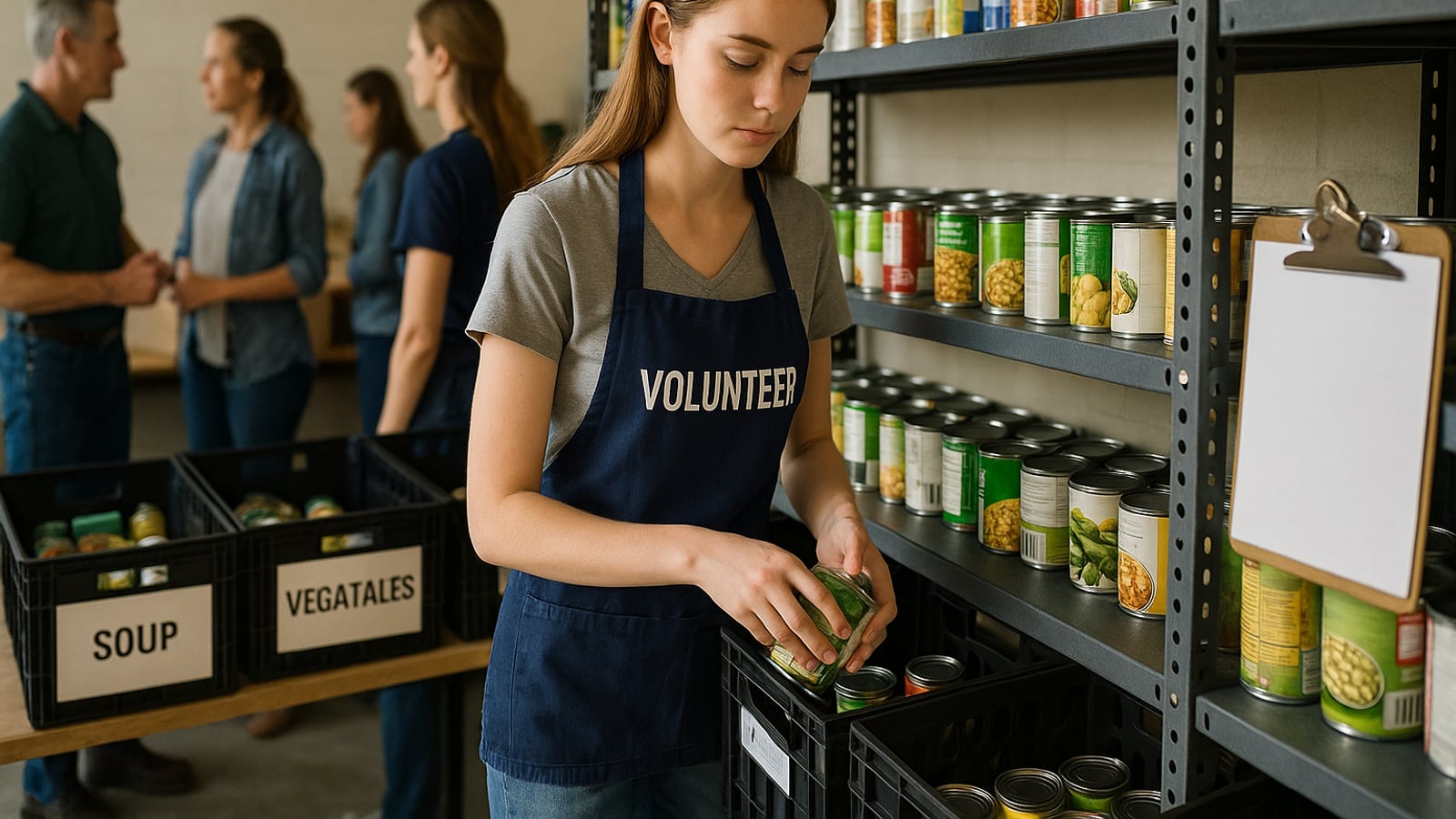
Pick the thing you'd still be doing in hour four.
That's the whole filter. Almost any volunteer job is interesting for the first hour. Somebody shows you around, everyone's friendly, you feel useful. Hour four is when the truth shows up — you're restacking the same shelves, the room is cold, and the person who was training you has gone to deal with something else. If you can imagine yourself content in hour four, you've found something that will actually teach you. If you can only imagine hour one, you've found an event, not a job.
Most of what people call volunteering is hour one on repeat. A park cleanup in April. A charity fun run in June. A canned food drive at school. None of that's bad. It's just not where skill comes from.
Weekly for a year beats a week in July
Two hours every Saturday morning for a year is about a hundred hours. A mission trip or a summer intensive might be forty hours in five days. Both look similar on paper. They're not similar at all.
The weekly one gives you something the intensive can't: a second chance at the same task. You do the intake form badly in week two, better in week five, and by week twelve you're the one showing the new person. That's the loop that builds actual competence. One-off events never get past the first attempt.
The weekly one also gets you known. After three months, the coordinator knows your name, knows you show up, and starts handing you things she wouldn't hand a stranger. That's when the real learning starts — when someone trusts you with the part that matters.
So commit to eight weeks before you decide anything. Not one shift. Eight. Most of what's annoying in week two has sorted itself out by week six.
Places that hand you a real task
Look for organisations that need work done, not organisations that need to be seen having volunteers.
- A food pantry or food bank. You'll learn inventory, rotation, food safety basics, and how to talk to adults who are having a rough month with dignity instead of pity. That last one is worth more than anything you'll learn in a classroom this year.
- An animal shelter. Cleaning, feeding, walking, socialising nervous dogs. Physical, repetitive, and you learn to read an animal that can't tell you it's scared.
- A library. Shelving, shelf-reading, running the summer reading table for little kids. Quiet, systematic, and libraries tend to actually train you.
- Tutoring younger kids through your school, church or a local literacy program. You will find out very fast whether you can explain something or only repeat it.
- Your church. Nursery, children's ministry, setup and teardown crew, sound and tech booth. The tech booth in particular is a genuine technical skill, and churches are usually desperate for people who'll learn it.
- A nursing home or meal delivery run. Conversation with people four times your age. Hard at first. It stops being hard.
- A habitat build, trail crew or community garden. Tools, safety, a finished thing you can point at.
Hospital volunteering and ambulance or fire cadet programs are excellent, and many have a minimum age of sixteen. Worth checking rather than assuming you're too young.
Four questions to ask before you say yes
Ask these on the phone or in the interview. Adults respect a teenager who asks them.
- Who's my supervisor, and will that person be there on my shift? If nobody can name a person, you'll spend your shifts standing around.
- What will I actually be doing? Push past "helping out". You want a verb.
- Is there training, and does it happen before my first shift or during it?
- After a year, would you be willing to write me a reference? Ask this early. It tells them you're serious, and it tells you whether they think of volunteers as people or as furniture.
If the answers are vague on all four, thank them and try somewhere else. There's no shortage of places that need hands.
Tell your parents the schedule, and keep it honest
Your parents should know where you're, who's in charge, what time it starts and what time it ends. Not because you're a child, but because that's how grown adults with jobs operate too. Nobody disappears for four hours without telling anyone.
A few lines that aren't negotiable:
Volunteer through an organisation that has actual policies — background checks on adult staff, other people in the building, a named supervisor. Not through someone who contacted you privately, and never through someone you only know online, no matter how legitimate the charity sounds. Real organisations have a website, a phone number and an address your parents can look at.
Don't accept a lift home from an adult you've just met. Sort out transport with your parents before your first shift, not at eight o'clock on a dark Saturday evening.
And if an adult at a placement ever makes you uncomfortable — crossing a line, asking to contact you privately, telling you to keep something between the two of you — you tell your parent, or the program coordinator, or a teacher or youth leader, today. Not next week. You won't be in trouble. Keeping it quiet is the only thing that ever makes it worse.
What quitting badly costs you
The most common failure isn't picking the wrong place. It's signing up for three things at once in September and ghosting all three by November.
Here's what that actually does. The coordinator built the Saturday rota around you. When you stop replying, someone covers your shift, usually the same tired person who covers everything. You don't get a reference. And the next teenager who emails that organisation gets a slightly more guarded reply.
If you need to stop, say so. "I've got exams in April, I can come back in June" is a completely reasonable sentence, and the person receiving it will be relieved you told them. Two weeks' notice, said out loud to a human. That's it. That one habit will serve you in every job you ever have.
Write down what you learned, while it's fresh
Every month or so, put four or five lines in your notes app. What you did, what went wrong, what you got better at. Be specific. Not "helped at the pantry" but "logged 60 donation boxes into the spreadsheet, learned to check expiry dates before intake, handled the desk alone on the 14th."
In two years, when you're filling in an application or sitting across from someone who asks what you've done, you'll have facts instead of adjectives. Everyone says they're hardworking. Almost nobody can say they ran the donation desk alone on a Tuesday because the usual person was sick.
The thing nobody tells you is that the people you serve teach you more than the work does. You'll meet a woman who worked thirty years and still needs the pantry. A boy who can't read at nine. A man in a care home who hasn't had a visitor since March. You'll stop seeing them as a category. That change is permanent, and it's worth more than the hundred hours.
Start with one place. Two hours. This Saturday.
Nina Castellan
BRO for Her
Runs the women-facing desk. Same standard, same tools, written for a different reader — not a softer one.

Read next