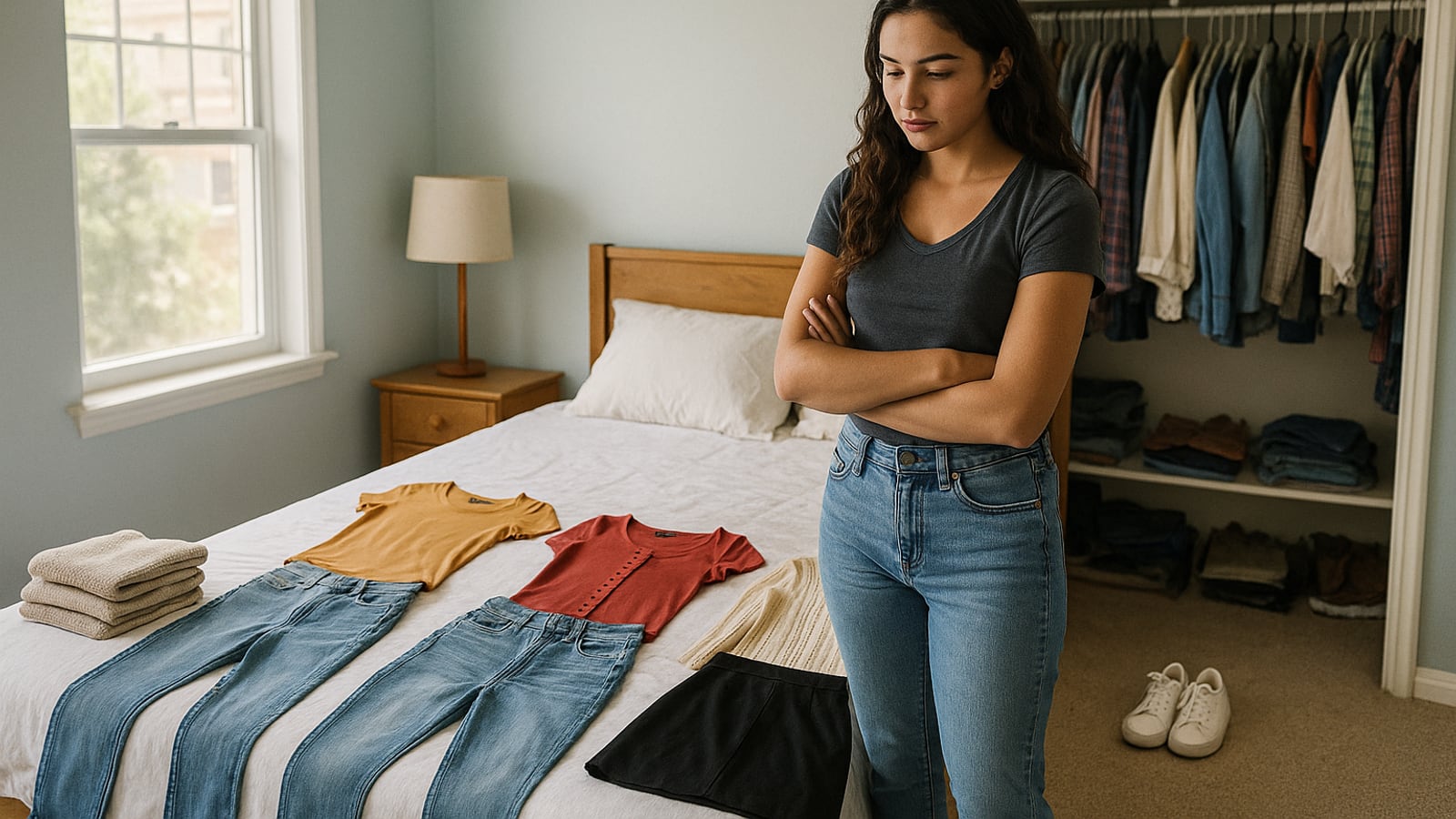
Go and look at what you wore last week. Not what's in your wardrobe — what you actually put on, seven days running. Most people find three or four things doing nearly all the work, plus a pile of stuff that never moves.
That small pile is the most honest information you have about your own taste. It's worth more than any haul video, because you chose it with your body and your morning mood instead of your thumb.
Start there.
The feed changes its mind on purpose
Every few weeks a new look appears. Everyone's wearing it, then nobody is, then it's embarrassing that you did. That churn isn't an accident and it isn't fashion being fickle. A trend that lasts five years sells you one jacket. A trend that lasts five weeks sells you a jacket, then makes it worthless, then sells you another one.
The apps are built to accelerate that. You linger on something, you get twelve more of it, and by Thursday you've been shown the same silhouette two hundred times. Your brain reads repetition as preference. That's not you falling in love with a style. That's you being worn down by one.
You can test this. Think of something you desperately wanted eighteen months ago. Do you still want it? Sometimes yes — that's real. Usually no, and that's the algorithm's fingerprint.
None of this means trends are stupid or that liking one makes you a sheep. Plenty of trends are genuinely good, and there's real joy in a group of friends all going through a phase together. The problem isn't liking things. It's letting a scroll decide for you, six times a year, at full price.
Build a file, then look for the repeat
Make a folder on your phone. Anytime something stops you — an outfit, a coat on a stranger, a color on a film poster, a photo of your grandmother in 1978 — save it. Don't curate it. Don't try to make it look good. Just collect for about a month.
Then open it and hunt for the repeat.
You'll find one. Maybe almost everything you saved has a collar. Maybe you keep saving the same three colors and no others. Maybe every single image is loose and nothing is tight, or every image has something structured in it, or you're clearly drawn to old things rather than new ones.
That repeating thing is your taste showing up. It's more useful than any label, because you can take it shopping. "I want a navy thing with a good collar" is a real instruction. "I want to look put together" isn't.
Write down three or four of those repeats on paper. That's your brief. Everything you buy for the next year should answer to it.
The two-week rule
Want something? Screenshot it, put it away, wait two weeks.
Most wants die in four days. The ones still alive after a fortnight are usually worth the money, and you'll buy them with your eyes open instead of at eleven at night with an ad in your face.
While you're waiting, ask the boring questions. What three things I already own does this go with? When would I wear it — name an actual day. Do I like this, or do I like the person modeling it and the room she's standing in?
That last one catches a lot of purchases. Half of what gets sold isn't clothing, it's a mood. Nice bedroom, good light, someone laughing. You can't buy that with a top.
Clothes get altered. You don't
A garment that doesn't fit is a garment problem. It's not a you problem, and any shop, app or account that suggests otherwise has got it backwards. Sizes aren't standard between brands and never have been. The number on the label describes a factory, not a person.
So learn the small repairs. Sewing on a button properly takes about ten minutes to learn once and then you have it forever. A dropped hem, a loose seam, a strap taken up — all doable at a kitchen table, and somebody in your family probably already knows how. Ask them. It's a good hour together.
For anything you really love, a tailor or an alterations shop can take in a waist or shorten sleeves for far less than the thing cost. That's how a decent secondhand coat becomes the best coat you own.
Secondhand is where the good stuff is
Charity shops, thrift stores, your mom's wardrobe, your aunt's loft, the box of things your older cousin outgrew. Older clothes are often made better — heavier fabric, real buttons, seams that don't give up after four washes.
Some ground rules that make it work instead of wasting your Saturday:
- Go with your brief, not with hope. You're looking for navy with a collar. You walk past everything else.
- Check the fabric label. Wool, cotton, linen and denim last. They also breathe, which matters in a school building in June.
- Check the seams and the armpits first. If they're tired, put it back, however nice it looks on the hanger.
- Go with a friend. It's a better afternoon and she'll tell you the truth.
One caution worth saying plainly: if you're going somewhere new to shop or meet up, tell a parent where you're going and who with. Not because you're a child. Because that's what sensible adults do for each other too.
Cost per wear beats the price tag
Take the price. Divide it by the number of times you'll realistically wear it. A cheap top worn twice is expensive. A solid pair of boots worn four times a week for three winters is nearly free by the end.
This is the single calculation that will save you the most money between now and your twenties, and almost nobody teaches it. Run it out loud in the shop. It feels awkward once and then it becomes automatic.
If money's tight at home, say so to yourself honestly rather than pretending. Fewer, better, borrowed and mended will always look more assembled than lots of new and thin. And if there's a family budget for clothes, have the conversation with your parents directly — what's the number, what does it need to cover, when does it reset. Grown-up conversations get you treated like a grown-up.
Don't become the girl who sneers
There's a failure mode on the other side of all this. You develop a bit of taste, and you start looking down on everyone still wearing what the feed told them to.
Don't. It's a mean, small way to be, and it makes you tiresome at fifteen and unbearable at twenty-five. Your friend loving a trend costs you nothing. Compliment her. Mean it.
Real confidence about how you dress is quiet. It doesn't need anyone else to be wrong.
What you're actually building
Personal style isn't a look you arrive at. It's a set of decisions you stop having to make twice — you know your colors, you know what you reach for, you know what a good seam feels like between your fingers. It frees up an enormous amount of thinking for things that matter more.
And there will be plenty of those. What you wear is real and it's fun and it's worth doing well. It's also nowhere near the most interesting thing about you, and the people who'll matter most in your life will work that out in about four minutes.
In ten years you'll have a wardrobe full of things you chose. Start choosing now.
Nina Castellan
BRO for Her
Runs the women-facing desk. Same standard, same tools, written for a different reader — not a softer one.

Read next