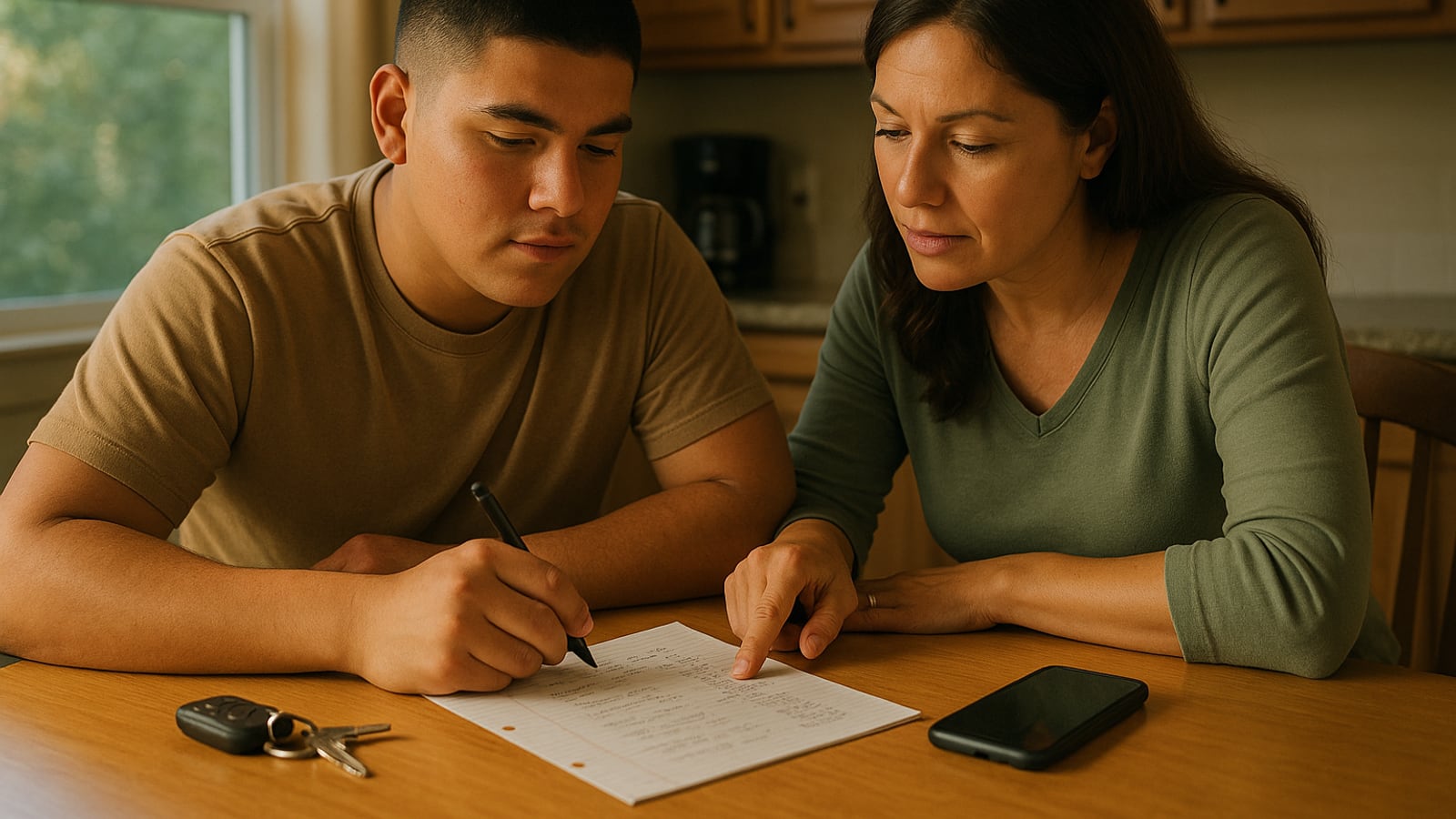
Write the night down. Addresses, names, drivers, times. Give it to your parents before they ask for it.
That's the whole move, and most guys skip it because it feels like surrendering something. It's the opposite. A guy who shows up with a plan gets treated like someone who makes plans. A guy who says "I dunno, we'll figure it out" gets a curfew, a phone tracker, and a ride home from his mom at 11:15.
Grad night is one of the few nights of your life where a lot of people you like are all in the same place at the same time, everyone's relieved, and nobody has homework. It's genuinely good. It's also the night the most things go wrong, because the plan is vague, the driving is unfamiliar, and everyone assumes somebody else is handling it.
So handle it.
What goes on the paper
Not a paragraph. A list. Your parents don't need a story, they need facts they can act on if their phone rings.
- Where you'll be, in order. Ceremony, then the diner, then Marcus's house. Actual addresses, not "somewhere near the high school."
- Who's driving each leg. By name. Including the ride home.
- Whose house, and whether a parent is home. If you don't know, say you don't know. Don't guess and don't smooth it over.
- When you're back. Pick a real number. 1 a.m. is a number. "Late" isn't.
- The phone situation. Your number, plus one friend's number in case yours dies.
Send it as a text the morning of. Then it's timestamped, it's in writing, and nobody's remembering it differently at 2 a.m.
Why this buys you room
Parents aren't actually trying to ruin the night. They're trying to manage the gap between what they know and what they're imagining. The gap is where the rules come from. Close the gap and the rules loosen almost every time.
Try the actual sentence: "I want to be out till one. This is where I'll be and who I'm with. If plans change I'll text you before we move." That's an adult negotiating. Most parents will meet that halfway or better, because it's the first time all year they've been given information instead of having to dig for it.
And if they still say midnight, take midnight without an argument and be home at 11:55. You're building something. The next ask goes easier.
The plan will change. Say so now.
Somebody's party gets shut down. Somebody's cousin knows about a bonfire. The group splits in the parking lot and suddenly half your ride is gone.
Agree in advance on one rule: the location changes, you send a text before you move. Not after. Not "I'll explain tomorrow." One line — "heading to the Alvarez house on Pine instead, riding with Danny." Ten seconds. It costs you nothing and it's the single thing that keeps a worried parent from calling five other parents.
The reason this matters isn't trust. It's that if something does happen, the difference between someone knowing where you're and someone guessing is enormous.
The ride is the part that actually kills people
Everything else on grad night is recoverable. A bad ride isn't.
Set one line and don't move it: you don't get in a car with a driver who's been drinking, and you don't get in a car with a driver who seems off. Not for two blocks. Not because it's awkward. Not because he's your friend and he says he's fine. A guy who's been drinking will always say he's fine — that's one of the first things to go.
Late-night driving is hard even sober. Unfamiliar roads, a full car, everyone loud, someone's phone playing DJ. If you're the one driving, that's a real job for the night. Take it seriously or hand the keys to someone who will.
Have a backup that doesn't require courage to use. A parent who's said, out loud, "call me at any hour, no questions tonight, we'll talk tomorrow." A rideshare account with money in it. An aunt across town. Anything that means walking away from a bad car is easy instead of heroic.
Ask your dad or your mom for that no-questions deal this week, before the night. Most parents say yes immediately, because they'd rather pick you up at 2 a.m. than get the other call. And they'll mean it.
The stuff that ends the night early
Alcohol, vapes, whatever somebody's older brother brought — you'll probably see it. You don't need a speech about it. You need a plan for the three seconds where someone holds something out and everyone's looking at you.
"No thanks, I'm good" works. Said once, plainly, then you change the subject. You don't owe anyone an explanation, you don't need a reason, and a reason actually makes it worse because reasons can be argued with. "No thanks" can't.
If someone keeps pushing, that's information about him, not about you. Go talk to someone else. There are ninety people there.
And if a friend is in trouble — throwing up, can't stand, won't wake up properly — get an adult immediately. Not in five minutes. Not after you've decided whether he'll be mad at you. Any adult in the building, or 911. You will never once regret being the guy who got help too fast.
The part about other people
You'll be around people all night who are excited, emotional, and saying goodbye to a version of their life. Some of them will be someone's girlfriend, someone's little sister, someone who came alone because her friends bailed.
Be the guy who makes that easier. Nobody owes anybody anything physical, ever, for any reason — not because it's grad night, not because you danced, not because somebody's leaving for school in August and it's the last chance. Not a gray area. If someone seems uncomfortable, or drunk, or stuck talking to a guy who won't take a hint, you can walk over and say "hey, your friends are looking for you." That's it. That's the whole intervention, and it works.
If something happens to someone — or to you — tell a trusted adult. A parent, a coach, a youth pastor, the school counselor on Monday. Today, not eventually. You won't be in trouble for it. The people who tell you otherwise are covering for themselves.
Small things that make the night better
Charge your phone to 100 and bring a cable. Eat actual food before, not just the cake at your cousin's thing. Bring forty bucks in cash because card readers fail and parking lots want cash. Keep your keys and wallet in a front pocket. Know which friend is the sensible one, and stay findable to him.
Take fewer photos than you think you need. You'll remember the parking lot at 1 a.m. better than anything on your camera roll.
When you get home
Go find your parents, even if the lights are off. Say you're back. Thirty seconds.
They've been half-awake since midnight, and that small thing means more than the whole plan did. Then in the morning, over eggs, tell them one real story about the night. Not the edited version — a real one.
You're leaving soon. This is how the new version of the relationship starts.
Sam Ortiz
Dads & Family
Father of three. Writes about presence, discipline and the long game, without pretending any of it's tidy.

Read next