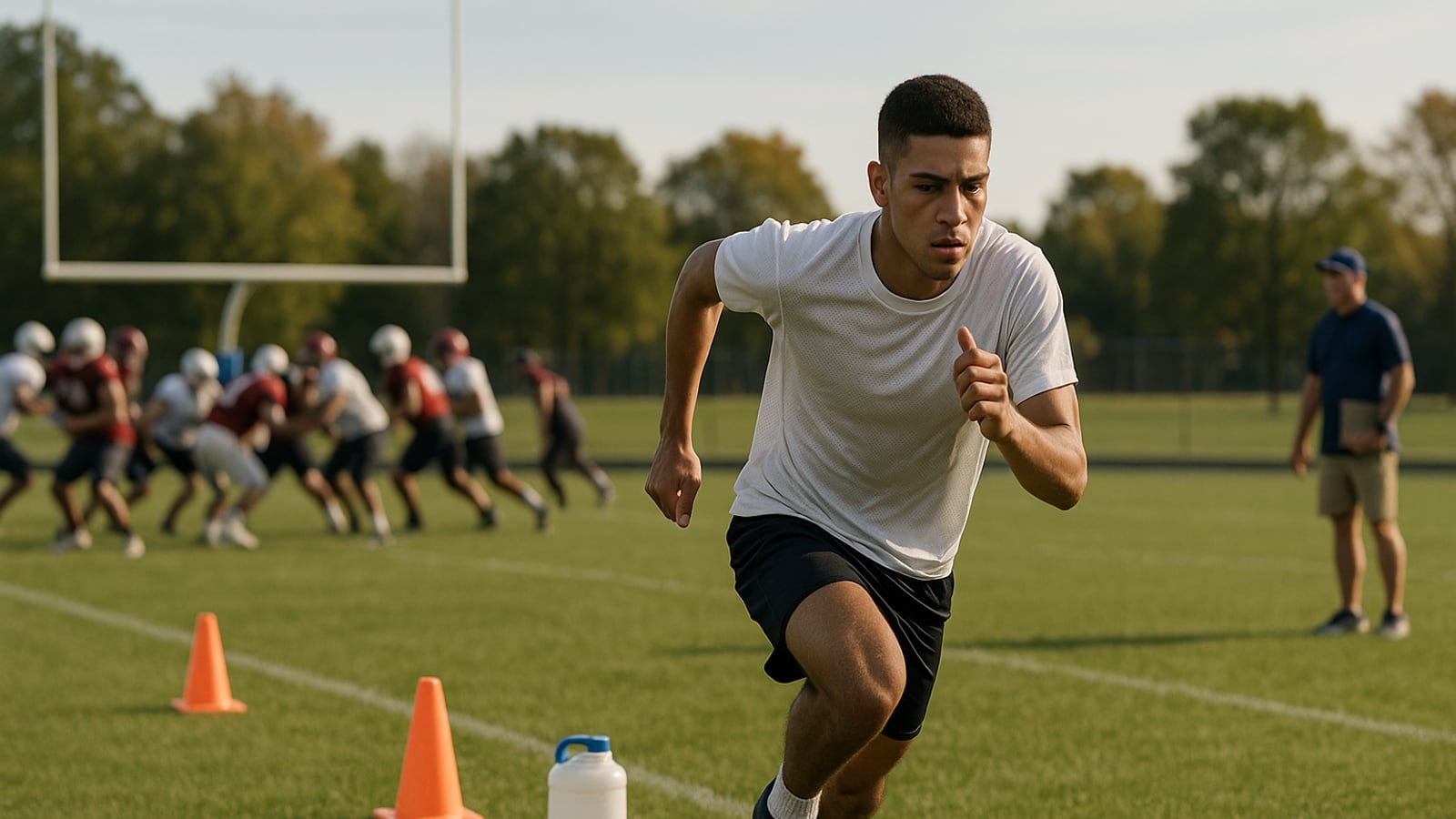
Be the easiest person on that roster to coach. That's the whole strategy, and it's available to you on the first day, no matter how far behind everyone else you're.
Coaches notice skill. Obviously. But skill is the thing they can't hand you in a week, so they stop thinking about it and start thinking about who they can actually work with. Who's early. Who knows the drill before it's explained twice. Who runs the last rep of a set like it's the first one. That list gets made in the first two weeks, and being the least experienced guy there doesn't keep you off it.
The first two weeks matter more than you'd think
Learn names fast. All of them, including the assistant coach and the kid who barely talks. Use them. It costs nothing and it changes how a room treats you.
Turn up ten minutes early, every time. Not to show off. Because ten minutes is enough to get your boots on properly, get a ball in your hands, and not be the reason a session starts late.
Learn the system before you try to shine in it. Most guys who look lost aren't unfit or slow, they just don't know where they're supposed to stand. Ask a teammate to walk you through it after practice. Write it down that night. Being the new guy who already knows the plays is a genuinely rare thing.
And watch the person who plays your position. Not resentfully. Properly. Where do his feet go before the ball arrives? When does he talk? What does he do in the two seconds before anything happens? That's free coaching and nobody else on the bench is taking it.
Pick one thing to be first at that doesn't need talent
You can't be the most skilled guy by November. You can be the fittest. Or the loudest communicator. Or the one who chases every lost cause. Or the best tackler, the best defender, the guy who never gets beaten for effort.
Choose one. Say it out loud to yourself and go after it for a whole season.
This isn't a consolation prize. Coaches build teams around guys who do one hard thing reliably, because reliability is the thing they're short of. A player who does nine things at seventy percent is less useful than a player who does one thing at a hundred.
The trade-off is real, so know it going in. If you spend your extra time on conditioning, your first touch won't improve much this season. If you spend it on your weak foot, you'll still get outrun. You can't fix five things at once. Pick the one that gets you on the field at this level, on this team, with this coach.
The bench is a job
Sitting on the bench badly is the fastest way to stay there.
Sitting on it well looks like this. You warm up like you're going on, and you stay warm. You watch the game, not your phone or the crowd. You know the score, the time, and what's going wrong. When your name gets called you're already moving, and you don't need to ask what the plan is.
Then there's the part nobody tells you about. You cheer. Actually cheer, by name, for specific things. It feels strange the first couple of times if you're frustrated. Do it anyway. The bench sets the mood of a team more than the starters do, and coaches know exactly who's holding it together and who's sulking in the corner.
Ask the coach the right question
There's a bad version of this conversation and a good one, and they're only a few words apart.
Bad: "Why aren't I playing?" It puts him on the defensive and invites an answer you'll argue with.
Good: "What are the two things I'd need to get better at to be in the rotation?" Then you write them down and you don't ask again for six weeks.
Catch him after a session, not during one, and not right after a loss. Keep it to ninety seconds. Thank him. Then go do the two things.
If he gives you a vague answer, that's information too, and you go back to picking your own one thing. Some coaches are brilliant at development and some aren't. You can't control which one you got.
Twenty minutes, four days a week
Improvement at your age comes from boring repetition on a small number of things, done when nobody's watching.
Twenty minutes is enough. A wall, a ball, a hoop in the driveway, a stretch of pavement. Four days a week beats two ninety-minute sessions, because your body learns from frequency more than heroics.
Keep a note on your phone. Date, what you did, how it went. Three lines. You'll want to quit in week three, and the only thing that gets most guys through week three is looking back at eleven entries and not wanting to break the streak.
Tell your parents what you're doing. Not for permission, for the simple reason that a driveway session at 7am goes better when someone in the house knows why you're up. A dad who understands the plan will usually find a way to help with it.
Don't let it curdle
The thing that actually ends most guys' seasons isn't ability. It's bitterness.
It shows up as sarcasm at practice. As blaming the coach to your friends. As quietly hoping the starter has a bad game. As deciding the whole thing is rigged, because that's less painful than admitting you're behind and it's going to take two years to catch up.
Watch for it in yourself. When you notice it, name it, and go and do something useful with your hands.
And be genuinely glad when the guy ahead of you plays well. Not fake-glad. Glad. He's on your team. His good game is your good result. If you can't get there yet, start by congratulating him out loud and letting your feelings catch up later. They usually do.
Your worth isn't your minutes. You already know that in the abstract. Living it on a Saturday when you didn't get off the bench is the actual work, and it's the kind of work that carries into jobs and marriage and everything after. God didn't price you by your stat line. Hold on to that and you'll last in sport a lot longer than the guys who peaked at fifteen and had nothing underneath it.
If something on the team isn't right
Being the newest guy sometimes means being the easiest target.
If there's hazing, if someone's being humiliated as a joke, if an older player or an adult is pressuring anyone to do anything involving their body, alcohol, drugs, or images on a phone, that's NOT a gray area and it's not something you sort out yourself.
Tell your parents today. If that's genuinely not possible, tell a teacher, your youth leader, the school nurse, or the athletic director. You won't be in trouble for reporting it, and you don't need proof or a perfect story. You just need to say what happened.
Protecting a team by staying quiet about that isn't loyalty. It's how bad teams stay bad.
The long game
Two seasons from now, half the guys who were better than you will have stopped. Some will get bored, some will find something they're naturally good at and go do that instead, some will get injured and never come back.
The ones still there will be the ones who liked the work.
Be one of those. Show up when it's raining and you're not in the squad and nobody would notice if you skipped it. That's the whole difference, and it was never about talent.
Ade Fisher
Young Men
Teaches the trades intake at a community college. Writes the manual he wishes his students arrived with.

Read next