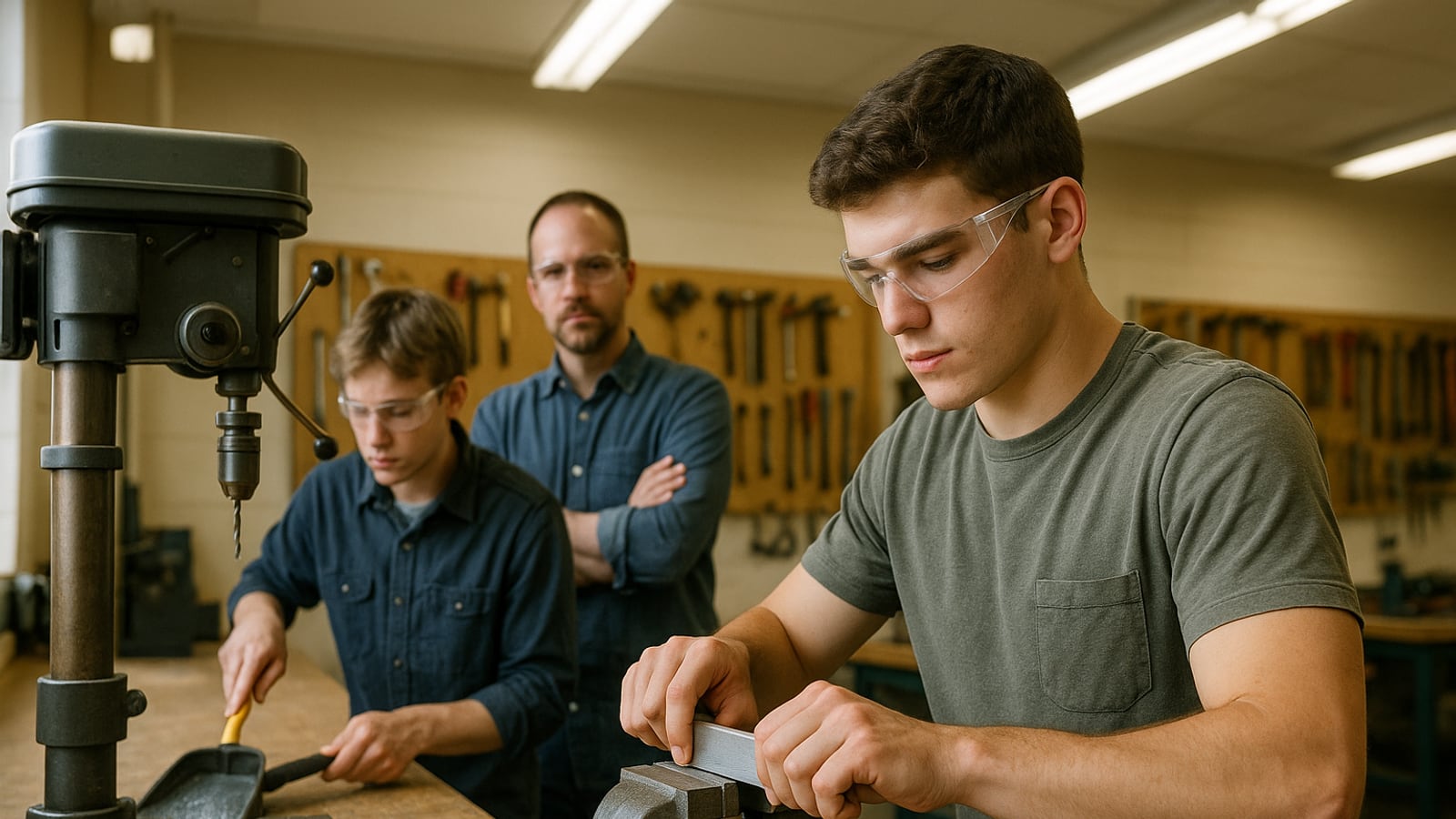
Pick the club that meets the most often, and join that one.
Not the one with the best name. Not the one your friend is in. The one with a standing Tuesday and Thursday, a room full of tools, and an adult who's there every single time. Hours on the machine beat everything. A kid who spends two afternoons a week in a shop for three years comes out the other side able to do things most adults can't do, and with a teacher who'll pick up the phone for him.
That's the whole trick. Everything after this is detail.
The first month, you're the guy with the broom
Nobody hands the new sophomore the mill key. You earn your way to the tools, and the currency is being useful before anyone asks.
Sweep the chips. Put the wrenches back in the right drawer, not the closest one. Coil the extension cords properly. Learn where the fire extinguisher is and where the eyewash station is, on day one, before you touch anything that spins.
Adults in shops notice this within two weeks. They're watching to see who respects the space, because the guy who's careless with a broom is going to be careless with a saw. Do the unglamorous part visibly and well, and somebody will start showing you things they don't show everybody.
Ask for the safety training in writing, too. Most schools have a machine-by-machine sign-off sheet. Get through it fast and get through it properly, and never run a machine you haven't been cleared on, even if the room is empty and you're sure you know how. That's not a rule about liability. That's a rule about your fingers.
Go deep on one machine instead of sampling all of them
The temptation is to try a bit of everything. Resist it for a while.
Pick one thing and get genuinely good. The lathe. Stick welding. The CNC router. The wiring harness on the robot. Whatever the room has that you find interesting enough to stay late for.
Being the person the team asks — go get Marcus, he's the one who can get the router to cut clean — changes how you're treated immediately. It also changes how you feel about yourself, which matters more than you'd think at sixteen. Competence is quiet. You don't have to talk about it.
Breadth comes later and comes fast once you have one skill deep. The habits transfer. The patience transfers. The willingness to scrap a part and start again transfers.
Write down what you build
Get a cheap notebook and keep a build log. Date at the top of the page. What you made, what the dimensions were, what went wrong, what you'd do differently.
Take photos. Finished parts, but also the jig you made to hold the part, the weld that cracked, the whiteboard with the sketch on it. Put them in one folder on your computer with dates in the filenames.
Three years of that's a portfolio. When you're seventeen and sitting across from a shop foreman or an apprenticeship board or an admissions officer, you open a phone with forty photos of real work and a notebook with your own handwriting in it. Almost nobody your age does this. It's an unfair advantage and it costs you four minutes a week.
Ask your teacher what certifications the school can get you
This is the question that separates guys who leave school with a hobby from guys who leave school with credentials.
Plenty of high schools can put students through OSHA 10 safety training, NIMS credentials for machining, or entry-level AWS welding qualifications. Some run dual-enrollment classes through a local community college, so you finish twelfth grade with college credit already banked. Others have direct pipelines into union apprenticeship programs, and the teacher knows exactly who to call.
None of it happens unless you ask. Go to your shop teacher, your robotics coach, or your school counselor and say: what can I actually leave here holding?
Then tell your parents what you found out and let them help you work out what's worth the time. They're going to be signing forms and driving you places anyway. Bring them in early rather than sideways.
Robotics has more jobs on it than driving the robot
Every competition team has kids who want to be on the drive team, and a shortage of kids who want to do the rest. The rest is where the skills are.
There's the mechanical side, the electronics and wiring, the control software, the CAD work, the fabrication. There's also a business side that most teams are desperate for help on — writing sponsor letters, managing a budget, tracking parts inventory, running the pit at competition so nothing gets lost.
Taking the unglamorous role early gets you the glamorous one later, and the business side teaches you things that pay for the rest of your life. Writing a letter to a local manufacturer asking for four hundred dollars, and then actually getting it, is a real skill. Very few adults are good at it.
Competition season will eat your life, so plan for it
Build season is brutal in the best way. Long nights, a deadline that doesn't move, tempers in the shop at 9pm on a Thursday.
Know what it's going to cost before you sign up. Your grades can slip if you don't protect them. Your sleep will slip regardless. Your family will see less of you for six weeks.
So put the calendar on the fridge in January. Tell your parents the competition dates and the late nights up front, so they're planning with you rather than finding out at dinner. Decide which class you're going to protect and do that homework first, every day, before you go to the shop. And take the Sunday. Church, a meal at a table, an afternoon where nobody is talking about gearboxes. Teams that skip rest don't build faster, they just build angrier.
Know the adults in the room
The engineer who mentors your team on Wednesdays works somewhere. The parent who welded your frame does that for a living. Your teacher spent twenty years in a trade before he came to teach.
Ask them what their job is actually like. Ask what they'd do differently. Ask, in March or April, whether their company takes on summer help — and if they say yes, have your parents in the conversation before you agree to anything. Off-campus work at your age goes through them.
Those are the connections that turn into a first paycheck. Not a website. A guy who's watched you sweep a floor and solder a joint and stay until the job was done.
What it turns into
Roughly three roads open from here.
An apprenticeship pays you while you learn and puts you on tools full time in your early twenties with no debt. A two-year technical degree gets you into higher-skill maintenance, machining or controls work. A four-year engineering degree costs more and takes longer, but puts you on the design side of the wall.
None of them is the honorable one. All three are honorable. Ask your school counselor to walk you through what each costs in your state and what the local demand looks like, because the answer genuinely changes county to county.
The part that doesn't change is this: a seventeen-year-old who can read a drawing, hold a tolerance, clean up after himself and be somewhere on time is already rarer than you think. Go be that, on Tuesday, in the back building.
Ade Fisher
Young Men
Teaches the trades intake at a community college. Writes the manual he wishes his students arrived with.

Read next