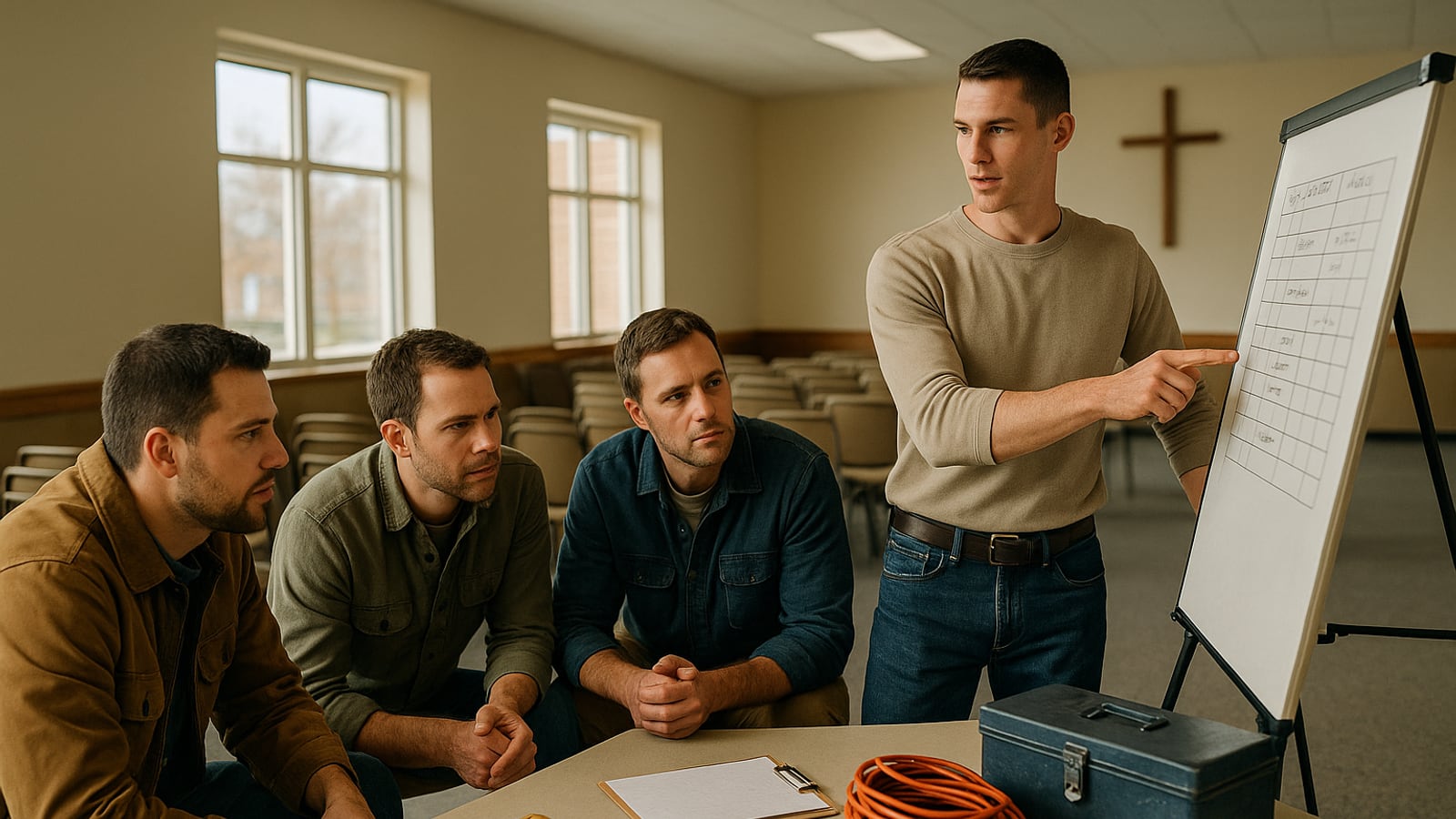
The quickest way to get influence nobody handed you is to close loops.
Watch any meeting, any committee, any group text about a church workday. Things get raised. Some get discussed. Almost none get a name attached and a date. The gap between "someone should look into that" and "I'll have it to you Thursday" is where unofficial authority lives, and it's mostly standing empty.
Step into it four or five times and something shifts. People start glancing at you when a question hangs in the air. Nobody voted. There was no announcement. You simply became the man things get given to, which is the only kind of leadership that can't be removed in a reorganisation.
Take the job nobody's fighting over
Every organisation has a task that's tedious, visible when it fails, and invisible when it works. Booking the room. Keeping the equipment list current. Writing the one-page summary that lets everyone else skip the two-hour call. Owning the spreadsheet everybody complains about and nobody maintains.
These jobs are ignored because they carry no glamour. They also carry enormous leverage. The person who maintains the schedule knows what everyone is doing. The person who writes the summary decides what the meeting was about. The person who owns the kit list gets consulted before any trip is planned.
You don't take these jobs as a manoeuvre. You take them because they need doing and you can do them well. But notice what happens: competence in an unowned area quietly turns into the right to speak about it.
One warning. Pick one. Two at most. The man who takes every orphan task isn't leading, he's absorbing, and in about eight months he'll be exhausted and quietly bitter about it.
Bring the fix with the complaint
Complaints are cheap and everybody's already holding several. The scarce thing is a proposal.
"The handover process is broken" gets you agreement and nothing else. "The handover's losing us a day per project. I drafted a one-page checklist, tried it on the last two jobs, and it saved most of that. Want to look at it?" gets you a decision.
The difference isn't optimism. It's that you've done the work of thinking it through and you've reduced what you're asking of the other person to a yes or a no. Most people in authority aren't resistant to change. They're just carrying more open questions than they can close, and you've just closed one for them.
Do this consistently and you get a reputation that travels ahead of you. He doesn't bring me problems, he brings me options. That reputation is worth more than any line on a business card.
Say the hard thing once, in the right room
There's a moment in most groups where everyone knows the plan has a hole in it and nobody wants to be the one to say so. Be the one. But do it properly, because doing it badly costs you everything you've built.
Properly means: in the room where it can be fixed, not in the car park afterwards. Once, clearly, without theater. Aimed at the plan rather than the person who made it. And then, if you're overruled, you get behind the decision and you don't say "I told you so" when it goes the way you said.
That last part is where most men fail. They mistake being right for being owed something. You're not owed anything. You said your piece and you were heard. Sulking about the outcome converts you from a trusted voice into a difficult one.
The men who can disagree well are rare enough that leaders collect them.
Credit out, blame in
You have an unlimited supply of credit and it costs you nothing to give away. Use specifics. Not "great job, team" but "the reason that landed is because Dan rewrote the second section on Sunday night." Say it in front of the person who matters. Say it when the person you're crediting isn't in the room, which is when it counts most.
Blame runs the other direction. If you were part of it, take your part fully and first, before anyone assigns it. "That was on me, I should have checked the dates." No qualifiers. No "to be fair, I did ask twice."
This looks like a losing trade and it isn't. Men who hand out credit get more of it back than they gave. Men who absorb blame get trusted with bigger things, because the boss knows an error won't turn into a week of finger-pointing.
Set the pace without narrating it
The strongest thing you can do in a group is be the standard rather than describe it.
Arrive before you said you would. Reply to the message that's been sitting unanswered for two days. Stay to stack the chairs. Put your phone face down when someone's talking. Do the second rep of the boring part properly when nobody's checking.
None of it announced. The moment you say "I always stay to clean up," you've traded the influence for the compliment, and it was a bad trade.
People calibrate to whoever's most consistent, not whoever's loudest. Be the fixed point.
Don't run a shadow government
This is the trap that catches capable men, and it's worth taking seriously.
When you're good and you don't have the title, there's a pull towards the alternative command structure. The side conversation. The group chat where the real decisions get made. The quiet eye-roll when the actual leader speaks. It feels like leadership. It's the opposite.
You can't build genuine influence by undermining the person who has the formal authority. Everyone watching learns that you'll do the same to them. And it poisons the culture in a way that's very hard to reverse.
If you can't support the leader publicly, go to him privately and say so. If that changes nothing and the disagreement is serious enough, leave. Those are the honest options. Running a parallel operation out of the break room isn't one of them.
Same rules at the kitchen table
Nobody gives you a title at home either. "Dad" is a description, not an authority; the authority has to be earned in the same currency.
Close loops. You said you'd fix the gate, fix the gate. Take the unglamorous job — the school run, the early morning, the boring maintenance nobody thanks you for. Credit your wife specifically and in front of your children. Take blame in front of them too, out loud, so they learn what it looks like when a grown man is wrong and says so.
Set the pace on the things you want them to carry. How you speak to a waiter. Whether you check your phone during dinner. Whether you pray when it's easy and when it isn't. They're calibrating to you whether you intend it or not.
A title would be easier. A title lets you be obeyed on a bad day. Without one, you only have what you've actually built, and it gets audited every single morning.
That's the better deal, even though it's the harder one. Most of the men who eventually get the title had been doing the job for a year already. And plenty of the ones who never get it are the reason the whole thing runs.
Your children will never once ask what your title was.
Ray Okonkwo
Money & Business
Former commercial banker turned small-business owner. Covers salary, credit, margins and the arithmetic nobody does before signing.

Watch
Worth an hour of your evening
More from Be a Man.
From channels we rate. Plays on YouTube.
Read next