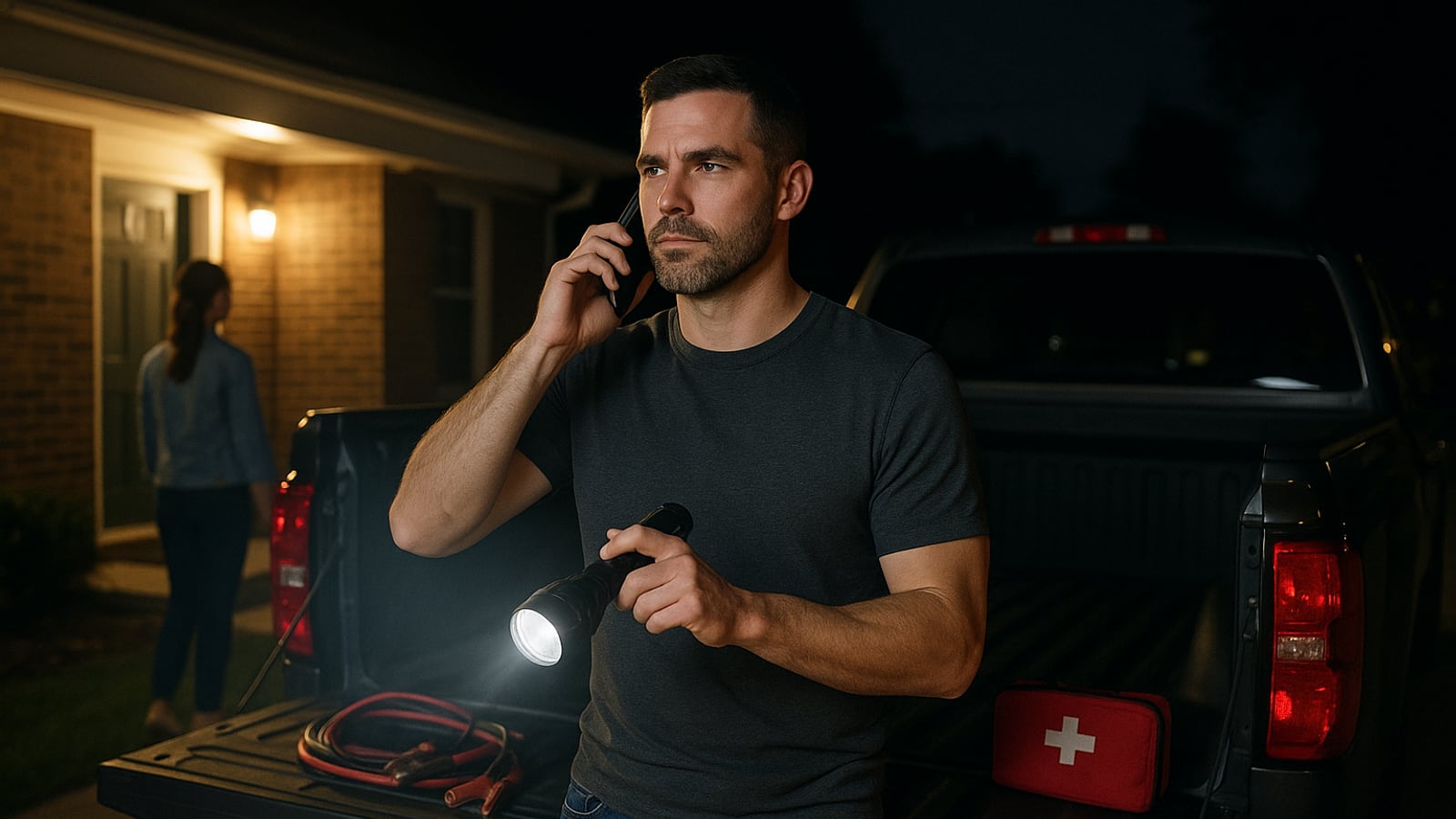
The man everyone calls in a crisis isn't braver than you. He's usually calmer, better prepared and easier to reach. Those three things are all learnable, and none of them require a personality transplant.
Start with the unglamorous one. He answers the phone.
Being reachable is most of it
Think about who you'd call at two in the morning with a real problem. Now think about why. It won't be because that man is the most competent person you know. It's because you're confident he'd pick up, and you're confident he wouldn't make you feel stupid for calling.
Most men lose the job right there. Phone on silent every night. Texts left for three days. A reputation for being busy. You can be the most capable man in your county and still never get called, because nobody wants to chase you.
So make yourself findable. Let the people who matter know your phone rings through at night. Reply to the small stuff quickly, because that's how people learn you'll reply to the big stuff. When somebody calls and says "sorry, is this a bad time", the answer is no.
Decide in advance, not in the moment
Composure looks like a trait. It's mostly a rehearsal.
The man who stays steady in an emergency has usually already run it in his head. He's thought about what he'd do if his wife called and said the house was flooding. If a friend said his marriage had ended that morning. If he arrived at a wreck on a back road.
You don't need a plan for every scenario. You need to have thought hard about five or six, so that the first ninety seconds aren't wasted on shock. Shock is what makes people freeze, and the antidote isn't courage. It's familiarity.
Pick one this week. Sit with it for ten minutes. What's the first phone call, what's the first physical action, who else needs to know. That's it. You've just cut your own reaction time roughly in half for that situation, for free.
Slow your voice down on purpose
The single most useful skill in a crisis is talking slowly.
A panicking person will match whatever they're given. Speak fast and high and they escalate. Drop your voice a step, slow the pace, use short sentences, and you'll watch their shoulders come down. It feels theatrical the first time. It works anyway.
Three sentences that do a lot of work:
- "Tell me what happened, from the start." Gets facts, buys you thinking time, gives them something to do with their mouth other than spiral.
- "I'm on my way." Not "let me know if you need anything." Nobody in real trouble knows what they need.
- "What's the next thing that has to happen?" Shrinks an overwhelming mess down to one action.
Practise the slow voice when nothing's wrong. On the phone with a frustrated customer service rep. With a toddler at the end of a long day. It becomes your default under pressure only if it's your default generally.
Know a small number of things cold
Broad competence is a myth. What the man everyone calls actually has is a short list of skills he's practised until they're boring.
Get certified in first aid and CPR through a recognized provider, in person, with your hands on a manikin. Renew it. A course you took eleven years ago is a memory, not a skill, and a real medical emergency needs trained hands and an ambulance, not somebody's best guess.
Beyond that, the list is shorter than you'd think. Know where the water shutoff and the breaker panel are in your house, and in your parents' house. Be able to change a tire in the dark and in the rain. Be able to jump a car without damaging either vehicle. Know how to get somebody through the door of an emergency room and speak for them when they can't speak for themselves.
And know how to sit with a grieving man without filling the silence. That one takes the longest to learn, and it gets used more than all the others combined.
Build a bench before you need it
Half of being useful is knowing who to call next.
A plumber who'll come out on a Sunday. A mechanic who'll tell you when not to spend the money. A lawyer, a pastor, a decent family doctor, somebody who understands insurance claims. You're not going to be the expert. You're going to be the man who knows the expert and can get them on the phone tonight.
Build that list in calm weather. Use these people for small jobs so they know your name. Pay them promptly. Recommend them to others. A tradesman who's been treated well for three years will answer your call at seven on a Saturday morning, and that's worth more than almost anything you can buy.
Write the numbers down somewhere that isn't only your phone. Phones get lost in exactly the situations where you need them most.
Have slack in your own life
You can't run to somebody else's fire if your own life is stretched to breaking.
That's the part men skip. Being the reliable one costs money, time and energy, and if you have none of those spare, you'll say the right words and do nothing. A few hundred dollars you can move without wrecking the month. A day you can take off without a negotiation. Enough sleep that you're not operating on fumes. A fuel tank that doesn't sit on empty.
None of it is dramatic. All of it is the difference between intending to help and actually arriving.
Your marriage counts here too. A man whose wife trusts him can leave the house at eleven at night to sit with a friend, and it costs them nothing. That trust is built in ordinary weeks, not claimed in emergencies.
Don't make it about you
Watch a man arrive at a crisis and start telling his own similar story. Watch him take over decisions that aren't his. Watch him post about it.
The useful man does the opposite. He asks what's needed. He takes the jobs nobody wants — the paperwork, the phone calls, the airport run, the laundry. He leaves the decisions with the person whose life it's, unless that person is genuinely incapable, and then he makes the smallest decision that gets them through the hour.
And he doesn't repeat anything. Not to his wife, not as a prayer request, not as a funny story in two years. A man who keeps confidences gets told the truth early, when problems are still small enough to fix. A man who doesn't gets told nothing until the ambulance is already there.
Come back on day thirty
The crowd shows up in week one. The casseroles arrive, the messages pile in, people mean every word of it.
Then it thins. By the second month, the widow is eating alone and the man who lost his job is answering the same question from strangers with no one left to ask him honestly.
Put it in your calendar. A month out, three months out, the anniversary. Send the text. Turn up with coffee. It takes almost nothing and it's the part that people remember for the rest of their lives.
Nobody ever decides in advance who they're going to call. The name just comes out under pressure, already chosen, without them thinking about it at all. The only question is whether the years you're living right now are putting your name on anybody's lips.
Marcus Vale
Editor-in-Chief
Twenty years in magazines, most of it deciding what to cut. Writes about work, discipline and the decisions that compound.

Watch
Worth an hour of your evening
More from Be a Man.
From channels we rate. Plays on YouTube.