Stop saying "call me if you need anything"
The man who's drowning won't call. He can't spare the pride, and he can't think of what to ask for. Show up with something specific.
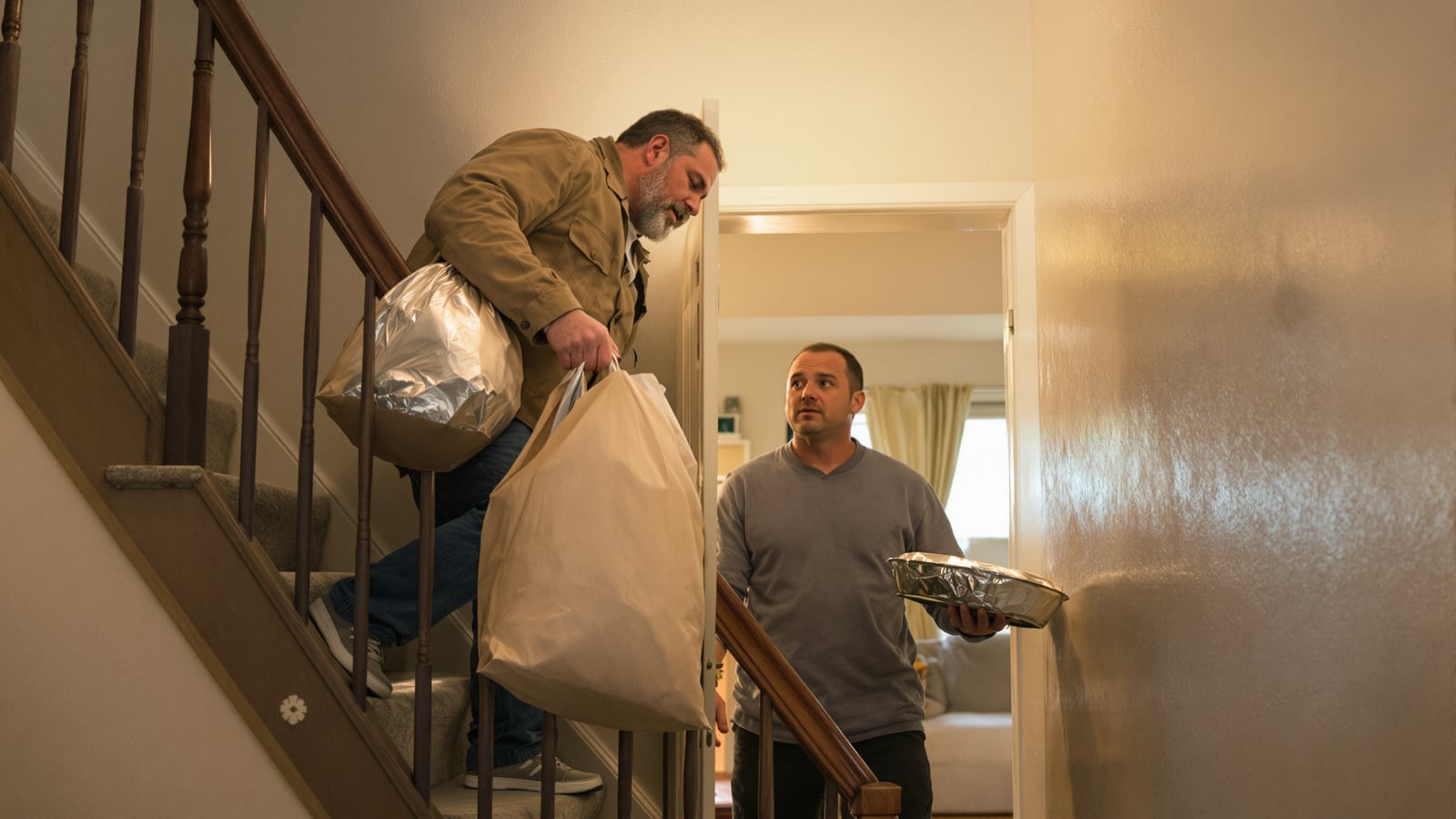
Quick answer: Don't offer. Decide on one small, useful thing, tell him when you're doing it, and do it. Then come back in a month, when everyone else has gone home.
This is commentary, and it's a strong opinion.
"Call me if you need anything" is the most generous-sounding sentence in the English language and one of the least useful. It gets said at every funeral, every hospital waiting room, every driveway after a layoff. And almost nobody ever calls.
That's by design. The sentence hands the work back to the man who's already out of it.
Why he won't ask
Think about what you're asking of a guy in his worst month. He'd have to admit he needs help. Then figure out what kind. Then pick which friend to bother, then word the request, then risk hearing "sorry, bad week."
His head is running at half speed. His pride is working at full speed. That's a bad mix, and the pride wins.
So he says "I'm good, man, thanks." You say "Okay, just let me know." Both of you walk away feeling decent, and nothing has been done.
Men are especially good at this. We go quiet before we go loud. If a friend you used to hear from every week has gone silent after a divorce, a diagnosis, a lost job or a death in the family, the silence is the message. He isn't fine. He's just not telling you.
Make it specific, then make it small
An open offer asks him to do the planning. A specific one takes the planning off him.
Compare:
- "Let me know if you need anything."
- "I'm bringing dinner Thursday at six. Anything your kids won't eat?"
The second one can only be answered with a yes. Same with these:
- "I'm mowing your yard Saturday morning. Leave the gate unlatched."
- "I'm driving your boys to practice Tuesday and Thursday until you tell me to stop."
- "I'm coming over Sunday to haul that mattress to the dump. I've got the truck."
- "I'll be at the hospital cafeteria at noon. I'm buying. You don't have to talk."
Notice that each one has a day and a time. That's what turns kindness into something he can accept without feeling like a charity case. It also makes it hard for you to back out, which is the point.
Keep the first move small. A man who's barely holding it together can say yes to a lawn mowed. He can't say yes to "let's talk about how you're feeling." Earn that second conversation by doing the first thing well.
What showing up looks like in person
Bring something. A pan of lasagna, a bag of ice, a case of water, a box of the good coffee. Come with your hands full, and make sure none of it has to be returned. Disposable pans were invented for exactly this.
Then leave the place better than you found it. Run the dishwasher. Take out the trash on your way out. Fold the laundry that's been sitting on the couch for a week. Do it without announcing it. A man in a hard season notices a clean kitchen the next morning and doesn't forget who left it.
Don't make him host you. No "Can I get you a drink?" from him. You're the one who gets up and finds the glasses.
Talk less than you'd like. You aren't there to fix his situation or to explain, with great wisdom, what happens next. Nobody has ever been comforted by a theory. Sit in the truck with him. Watch the game. Hand him a wrench. Sometimes the best thing you'll do all day is be present in the room and say nothing clever.
And if he wants to talk, listen. If he cries, don't flinch and don't fill the silence. Stay put. That's the job.
Where it goes wrong
Showing up unasked isn't the same as showing up unannounced. Walking into a closed-up house uninvited can feel like an intrusion, not a gift. Text first: "I'm dropping off dinner at 6. I'll leave it on the porch if you'd rather not see anybody." Let him choose how much company he can handle. Most men will let you in anyway.
Don't take over. You're there to carry the load he points to, not to rearrange his garage while he watches. Ask where the mower is. Put things back.
Don't make it about you. If you find yourself telling the story of your own rough year, stop. Don't post about your good deed either. And don't tell it later at the bar. What you saw in his kitchen stays in his kitchen.
Show up for the man, not for the mess he's making
Here's the part that gets skipped. Being a good friend doesn't mean being a doormat.
If your buddy's in a hole because life hit him, you carry the other end of the couch. If he's in a hole he keeps digging, a gambling habit or a bottle or a string of lies, you show up differently. You still show up. You just don't bankroll it, cover for him or lie to his wife on his behalf.
Lend only what you could stand to never see again. Say no when no is right. Say it plainly and kindly, and then stay in his corner. A friend who never says no isn't loyal. He's just easy to use.
Your own house counts too. If you're gone every night helping a friend and your kids are asking where you are, you've traded one failure for another. Tell your wife what you're doing. Better yet, bring her in. A lot of the best help comes from couples: she knows what the wife is too tired to ask for. Your family comes first, and that's exactly why you're worth borrowing from.
This is the same instinct that duty is unfashionable, and it holds everything up argues for. It's also part of the work described in masculinity is a job description, not an identity. You take on the load because someone has to, and you don't need a thank-you.
The part nobody does: week six
The first week, the porch is full of casseroles. Everybody's there. By week six the casseroles have stopped, the cards have stopped, and the man is still in it. That's when he's most alone, and it's the easiest time to be the one who makes a difference.
Put it on your calendar. Thirty days out, then sixty, then ninety. A text that says "Coming by Saturday with breakfast" lands harder in week six than it ever did in week one.
If you've let someone down in the past, because you went quiet or you missed the thing or you weren't around when it counted, don't wait until you can say it perfectly. Say it. Most men have never given a real apology, and a short, honest one is a good place to start. Then show up this time.
Somebody did this for you once, or you wish they had. Either way, you know what it was worth.
Pull out your phone. Think of the man who's gone quiet. You already know his name.
Marcus Vale
Editor-in-Chief
Twenty years in magazines, most of it deciding what to cut. Writes about work, discipline and the decisions that compound.

Watch
Watch how it's done
Picked for this article.
From channels we rate. Plays on YouTube.
Dr. Kate Truitt
Tips: How to Support a Loved One as They're Navigating Grief & Loss with Dr Kate Truitt
Stanford Center for Health Education
Suicide Loss: How To Help Someone Grieving | Stanford
Read next