
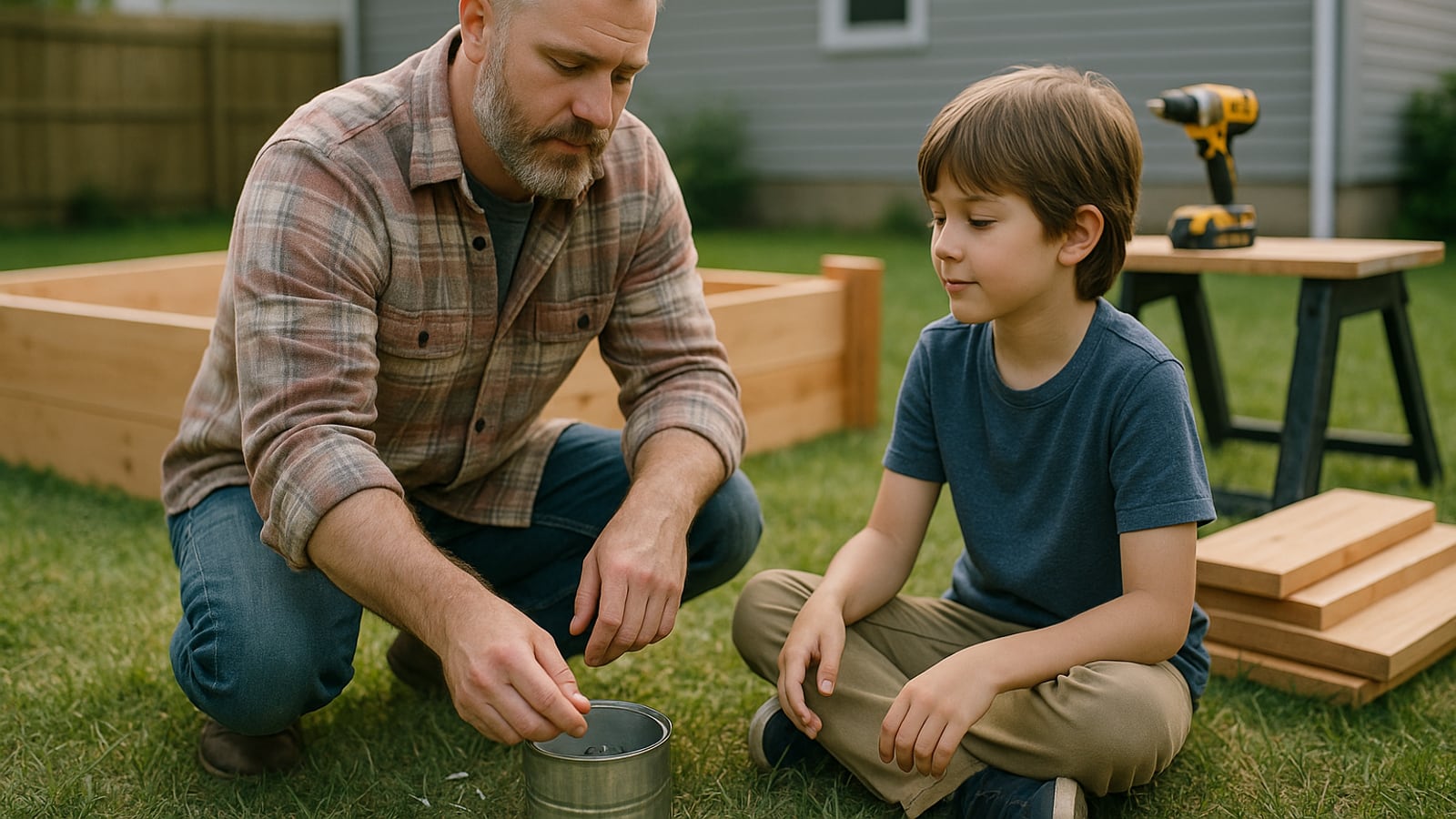
It was a coffee can of drywall screws. Your eight-year-old bumped it off the workbench, a few hundred screws scattered under the table saw, and you said something in a voice that made him go very still.
Then you spent twenty minutes on your knees fishing screws out of the sawdust, feeling like the worst dad in the county.
Now rewind the tape. You'd been up since 5:15. You drove to the hardware store twice because the first bracket was the wrong size. You skipped lunch. Your brother-in-law texted, again, about the money you've owed him since March. By the time that can hit the concrete, the gun was already loaded. Your son just happened to be standing near the trigger.
Most men who want to fix their temper go after the wrong moment. They work on the blowup itself. Count to ten, walk away, breathe. Those tools are real, and keeping your temper is a skill you can build. But they're your last line of defense. Self-awareness means working further upstream, where the fuse gets lit hours before anything goes off.
The spark and the load
Every blowup has two parts. The spark is the event: the spilled screws, the guy who cut you off, your wife asking where the receipt went. The load is everything already sitting in the chamber: sleep, hunger, stress, the conversation you've been avoiding.
Men blame the spark because it's visible and it happened right before. But the same spark on a good day barely registers. On a Saturday morning after eight hours of sleep and a real breakfast, you'd have laughed, handed him a magnet and made a game of it.
So the spark isn't really the problem. The load is. And the load is something you can see coming if you bother to look.
Keep a log for two weeks
This is the part most men skip, and it's the part that works.
Every time you snap, or come close, write it down within an hour. A notes app is fine. A pocket notebook is better, because you'll actually open it. Four lines:
- When: time of day, where you were.
- What happened: the spark, in one plain sentence.
- What state you were in: how you slept, when you last ate, what else was on your plate.
- What it made you feel you were: stupid, ignored, disrespected, cornered, broke.
That last line is the one that matters. Don't write "she was being unreasonable." Write about you. The question is what the moment hit, not who caused it.
The annoying part: the first few days feel pointless and a little humiliating. You'll want to skip the entries where you were plainly in the wrong. Those are exactly the ones to write down. A log that only records the times you were justified is just a diary of grievances.
What the patterns usually show
After two weeks, read it all in one sitting. Most men find the same few things over and over.
Competence. Something makes you look or feel incompetent. The bolt that won't break loose. The printer. Your daughter asking a math question you can't answer. A lot of male anger is embarrassment wearing a louder coat.
Respect. Being corrected or brushed off, especially in front of other people, and especially in front of your kids.
Control. A plan you built gets blown up. You wanted to leave at 8:00 and it's 8:40 and somebody still can't find a shoe.
Money. Anything that touches the account, even sideways.
Then there's the load side, which is almost embarrassingly simple. Late afternoon. Before dinner. After a bad night. Sunday evening before a hard week. You'll probably find that most of your entries cluster in a few specific windows.
Most men have one big trigger and one bad time of day. Once you know both, you know where the thin ice is. You can walk around it, or at least walk on it slowly.
Your body knows before you do
Anger shows up in your body a few seconds before it shows up in your mouth. Learn your earliest tell.
For some men it's the jaw. For others, shoulders creeping toward the ears, hands going tight on whatever they're holding. Some men get loud. Some get very quiet and very precise, which is often worse. A dead giveaway is when you start over-explaining, building a courtroom case for why you're right in a conversation about the dishwasher.
Pick your earliest signal and treat it like a check-engine light. You don't have to pull over and panic. You do have to stop pretending you didn't see it.
Tell the people you live with
Here's where self-awareness turns into something your family can actually use. Hand them the map.
Sit down with your wife on a calm evening and say it plainly: "After three hours in the garage with no food, I'm not the guy to ask about the budget. Catch me after dinner." Tell her your tell. Give her permission to say, "You're getting hot. Go eat something."
That takes humility. It also puts her first, which is the whole job. You're taking the burden of reading your moods off her shoulders and carrying it yourself.
Kids can handle a version of this too. "Dad gets grumpy when he's hungry, so if I sound short before dinner, that's on me, not you." You've just taught your son something most grown men never learn: bad moods have causes, and a man owns his.
Don't turn awareness into an alibi
There's a real trap here. Some men learn their triggers and start using them as a permission slip. "You know I get like this when I'm tired." That isn't self-awareness. That's a warning label you slapped on yourself so you wouldn't have to change.
Knowing your triggers raises the standard. Once you know that 5:30 on a weekday is your danger zone, snapping at 5:30 isn't an accident anymore. It's a choice you saw coming. So eat something at 4:00. Sit in the truck for five minutes before walking in the door. Put the budget talk on Saturday morning.
And not every flash of anger is a malfunction. If somebody threatens your family, bullies your kid or lies to your face, anger is the correct response. You're not trying to become a man who feels nothing. You're trying to become a man whose anger answers to him, aimed at the right thing, at the right size, at the right time. That's the difference between a watchdog and a stray. The ideas in masculinity is a job description apply here: strength that serves the people around you, not strength that makes them flinch.
When you miss anyway
You will. The log doesn't make you perfect. It makes you faster.
When you blow it, repair it quickly and without a speech. A real apology names what you did, skips the excuses and doesn't ask the other person to make you feel better. "I yelled at you about the screws. That wasn't about you. I was tired and hungry and I took it out on you. I'm sorry."
Then get down on the floor and pick up the rest of the screws with him. Leave the room calmer than you found it, even if you're the reason it got loud.
One more thing, said straight. If your anger has ever turned physical, if your wife or kids are scared of you, or if it gets worse when you drink, a notebook isn't enough. Talk to your doctor or a licensed counselor. That isn't weakness. It's what a man does when he takes his job seriously.
Your son won't remember the screws. He'll remember what your face did when the can hit the floor, and whether it looked different a year later.
Cal Brennan
Fitness
Strength coach. Trains fathers, tradesmen and desk workers, which means programmes that survive a bad week.

Watch
Watch how it's done
Picked for this article.
From channels we rate. Plays on YouTube.
Therapist Aid
Anger Management: Warning Signs + Anger Thermometer
Dr. Juan Santos
Understanding Anger Triggers (Explained by a Counselor)
Read next