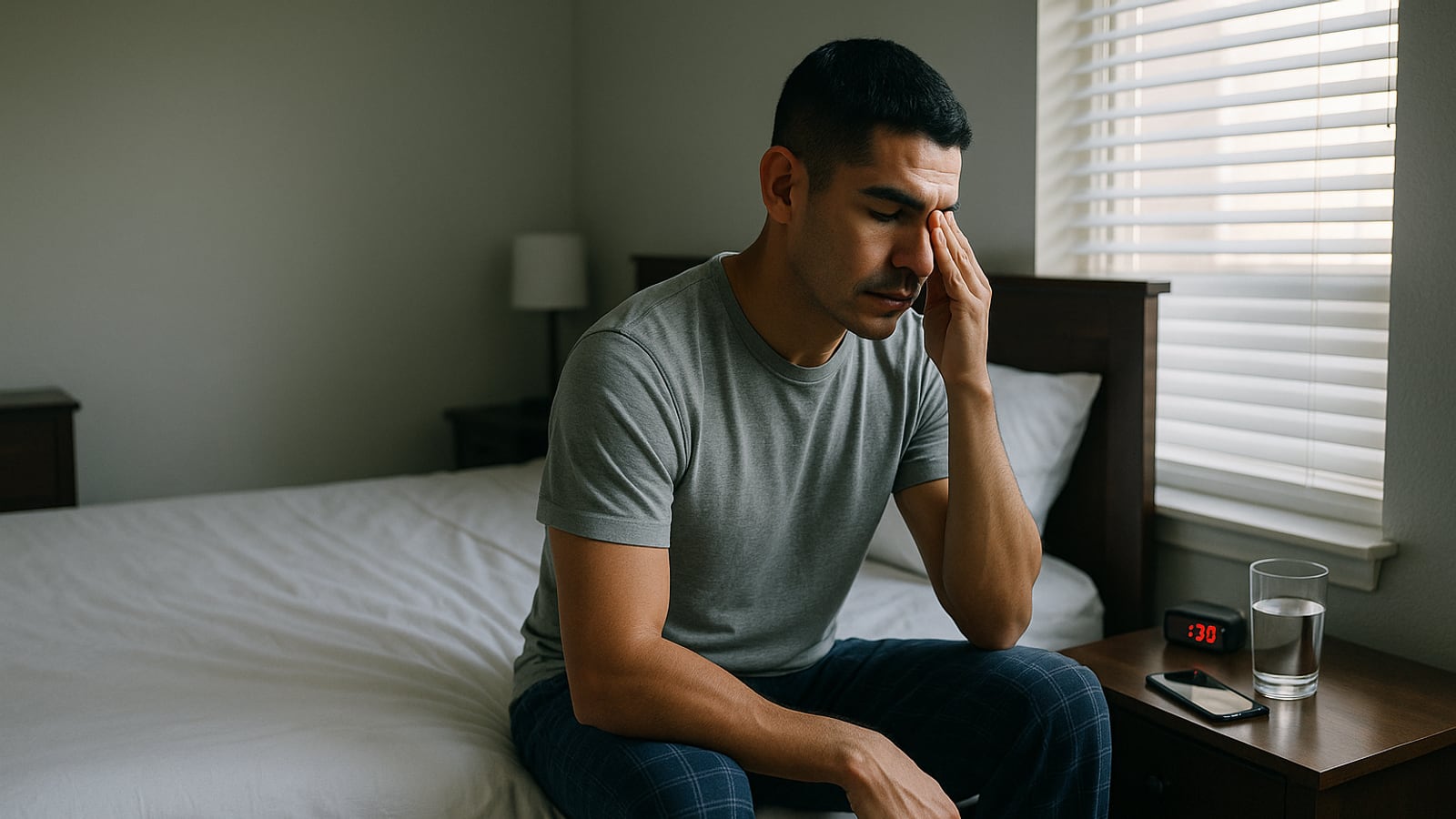
The instruction that fixes most chronic insomnia sounds like a prank: get less time in bed, not more.
Not less sleep. Less time lying in bed trying. If you're in bed nine hours and sleeping six of them, those three spare hours aren't a cushion. They're the problem. They're teaching your body that the mattress is a place where you lie awake doing math about how wrecked you'll be at the 8 a.m. standup.
The treatment is called CBT-I, cognitive behavioral therapy for insomnia. The American College of Physicians recommends it as the first-line treatment for chronic insomnia in adults, before medication. Not as a nice adjunct. First. And the reason it beats sleeping pills over the long haul isn't that pills don't work. It's that the pill stops working the night you stop taking it, and CBT-I doesn't.
What you're actually treating
Insomnia that's lasted three months isn't the same animal as the bad stretch you had after your second kid was born. Short-term insomnia has a cause you can point at: a deadline, a death, a move, a sick toddler. Chronic insomnia has outlived its cause. The original stressor is gone and the insomnia stayed, because you spent months building habits around it.
Longer time in bed. Earlier bedtime "to catch up." Naps. A 9 p.m. drink. Lying there at 2:40 a.m. rehearsing tomorrow's failure. Every one of those is a reasonable response and every one makes tonight worse.
CBT-I dismantles the habits. Four to eight weeks, no prescription, and you can do a serious version of it yourself.
Two weeks of a paper diary first
Don't skip this and don't use a wearable. A sleep tracker's guess about your REM stages is theater. What you need is five numbers a morning, written down within a minute of getting up, on an index card on the nightstand.
- What time you got into bed
- What time you think you fell asleep
- Roughly how long you were awake in the middle
- What time you woke for the last time
- What time your feet hit the floor
Do it for seven nights minimum, fourteen if you can stand it. Estimates are fine. Nobody's grading you.
Then work out your sleep efficiency: total time actually asleep, divided by total time in bed, times 100. Seven hours asleep in nine hours of bed is 78 percent. Healthy is usually north of 85.
That number is the whole game. You're going to drive it up, and then trade it back for more sleep.
Set the window
Two rules and they're both unpleasant.
Rule one: pick a wake time and never move it. Weekdays, weekends, the morning after the worst night of the month. 5:45, 6:30, whatever fits your commute. This is the anchor. Sleeping in on Saturday until nine feels like mercy and costs you Sunday night.
Rule two: your time in bed equals your average actual sleep, plus about 30 minutes. If the diary says you're averaging six hours of sleep, your window is six and a half. Count backward from your fixed wake time. Wake at 6:00, window of six and a half, you're not getting into bed before 11:30.
Set a floor of five and a half hours. Don't go below it no matter what the arithmetic says.
Then the third piece, and it matters as much as the clock. The bed is for sleep only. No phone, no laptop, no TV, no lying there awake for an hour. If you've been awake long enough to feel annoyed about it, get up. Don't look at the clock to check. Go sit in another room with a dim lamp and something boring on paper, and come back when you feel heavy. Repeat as many times as it takes.
Week one is genuinely rough
Days four through seven are where people quit, so know it's coming.
You'll be tired in a way that feels like you've made things worse. Mid-afternoon will be grim. Coffee will stop doing what it used to do. Your spouse will ask, reasonably, why a treatment for tiredness involves being more tired.
Because that pressure is the medicine. Sleep drive builds with hours awake, and you've been bleeding yours off in naps, early bedtimes and 9 p.m. couch dozes. Compress the window and the drive gets strong enough to overwhelm the anxiety that's been beating it. Usually somewhere in the second week you stop falling asleep and start dropping.
Two hard rules during the rough patch: no naps, and no driving when you're fighting to stay in your lane. If your job involves a vehicle, heavy machinery or night shifts, do this with a clinician instead of solo.
Then you buy the time back
Once your sleep efficiency runs above 90 percent for a week, add 15 minutes to the window. Earlier bedtime, same wake time.
Hold for a week. Above 90 again? Another 15. Below 85? Take 15 back off.
You're titrating, same as you'd add plates to a bar. Most people land somewhere between six and a half and eight hours of time in bed that's mostly, boringly, filled with sleep. The goal isn't a number on an app. It's that bed stops being the place where you fight.
The version that survives children
Straight CBT-I assumes your nights are yours. If a four-year-old shows up at 1 a.m. with a bad dream, that's not insomnia, that's parenting, and no protocol fixes it.
Keep the two things that do the most work and let the rest slide. Fixed wake time. Nothing in bed but sleep. Those two, done imperfectly for a month, beat the full protocol abandoned on day six.
If you're tag-teaming night duty with your spouse, split it by block rather than alternating wakeups. One of you owns 10 p.m. to 2 a.m., the other owns 2 to 6. One person getting a real four-hour run is worth more than two people getting shredded equally. Trade the blocks weekly so nobody's permanently stuck with the bad one.
And if you must nap, before 2 p.m. and under 25 minutes. Set the alarm across the room.
The part between your ears
The clock work handles most of it. What it doesn't handle is the 3 a.m. spiral.
Two things help. First, a worry appointment: ten minutes with a notepad in the early evening, well before bed, where you write down what's chewing on you and one next action for each. Not solutions. Next actions. Your brain brings you problems at 3 a.m. because it doesn't trust you've logged them.
Second, drop the catastrophe math. One bad night doesn't ruin tomorrow. You've had bad nights and still done your job. The belief that you're finished if you don't sleep is itself an alerting stimulus, which is a fancy way of saying the fear of not sleeping keeps you awake.
When this isn't the right tool
Loud snoring, gasping, someone telling you that you stop breathing, morning headaches, or sleepiness that no amount of sleep touches? Get screened for sleep apnea before you do any of this. Restricting time in bed won't fix a blocked airway and can make you more dangerous behind the wheel.
Same caution if you have bipolar disorder or a seizure disorder. Sleep restriction can destabilize both, and it needs supervision.
If you're on a sleeping pill now, don't just stop. Some of them rebound hard. Talk to whoever prescribed it about tapering while you build the new schedule.
And if none of it moves after six weeks, ask your doctor for a referral to behavioral sleep medicine. There are also structured digital CBT-I programs, including prescription ones, if the nearest clinician is three hours and a four-month wait away. Gregg Jacobs' Say Good Night to Insomnia and Colleen Carney's Quiet Your Mind and Get to Sleep walk through the same protocol on paper for the price of lunch.
This is general education, not a treatment plan for you specifically. Your doctor knows your history and an article doesn't.
Give it a month. The first week you'll want to throw the index card away. Around night ten you'll get in bed at 11:30 and the next thing you'll know is the alarm, and you'll lie there for a second genuinely confused about where the night went.
Cal Brennan
Fitness
Strength coach. Trains fathers, tradesmen and desk workers, which means programmes that survive a bad week.

Watch
Worth an hour of your evening
More from Fitness.
From channels we rate. Plays on YouTube.
Read next