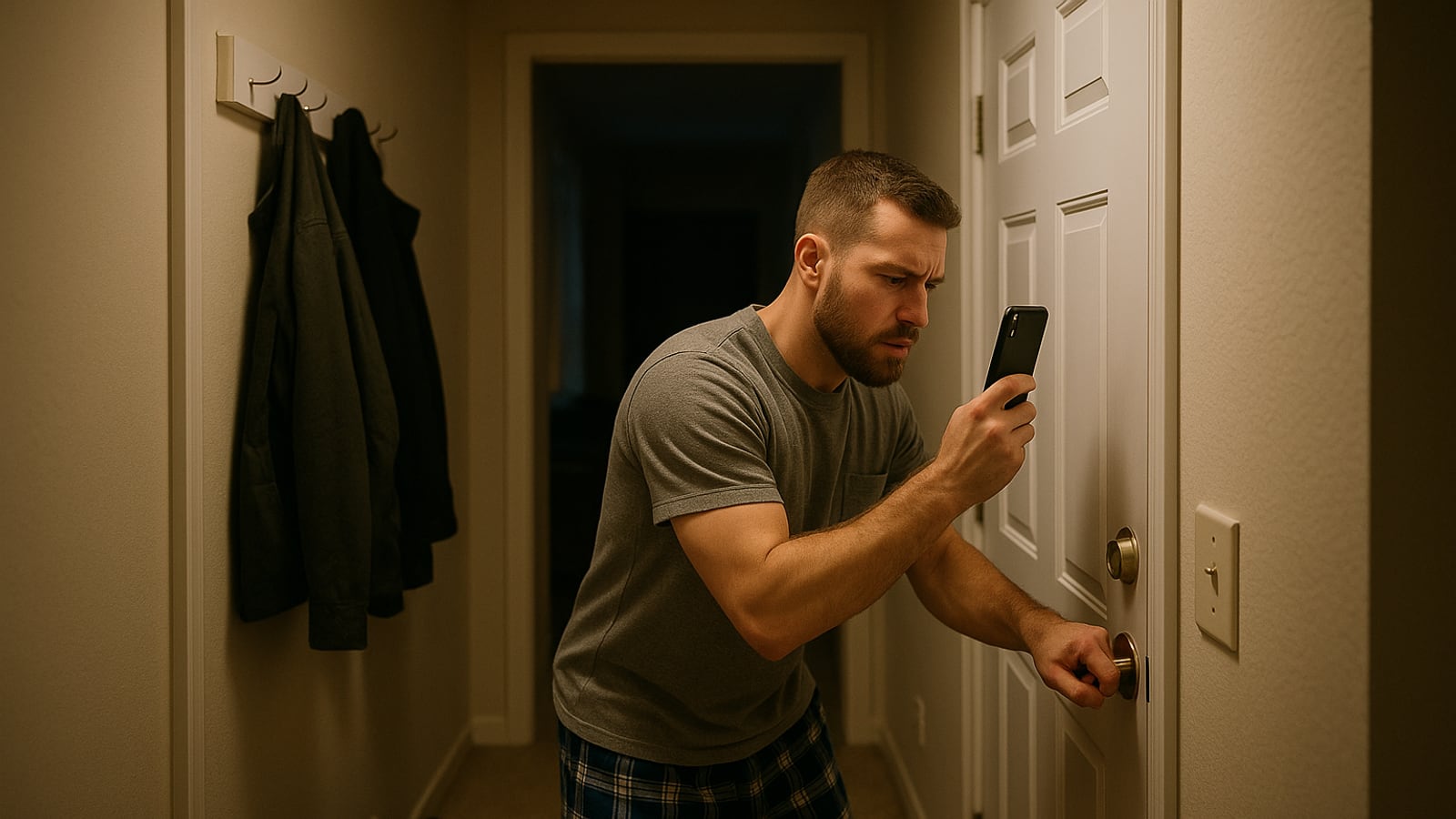
A man checks the front door before bed. Locked. He walks to the bedroom, gets under the covers, and then his brain asks the question again. So he gets up. Locked. Back to bed. Up again. On the fourth trip he takes a photo of the deadbolt with his phone so he can look at the picture instead of getting out of bed, and for about ninety seconds, that works.
That's not a tidiness quirk. That's a loop, and the loop is the actual disorder.
Most people use "OCD" to mean particular about order. Labels facing out, pens lined up, the garage pegboard with the tool outlines drawn on it. That guy is usually just organized and slightly pleased with himself. Obsessive-compulsive disorder is something else, and it's common enough that you probably know someone carrying it quietly. Some of them are carrying it at 2 a.m. while everyone else in the house sleeps.
None of what follows is a diagnosis. It's the shape of the thing, so you can recognize it and go talk to someone qualified instead of white-knuckling another year.
The obsession is the part nobody chooses
An obsession isn't a hobby or a preoccupation. It's an intrusive thought, image or urge that shows up uninvited and lands wrong. It feels foreign. It contradicts what you actually believe about yourself, and that mismatch is exactly what makes it stick.
Everybody gets intrusive thoughts. Standing on a balcony and having your brain offer up a flash of jumping. Driving over a bridge and picturing the wheel turning. Holding a knife and getting a split-second image you'd never say out loud. For most people that flickers through and is gone in three seconds, filed under "brains are weird."
For someone with OCD, the thought doesn't flicker. It lands, and it gets treated as information. Why would I think that unless part of me meant it? The anxiety spikes hard, and the search for certainty begins.
The compulsion is anything that makes the spike go down
This is where people miss it, because they're watching for hand-washing.
A compulsion is any behavior done to reduce the distress of the obsession. Washing and checking are the famous ones. But a huge share of compulsions happen entirely inside someone's head, where nobody can see them:
- Mentally replaying a conversation to confirm you didn't say something offensive
- Silently counting, or repeating a phrase until it feels right
- Reviewing your own memory of an event over and over looking for proof
- Asking your spouse the same reassurance question in three different wordings
- Googling symptoms, then Googling them again from a different phone
Avoidance counts too. Not taking the highway. Not holding the baby when you're tired. Not using the sharp knives.
The cruel part is that all of it works. The relief is real, and it arrives fast. That's the problem. Every time relief follows the ritual, the brain files the conclusion: that was a genuine threat, and the ritual is what saved us. The next spike comes back a little stronger and a little sooner. Compulsions aren't the coping strategy. They're the fuel.
The theme changes, the loop doesn't
People get attached to their theme and assume it defines them. It doesn't. Contamination, harm, checking, symmetry, the "just right" feeling, moral replay, health fears, worries about whether you love your spouse enough. Themes swap around over a lifetime. Someone who spent their twenties washing might spend their thirties replaying conversations.
The machinery underneath is identical every time. Intrusive thought, spike, ritual, relief, stronger thought.
If you want one question to sort ordinary carefulness from OCD, try this one: can you leave it alone? A careful person checks the stove once and goes to bed. Someone in the loop can check it once and still lie there for forty minutes with their chest tight, negotiating.
New parents get hit hard and say nothing
This is the presentation that stays hidden the longest, and it's worth naming plainly.
Plenty of new mothers and fathers get sudden, graphic, unwanted thoughts about harm coming to their baby. Dropping the baby down the stairs. Something happening in the bath. The thought is horrifying, so they tell nobody, because they're convinced that saying it out loud means someone takes the child away.
The distinguishing feature of these thoughts is that they're revolting to the person having them. They run directly against everything that person wants. That's what makes them intrusive rather than intentions, and it's why clinicians who work in this area see them constantly and aren't shocked by them.
What follows is usually avoidance. Dad stops doing bath time. Mom won't be alone with the baby. The family quietly reorganizes itself around a fear nobody has described. If that's your house, tell an OB, a family doctor or a therapist the actual sentence. They've heard it before this month.
It shows up in the gym too
You train four days a week, you log your lifts, you eat roughly the same six meals. That's discipline, and it's most of why you're still in decent shape with two kids and a commute.
But watch for the version that stops being discipline. Redoing a set because the last rep felt slightly off. Needing to end on an even number. Re-weighing the same chicken breast. Checking the gym locker four times. Logging a workout, then reopening the app to confirm you logged it. Refusing to skip a session when you're sick because skipping feels dangerous rather than just annoying.
The test is the same one. Can you miss a Tuesday, feel mildly irritated about it, and move on? Or does missing it cost you the evening?
What actually treats it
The front-line psychological treatment for OCD is exposure and response prevention. ERP. You work with a therapist to deliberately face the trigger and then not perform the ritual, starting small and climbing a ladder you build together. Touch the door handle and don't wash. Lock the door once and walk to the car.
The anxiety goes up. Then, without you doing anything about it, it comes down on its own. Do that enough times and the brain updates its threat map, because it finally got to see what happens when the ritual doesn't rescue anybody.
Honest warning: ERP is unpleasant, and week three is where people quit. It's also the treatment with the strongest track record, and a good therapist paces it so you're never thrown in cold.
Medication is a real option and a separate conversation. OCD is often treated differently from ordinary anxiety in terms of dosing and how long a trial runs, which is exactly why that conversation belongs with a psychiatrist and not a message board. The International OCD Foundation keeps a directory of clinicians who actually do ERP, which matters, because plenty of well-meaning talk therapy accidentally becomes reassurance-giving.
What the rest of the family should do
Stop supplying the reassurance. Not by ambush, and not with a speech. Sit down together when nobody's spiraling and agree on it out loud: I love you, and I'm not going to answer the lock question anymore, because answering it makes tomorrow worse.
Clinicians call this family accommodation, and it's the most loving trap in the house. Checking the stove for him. Doing the laundry twice. Answering the same question at midnight because it's faster than the alternative. Every time you do it, you're paying the interest on someone else's debt.
Keep the boring stuff steady while you're at it. Sleep, a daily walk, less alcohol. None of that treats OCD, and anyone who tells you a morning routine fixes it's selling something. It just raises the floor, and a higher floor makes the hard work survivable.
The door is locked. It's been locked since you left the house. The job was never to prove that. The job is getting in the car anyway.
Cal Brennan
Fitness
Strength coach. Trains fathers, tradesmen and desk workers, which means programmes that survive a bad week.

Watch
Worth an hour of your evening
More from Fitness.
From channels we rate. Plays on YouTube.
Read next