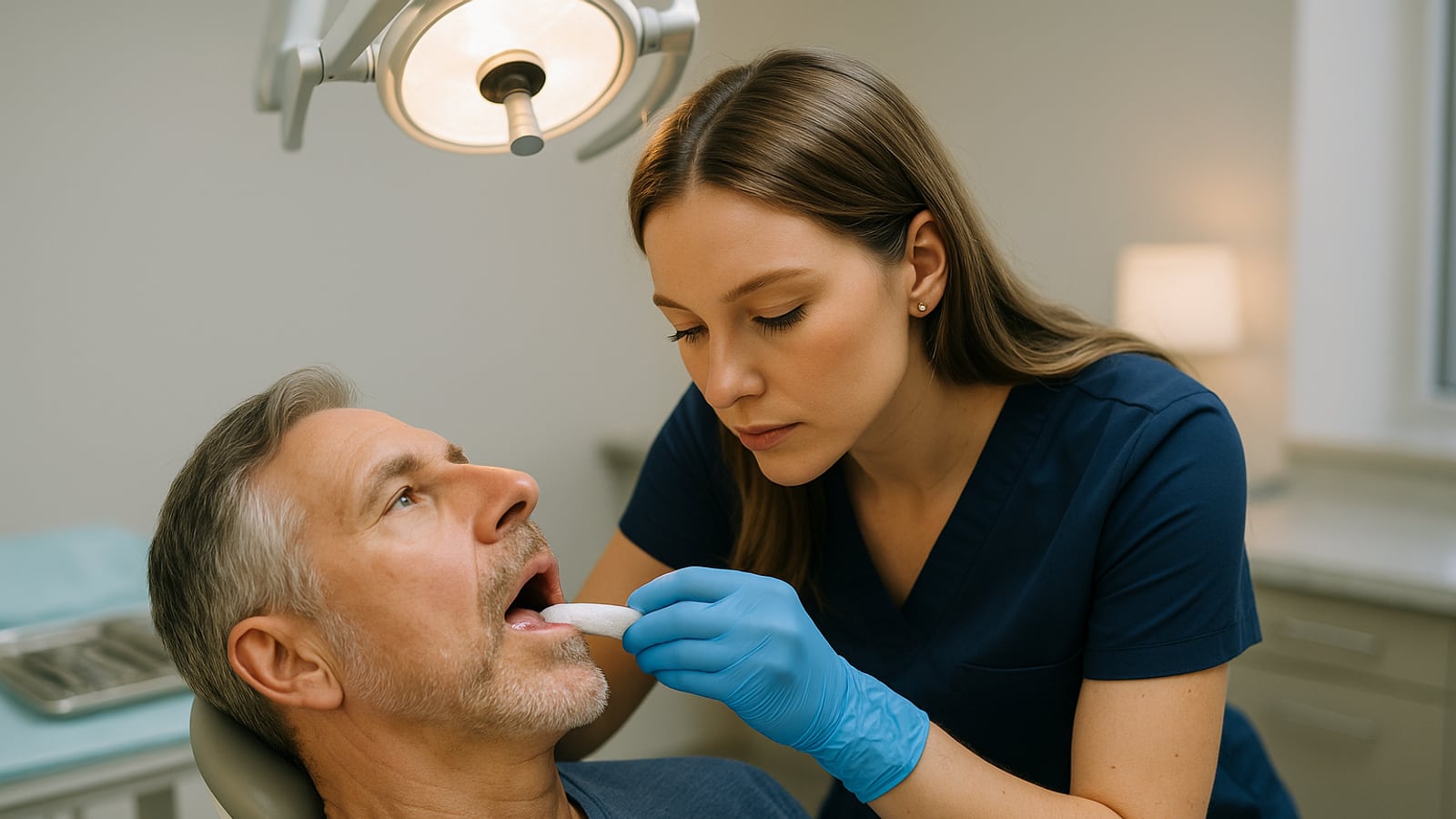
The part where the hygienist wraps a square of gauze around the tip of your tongue and pulls it left, then right, then lifts it to look underneath — that's the cancer check. It takes about ninety seconds. Most people spend it staring at the ceiling light thinking about work.
Worth knowing what's happening, because the sides and underside of the tongue are where oral cancer likes to start, and you can't see either one in your bathroom mirror without doing exactly what the hygienist does.
What they're actually looking at
A proper oral cancer exam has two halves, and the first one happens before your mouth ever opens.
The hands on your neck aren't a massage. They're feeling for lymph nodes that shouldn't be there, along the jawline and down the sides, plus the area under the chin. A node that's firm, fixed in place and doesn't hurt is the one that gets attention. Tender and squishy usually means you fought off something last month.
Then the inside. Lips flipped out, cheeks pulled back, the gutters between cheek and gum. Roof of the mouth, soft palate at the back, the tonsil area. The floor of the mouth under the tongue, which gets a gloved finger from below and a look from above at the same time. And the tongue itself, held with gauze so it can't slip, rotated so both lateral borders are visible.
They're looking for a patch that's the wrong color. A sore that's got a raised, rolled edge instead of a clean one. Anything firm under the surface that shouldn't be firm.
Red patches matter more than white ones. A white patch that won't wipe off gets watched or biopsied. A velvety red patch gets biopsied, usually sooner.
The signs you report, and the number that matters
Here's the uncomfortable truth about this particular exam: there's no national screening program for oral cancer the way there's for colon cancer at 45. No mailed kit, no reminder from your insurer. The dentist's look is the closest thing most adults get, and plenty of what gets caught early gets caught because the patient spoke up.
So speak up. The threshold is two weeks.
Anything in your mouth or throat that's still there after two weeks and isn't getting better needs a professional set of eyes on it. Not three months. Not "after the holidays." Two weeks.
Report these:
- A sore or ulcer that won't heal. Canker sores hurt like crazy and clear in seven to ten days. The dangerous ones often don't hurt much at all, which is exactly the problem.
- A red or white patch on the tongue, gums, cheek lining or floor of the mouth that you can't rub off.
- A lump in the neck that's painless, firm and doesn't shrink. This is how a lot of throat cancers announce themselves, and painless is what fools people.
- Hoarseness lasting more than two or three weeks when you haven't been sick or shouting at a game.
- Trouble or pain swallowing, or the feeling that something's stuck in your throat that never clears.
- Ear pain on one side with a normal-looking ear. Nerves from the throat refer pain to the ear. An ENT sees this constantly and it's a classic tip-off.
- Numbness or tingling in the tongue, lip or chin with no dental work to explain it.
- A tooth that loosens with no injury, or a denture that suddenly stops fitting right in one spot.
- Bleeding in the mouth you can't trace to flossing or a cut.
Any one of those, on its own, past two weeks. Don't wait for a second symptom to keep it company.
Who's actually getting this
The old picture was a heavy smoker in his sixties with a whiskey habit. Tobacco and alcohol together are still the biggest driver, and they don't just add up, they multiply. Every form counts — cigarettes, cigars, pipes, dip, chew, snus. Chewing tobacco parks a carcinogen in the same spot in your cheek for an hour at a time, which is why those lesions show up right where the tin goes.
But the picture changed. A large share of throat cancers now trace to HPV, and they show up in men who never smoked a day, often in their forties and fifties, often in better shape than their doctor. The presentation is usually that painless lump in the neck rather than a sore you can see. That's why "I don't smoke" isn't a reason to ignore the list above.
The HPV vaccine is approved through age 45, and whether it makes sense for you at your age is a real conversation to have with your doctor. It's shared decision-making past 26, not a blanket recommendation, so ask.
One more: your lower lip. Sun exposure drives lip cancer, and if you work outside, fish, hunt, coach or spend Saturdays on a roof, that lip has been taking the same UV your forearms take. A lip balm with SPF in the truck console costs less than the copay for the biopsy.
The two-minute check, once a month
Bright light, a mirror, clean hands, and a gauze square or a paper towel.
- Pull your lower lip down, look at the inside surface and run a finger along it. Same with the upper.
- Hook a finger in your cheek and pull it out. Look at the whole lining, both sides. Feel it between finger and thumb.
- Stick your tongue out, grab the tip with the towel, and pull it gently to the right. Look at the whole left border. Reverse it.
- Lift your tongue to the roof of your mouth and look underneath, and at the floor of the mouth.
- Say "ahh" and look at the soft palate and back of the throat.
- Fingers flat, run down both sides of your neck and under your jaw, feeling for anything firm.
Do it the first Sunday of the month. Do it after you brush, so you're already standing there. The point isn't diagnosing anything — you can't. The point is that you'll know what your mouth normally looks like, so a change registers instead of hiding for eight months.
The lever you actually control
If you want one behavior change with real weight behind it, cut the alcohol. Risk here scales with how much and how often, and the interaction with tobacco is brutal. Two drinks on a Friday is a different animal from a nightly four.
If you dip, quitting that beats every supplement you've ever bought. The tin is a delivery system pointed at one square inch of tissue.
Then just go to the dentist twice a year. Not because your teeth need it, though they do. Because that's the only appointment on your calendar where a trained person looks at the roof of your mouth.
And when you're in the chair, say the sentence out loud: "Can you do the oral cancer exam?" You'll almost always get "we already do." Good. Now they know you're paying attention, and they'll take the extra thirty seconds at the back of the throat.
This isn't medical advice and it's no substitute for your dentist or your doctor. It's a list of things worth saying out loud in a room where somebody can actually look.
A sore that outlasts a two-week pay period isn't a sore anymore. It's a question.
Cal Brennan
Fitness
Strength coach. Trains fathers, tradesmen and desk workers, which means programmes that survive a bad week.

Watch
Worth an hour of your evening
More from Fitness.
From channels we rate. Plays on YouTube.
Read next