The cancer check your dentist does and the signs to report
Most mouth sores are nothing. The ones that matter follow a pattern, and two weeks is the number that decides which is which.
Two weeks. That's the rule worth keeping in your head, because it does most of the work.
A sore spot in your mouth, a rough white patch on the inside of your cheek, a lump in your neck you found while shaving. If it's still there fourteen days later and it isn't clearly getting better, it stops being a nuisance and becomes a phone call. Not a "mention it at my next cleaning in April" item. A call.
Most mouth sores are nothing. You bit your cheek chewing jerky. You burned the roof of your mouth on coffee you shouldn't have gulped. Canker sores hurt like crazy and heal on their own in a week or ten days. The cancers are usually the quiet ones, and that's the cruel part. The thing that hurts gets your attention. The thing that doesn't gets ignored until it's big.
What the dentist is actually doing when they poke around your neck
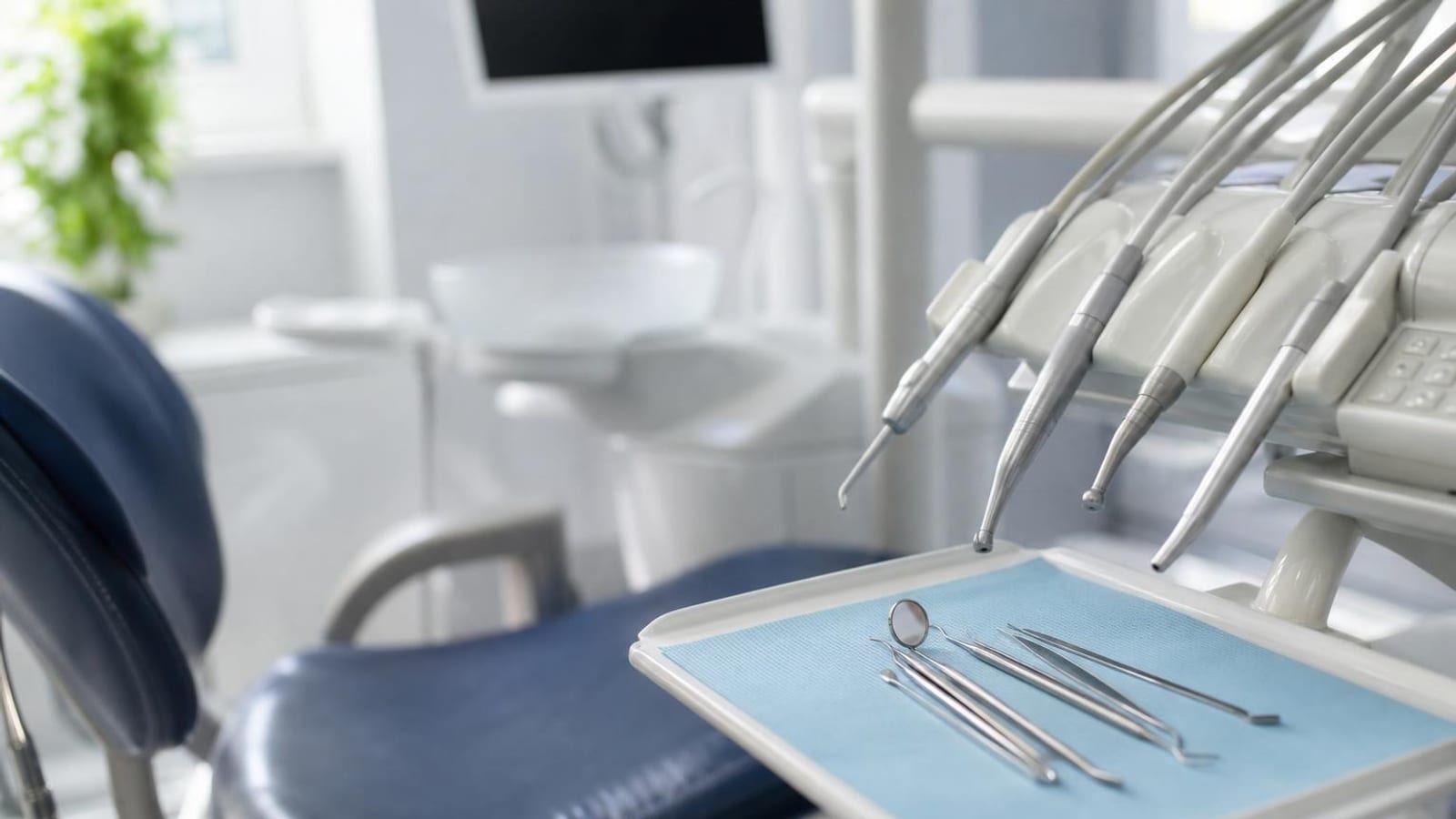
You've probably had this done a hundred times without noticing it was a screening. A good oral cancer exam takes about two minutes and uses no equipment beyond gloves, a light, a mirror and a square of gauze.
They stand behind you or beside you and run their fingers down both sides of your neck, under your jaw, and along the front of your throat, feeling for lymph nodes and anything firm that shouldn't be there. Then they look at your lips, pull your cheeks out to see the inside surfaces, tilt your head back for the soft palate and the back of the throat.
Then comes the part people remember. They wrap gauze around the tip of your tongue, pull it forward and swing it side to side so they can see the edges. They ask you to lift your tongue so they can see the floor of your mouth, and they press up under your jaw with one hand while feeling inside with the other.
That tongue-pull matters. The sides and underside of the tongue and the floor of the mouth are where a lot of oral cancers show up, and you can't see any of it with a casual glance in the bathroom mirror. If your dentist looks at your teeth for twenty minutes and never touches your neck or your tongue, you didn't get screened. You got a cavity check.
You're allowed to ask. "Did you do the oral cancer screening today?" is a normal question and any decent hygienist or dentist will answer it in one sentence and probably do it right then.
Some offices run a fluorescent light device over your mouth as an add-on, sometimes for an extra fee. The case for those isn't settled, and none of them replaces eyes and fingers. Don't skip the exam because the office doesn't have the gadget, and don't assume the gadget means the exam happened.
The self-check that takes one minute
Do this once a month. Bathroom, good light, clean hands, a paper towel for grip.
- Lips. Pull the top and bottom out. Look at the inside and the border where the lip color meets skin, especially the lower lip.
- Cheeks. Hook a finger in and pull each one out. You're looking for white patches, red patches, or a sore that keeps showing up in the same spot.
- Tongue. Stick it out, grab the tip with the paper towel, pull it gently to each side. Look at the edges. Then lift it and look underneath and at the floor of the mouth.
- Roof and throat. Head back, say "ahh," look at the soft palate and the tonsil area for anything lopsided.
- Neck. Fingertips flat, walk down both sides from behind the ear to the collarbone, then under the jaw. You're feeling for a lump that's firm, doesn't move much and doesn't hurt.
Red patches worry doctors more than white ones, which surprises people. A velvety red spot that won't rub off and won't heal deserves attention faster than a white one, though both get reported.
The signs that aren't in your mouth at all
Throat cancers in particular tend to announce themselves somewhere else, which is why they get caught late.
A painless lump in the neck that's been there three weeks. One-sided ear pain when your ear itself is fine and the doctor sees nothing wrong in it. A sore throat that's only on one side and won't quit. Hoarseness lasting more than three weeks in a guy who hasn't been shouting at a ball game. Trouble swallowing, or the feeling that food catches in the same spot every time. A tooth that suddenly goes loose with no injury. Numbness in the lip, chin or tongue. Bleeding in the mouth you can't explain.
Contrast that with the ordinary version. Swollen nodes from a cold hurt, come with a fever or a stuffed head, show up on both sides and shrink within a week or two. Pain plus a cold usually means your body's doing its job. Painless, firm and persistent is the pattern to report.
Who's getting these now
The old picture was a man in his sixties with a long history of cigarettes and heavy drinking, and that risk is still real. Chewing tobacco and dip hit the gum and cheek lining directly. Cigars and pipes count. Alcohol and tobacco together are worse than either one alone.
But the fastest-growing group is different. HPV-related cancers of the tonsil and base of the tongue have been rising for years, they show up in men more than women, and plenty of those men never smoked and barely drink. They're in their fifties, they lift three days a week, and they found a neck lump. The HPV vaccine is approved in the US for adults through age 45, and whether it makes sense for you is a conversation with your doctor, not a decision to make off an article.
One more, for anybody who works outside. Lip cancer loves sun exposure, and the lower lip takes the hit. A lip balm with SPF in the truck console costs a couple of dollars and takes two seconds. Pick one with zinc oxide. Mineral filters sit on the skin, cover both UVA and UVB, and go easier on lips that are already chapped and cracked.
What happens after you report it
Your dentist or doctor looks, and if the spot is suspicious you get sent to an oral surgeon or an ENT. The answer comes from a biopsy. Nothing else is an answer.
Push back politely on "let's watch it for three months" if the thing has already been there a month. A two-week recheck is reasonable. A whole season isn't, and you're allowed to say so or get a second opinion.
If it turns out to be something, ask about treatment timing early, because radiation to the mouth and throat changes eating and swallowing for a stretch, and a dentist should see you before treatment starts, not after.
You don't have to stop training
This is where guys either overreact or disappear. If you're in a workup or in treatment, the goal isn't your old program. Sustainable beats optimal, always, and it beats it by a mile when you're tired and stressed and still driving somebody to practice on Tuesday.
Two full-body sessions a week, something like six or eight working sets each, keeps most of what you've built. Walking every day does more for appetite, sleep and mood than any workout you'll skip out of guilt. If swallowing gets hard, calories come from whatever goes down: whole milk, smoothies, eggs, soup. Protein first, vanity second. Ask your care team what to lift and when, especially after surgery.
And show up to the dentist twice a year, which is the entire point of everything above. If you're paying cash, call and ask for the price of an exam and cleaning before you book. It's a smaller number than most men assume, and it buys you a set of trained fingers on your neck.
The sore doesn't care how busy your March is. It's gone in two weeks, or it's a phone call.
This is general information, not medical advice. Anything you find in your own mouth or neck goes to your dentist or doctor.
Cal Brennan
Fitness
Strength coach. Trains fathers, tradesmen and desk workers, which means programs that survive a bad week.

Watch
Watch how it's done
Picked for this article.
From channels we rate. Plays on YouTube.
MouthCancerFoundation
Self Examination For Mouth Cancer (Full) #MC7
My Dental Key
Learn the Oral Self Examination/ Oral Cancer Screening | My Dental Key
Read next