
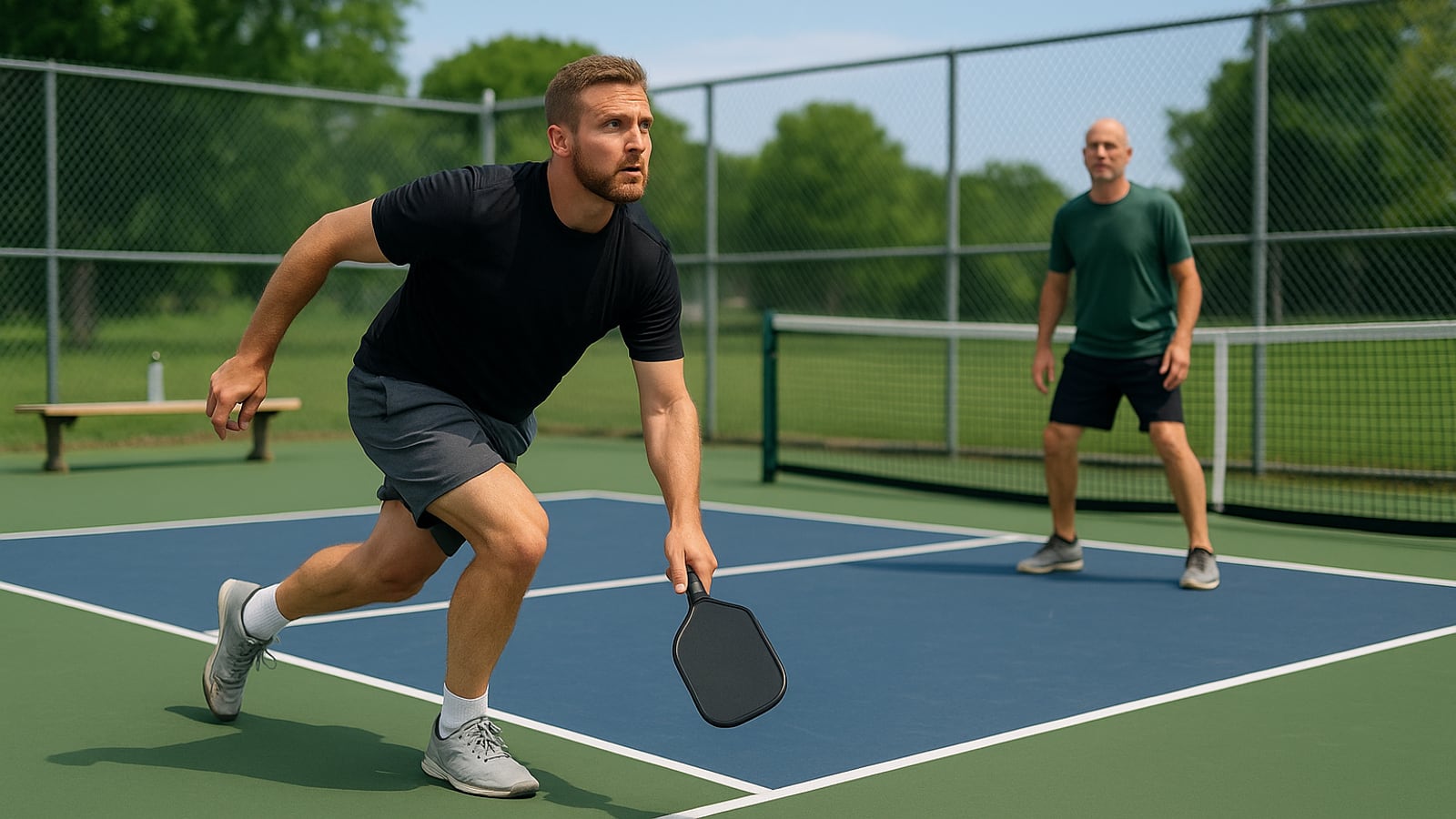
Quick answer: Most pickleball injuries come from cold calves, the wrong shoes and backpedaling after a lob. Warm up for eight minutes, wear court shoes, and never run backward. Turn and go, or let the ball go.
Saturday, 8:05 a.m. You park, leave the coffee in the cupholder, and you're on the court by 8:07 because the kids have soccer at ten and you've got maybe ninety minutes. Second game, your opponent floats a lob over your head. You shuffle backward three steps, your heel catches, and you put a hand down behind you to break the fall.
That's the most common way a grown adult ends up in a wrist splint from a game played with a Wiffle ball.
Pickleball looks gentle. It's a 20-by-44-foot court and a plastic ball. But it's full of short, sharp stops, lunges and lateral pushes, and a lot of the people playing it haven't sprinted since high school. The injuries aren't random. They cluster in three places, and each one has a cause you can do something about.
The wrist: it's a falling injury, not a swinging one
People assume the wrist gets hurt from the paddle. Sometimes it does. Overuse soreness on the outside of the forearm and elbow is real, especially if you grip the paddle like it owes you money.
But the serious wrist injury is a fracture from falling on an outstretched hand. And the fall almost always comes from moving backward. Your feet can't see where they're going, your weight is on your heels, and when you tip, your hand goes down behind you on reflex. The whole weight of your body lands on the small bones of the wrist.
The fix is a rule, not an exercise:
- Never backpedal. If the lob is going over you, turn your hips and run at an angle to get behind it, the way an outfielder does.
- If you can't get there going forward, let it go. One point isn't worth six weeks in a cast.
- Loosen your grip. On a scale of one to ten, hold the paddle around a four. A death grip loads the forearm on every shot.
Somebody sensible will say that letting lobs go makes you easy to beat. Fair. At a competitive level you'll need to learn to track them down. Learn to do it turning and running, and practice it on purpose before you need it in a game.
One more thing about wrist falls. If you land on your hand and there's pain at the base of your thumb, on the side where a small hollow forms when you give a thumbs-up, get it looked at even if it seems minor. Some wrist fractures don't show up as dramatic swelling and are easy to write off as a sprain. A doctor or urgent care can tell you whether you need an X-ray.
The ankle: shoes and stray balls
Ankle sprains come from quick lateral moves at the kitchen line, and from stepping on a ball.
The shoe problem first. Running shoes are built to go forward. They have tall, soft heels and not much support along the sides. Plant hard sideways in one and your foot can roll right over the edge of the sole. A court shoe, the kind made for tennis or pickleball, sits lower, has a wider, flatter base and a firmer side wall. That's the whole difference and it matters. ASICS and K-Swiss both make pickleball versions of their tennis shoes. Buy whatever court shoe fits your foot well. The category matters more than the brand.
The ball problem is simpler. A ball from the next court rolls into yours mid-point. You're watching the play, not your feet. You step on it and your ankle rolls. The rule in every decent game is that anyone who sees a loose ball calls it, and play stops. Say it out loud. Nobody will think you're being fussy, and the guy who just avoided a sprain will buy you a coffee.
The Achilles: the one that takes a year
This is the injury to take seriously, because it's the one that can end a season and a lot more. Achilles ruptures tend to happen to people in middle age who are active on weekends and sitting the rest of the week. It usually happens on a sudden push-off, like lunging for a drop shot or exploding forward from a standstill.
People who've had one often say it felt like someone kicked them in the back of the leg. They turn around and nobody's there.
Two things set it up. First, a cold calf. You walked from the parking lot straight into a forward lunge. Second, a calf and tendon that have spent five days a week shortened under a desk. If you sit all day, the damage from ten years at a desk doesn't stop at your back. Tight hips and tight calves come along for the ride.
Warning signs to respect: tightness or aching at the back of the heel that shows up during play or the next morning, or a calf that feels "grabby" on push-off. That's the time to stop for the day, not to play through it. If you ever feel that sudden kick-in-the-leg sensation and can't push up onto your toes, stop immediately and get seen by a doctor promptly. Don't walk it off. How it's treated, and how fast, makes a difference, and that's a call for an orthopedic doctor, not the guy on the next court.
The eight-minute warm-up
This is the part people skip, and it's the part that does the work. It doesn't need a mat. Do it at the fence while your partner's still parking.
Minute 1–2: get warm. Brisk walk around the court, then march in place with high knees. You want to be mildly out of breath, not tired.
Minute 3: ankles and calves.
- 10 ankle circles each direction, each foot.
- 15 slow calf raises on both feet. Up in one second, down in three.
- 8 on each foot alone, same slow lowering. The slow lowering is the point. It loads the Achilles gently before you ask it for anything sudden.
Minute 4: hips.
- 10 leg swings forward and back, each leg, holding the fence.
- 10 side to side, each leg.
Minute 5: move sideways.
- Two lengths of the baseline in a side shuffle, each direction.
- Two lengths of carioca, the crossover step, if your coordination allows it. If it doesn't, more shuffling.
- Ten split steps, the little hop and land you do as your opponent hits. Land soft, knees bent.
Minute 6: wrists and shoulders.
- 10 wrist circles each direction.
- 10 big arm circles forward, 10 back.
Minute 7–8: warm up the game, in order. Start with dinks at the kitchen. Then back up to mid-court for easy drives. Then a few overheads at half speed. Finally, have your partner feed you three or four gentle lobs, and practice turning and running for them. Last step: rehearse the exact movement most likely to hurt you, at low speed, before it counts.
That's it. It feels like a lot the first time. By the third Saturday it's automatic.
During and after
Sit out a game every hour or so. Open play can run for two hours straight if you let it. The hardest lunge you'll make all morning is usually late, when your legs are tired and your form has gone sloppy.
Hydrate before you're thirsty, especially on summer courts. Cramping calves and tight tendons don't mix well.
At home, twice a week: the slow calf raises from the warm-up, done off the edge of a stair, three sets of fifteen, lowering all the way down. Five minutes. It builds a calf and tendon that can take a sudden load. Add a few sets of wrist curls with a light dumbbell or a soup can for the forearms.
Sleep counts too. Soft tissue repairs overnight, and if Friday was a short night, Saturday's lunge is riskier. There's a reason eight hours in bed doesn't always feel like eight hours of sleep, and it's worth fixing if you want your body to keep up with your weekend.
The shot you don't take
The players who are still out there at seventy aren't the ones who dove for everything at forty-five. They're the ones who warmed up, wore the right shoes, and let a few lobs sail over their heads without a second look.
You've got kids who need a parent who can drive them to practice, carry the groceries and chase them across the backyard. Weekend pickleball should add to that, not take it away for six weeks.
Let the lob go. Win the next point.
This is general information, not medical advice. For pain that doesn't settle, or any injury you're unsure about, see your doctor or a physical therapist.
Cal Brennan
Fitness
Strength coach. Trains fathers, tradesmen and desk workers, which means programmes that survive a bad week.

Watch
Worth an hour of your evening
More from Fitness.
From channels we rate. Plays on YouTube.
Read next