What ten years at a desk did to your posture, and how to undo it
Posture isn't a shape you hold. It's capacity you build. Eight minutes twice a day and two strength sessions a week will do more than any brace.
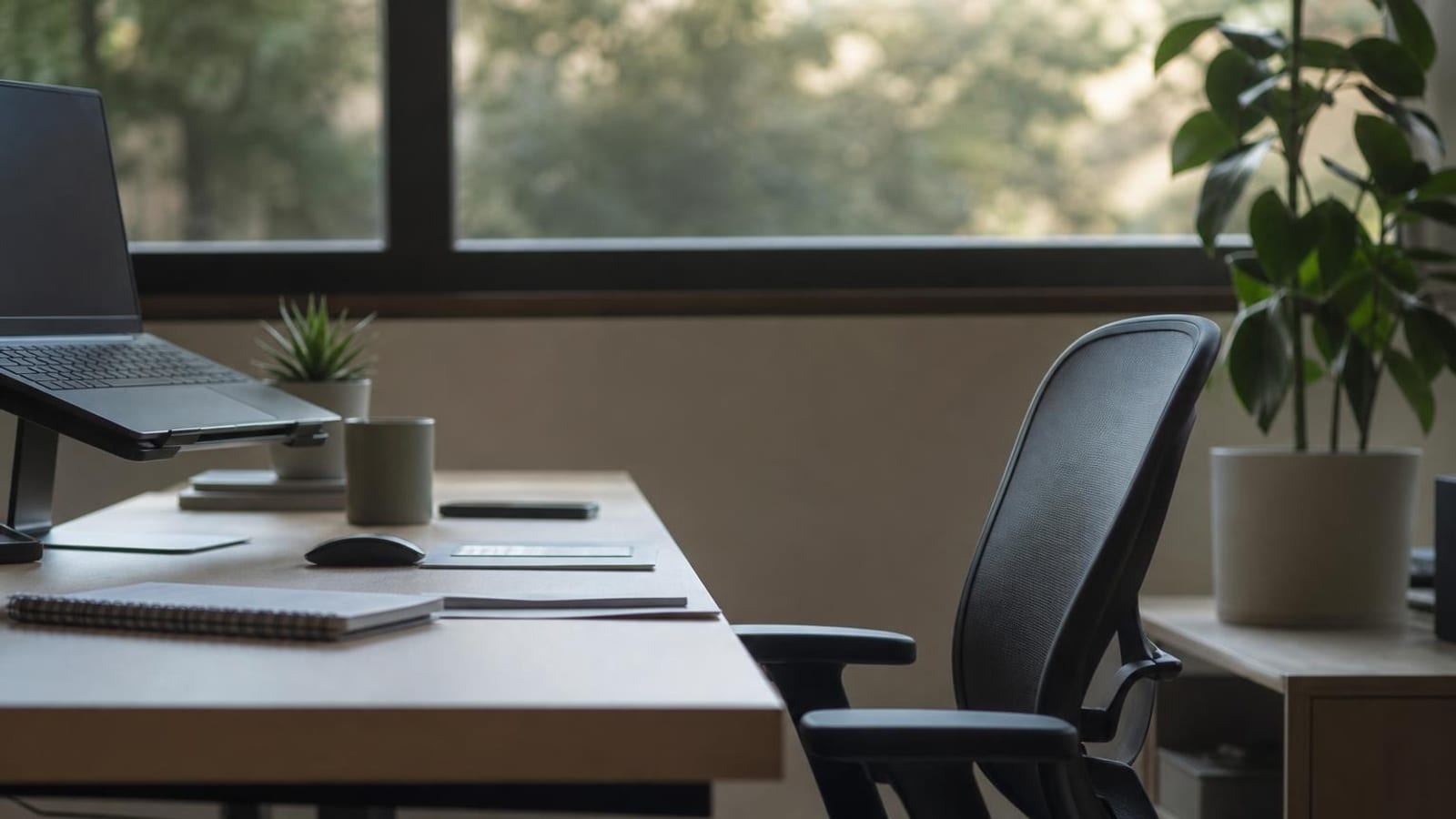
Stop trying to sit up straight. It doesn't work, it never worked, and it's the reason most people give up on this within a fortnight.
Posture isn't a position you hold with willpower. It's the range of positions your body can get into comfortably, and the strength to hold them without thinking about it. Ten years at a desk didn't give you bad posture. It gave you a narrow menu. Your body got very good at one shape and lost access to the others.
So the work isn't holding still better. It's widening the menu, then loading the new range so it sticks.
What actually changed
Sitting for a decade does a handful of predictable things, and they compound.
Your hip flexors spent 40,000 hours in a shortened position. They're not "tight" in a mystical sense. They've just adapted to the length you use, and when you stand up they pull your pelvis forward, which your lower back absorbs.
Your glutes stopped doing their job. You sat on them. They don't switch off permanently, but they stop being your default hip extensor, and your hamstrings and lower back pick up the slack.
Your mid-back, the thoracic spine, stiffened in a rounded position. Twelve vertebrae that are supposed to extend and rotate now mostly do neither. That's the one that matters most for how you look and feel, because when the mid-back can't extend, the shoulders can't sit back and the neck has to poke forward to get your eyes level.
Your shoulders rolled in, because a keyboard and a mouse keep your arms out in front of you all day and you almost never pull anything toward you.
Your neck learned to carry your head an inch or two in front of your shoulders. That's a surprising amount of extra load on a small set of muscles, for eight hours, for years.
None of this is damage. It's adaptation. Which is good news, because adaptation runs in both directions.
The stuff that doesn't work
Posture braces. They hold you in a shape without building anything. Take it off and you're back where you started, only now the muscles have had a rest they didn't need.
One long stretching session at the weekend. Ninety minutes on Sunday against fifty hours of sitting isn't a fair fight. Frequency beats duration here, badly.
Stretching alone. You can absolutely get more range with stretching. You will lose it again within days if you don't do anything strong in that new range. Stretch to open the door, then load it so the door stays open.
Buying a standing desk and standing all day. Standing for eight hours swaps back stiffness for foot, calf and knee complaints. Alternating is the whole point. If you get a sit-stand desk, actually change position every 45 minutes or so.
Eight minutes, twice a day
This is the part that works, and it's small enough that you'll keep doing it. One round in the morning, one when you get home. It doesn't need a mat, kit, or good intentions.
Thoracic extension over something firm. A foam roller across the mid-back, or the edge of a hard-backed chair. Support your head with your hands, ribs down, and let the mid-back drape backwards over the support. Breathe out fully at the end of the range. Five or six slow breaths, then move the roller an inch and repeat. Two or three positions. Don't do this in the lower back, you'll just hinge where you already hinge.
Half-kneeling hip flexor stretch, done properly. Back knee down, front foot forward. Now squeeze the glute on the back leg and tuck your tail under before you move forward at all. Ribs stay down. If you feel it in your lower back, you've arched instead of stretched. Thirty to forty-five seconds per side. Most people do this wrong for years and wonder why nothing changes.
Wall slides or a band pull-apart. Twelve to fifte reps, slow, with the shoulder blades doing the work rather than the arms. This is the counterweight to eight hours of reaching forward.
Chin nods. Lie on your back or stand against a wall. Gently draw your chin back and slightly down, as if creating a double chin, without tilting your whole head. Hold five seconds, ten reps. It's unglamorous and it's the single best thing for a neck that's been leading the way for a decade.
Calf and ankle. Toes on a step, heel dropped, thirty seconds each side. Stiff ankles change how you stand and how you squat, and almost nobody connects the two.
That's it. Eight minutes. Some days you'll do four minutes. Four minutes done daily still beats forty minutes done monthly.
Two strength sessions that lock it in
Mobility opens the range. Strength is what tells your nervous system to keep it. You don't need a bodybuilding program. You need two sessions a week, 35 to 40 minutes each, built around four things.
A hip hinge. Romanian deadlifts, hip thrusts, or kettlebell deadlifts. This teaches the glutes to extend the hip again and gives the hamstrings length under load, which is worth more than any hamstring stretch.
A single-leg squat pattern. Split squats or step-ups. Sitting makes you symmetrical in a bad way, and single-leg work exposes and fixes the side that's been coasting.
Rowing, more than pressing. Two pulls for every push. Dumbbell rows, cable rows, face pulls, chin-ups if you have them. If you only change one thing in your training, change this ratio.
A carry or an overhead press. Loaded carries teach the trunk to hold a tall position without you thinking about it. That's the actual definition of good posture.
Twice a week, for months, is the dose. Not six weeks. This is a ten-year adaptation you're reversing.
The desk itself
Fix the environment or you'll spend the rest of your life fighting it.
- Top of the monitor roughly at eye level, screen about an arm's length away. A laptop on a desk guarantees a forward neck. Raise it and use a separate keyboard.
- Elbows at roughly ninety degrees, forearms supported, shoulders down.
- Feet flat. If they dangle, get a footrest or lower the chair and raise the screen.
- Phone calls standing or walking. That's twenty minutes of position change most people already have available.
- A ten-minute walk after lunch. It resets everything the morning did.
What to expect, and when to get help
Stiffness usually eases within two or three weeks. Strength changes take two or three months. Looking different in photographs takes longer than that and shouldn't be the goal anyway. The goal is standing up from your desk at 6pm without doing the noise.
Get assessed by a physiotherapist or your doctor rather than working through a routine if you have pain radiating down an arm or leg, numbness or tingling, pain that wakes you at night, or symptoms that haven't shifted at all after six weeks of consistent work. Those are worth a proper look from someone who can put hands on you.
The other thing that helps, and nobody puts it in a program, is getting on the floor with your kids. Kneeling, squatting, sitting cross-legged, standing up with a four-year-old attached to your leg. Every one of those is a position your body has forgotten. Two years of that beats two years of a gym membership you use in March.
You spent a decade training for one chair. Give it a season of training for everything else.
Cal Brennan
Fitness
Strength coach. Trains fathers, tradesmen and desk workers, which means programs that survive a bad week.

Watch
Worth an hour of your evening
More from Fitness.
From channels we rate. Plays on YouTube.
Read next