Your Pond Problem Probably Isn't the Fish
Weeds, muddy water and stunted bluegill all trace back to the same few things, and most of them you can fix in a weekend.
Most ponds I've walked up to with a landowner get introduced the same way: "It's full of algae and there's nothing in there but little bluegill." Then he asks what to stock. Wrong question. Stocking a sick pond is like putting new tires on a truck with a bent frame.
Start with the bottom, the depth and the water that runs into it. Everything else follows.
Know what you actually own
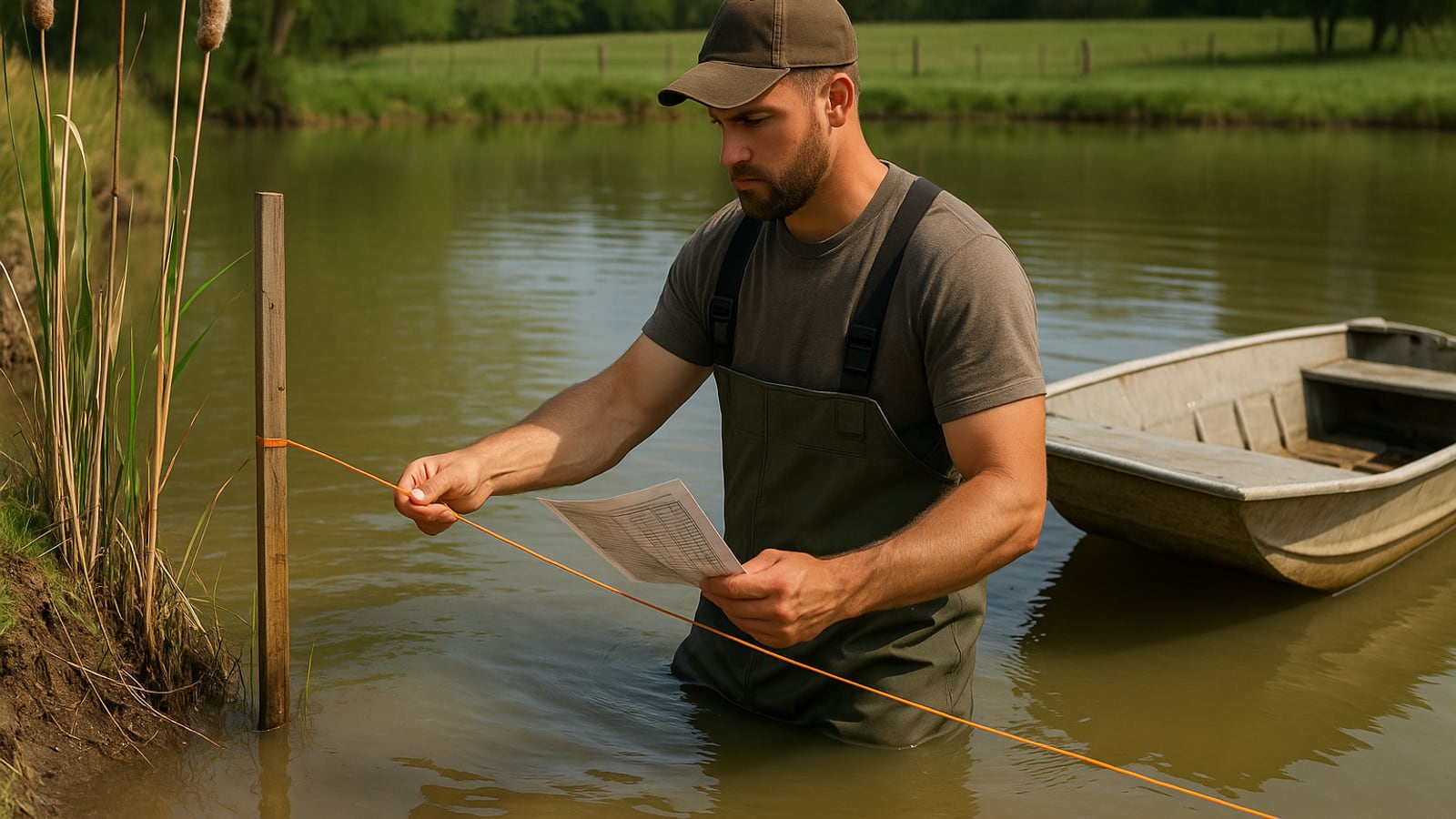
Walk the shoreline with a rope, a weight and a tape. Take depth readings on a grid from a boat or a kayak. You want to know two things: how deep the deepest hole is, and how much of the pond is under three feet.
Under three feet, sunlight reaches bottom and plants grow. If half your pond is two feet deep, you don't have a weed problem, you have a shape problem. No chemical fixes that permanently. A pond that's mostly eight to twelve feet with a steep drop at the bank grows far fewer weeds because the light never reaches the mud.
Now look uphill. The watershed feeding the pond should be roughly ten to twenty acres of drainage per surface acre of water in most of the country, less where it rains hard. Too small and the pond drops every August. Too big, and every storm dumps sediment, cow manure and lawn fertilizer straight into your fishery. That runoff is the single most common reason a pond turns pea-green every June.
If the water coming in crosses a pasture, a feedlot or a fertilized hayfield, fixing that path does more than any product you can buy. A grass buffer thirty feet wide, a small sediment trap above the inlet, fencing the cattle out and giving them a tank instead. Boring work. It's the work that lasts.
Identify the plant before you kill anything
People spray first and read later. Then they wonder why nothing died.
Filamentous algae is the green cotton candy that floats up in mats. It's not a plant with roots. Copper-based algaecides work on it.
Duckweed and watermeal are the tiny green flakes that cover the surface like spilled paint. Watermeal is the size of a grain of sand and it's the worst thing in this article. It laughs at most treatments and it comes back on duck feet.
Pondweed, coontail, naiad are rooted or suspended submerged plants. They need a systemic or contact aquatic herbicide, and the label tells you which one.
Cattails and willows are shoreline plants and get treated completely differently, usually with an aquatic-labeled glyphosate and a surfactant, late summer when they're pushing energy into the roots.
Take a photo, take a sample in a Ziploc, call your county extension office or your state's fisheries biologist. That call is free in most states and it's better advice than anything on the label of a jug at the farm store.
And read the water use restrictions. Some aquatic herbicides put your irrigation, your livestock water or your swimming off-limits for days.
Never nuke the whole pond at once
This is the mistake that kills fish.
A pond full of vegetation is a pond full of dissolved oxygen production. Kill all of it on a ninety-degree afternoon and two things happen. The oxygen source stops, and the decaying plant matter consumes what's left. Forty-eight hours later you're picking up dead bass.
Treat a third of the surface at a time. Wait ten to fourteen days between sections. Start in late spring when the water's still cool and the plant mass is small, not in August when the pond's wall to wall salad and you've finally had enough.
If you're treating in hot weather anyway, run aeration during and after. Which brings me to the thing most ponds are missing.
Aeration, and how to not kill everything with it
A bottom diffuser beats a surface fountain for anything over six feet deep. The fountain is pretty. The diffuser sits on the bottom, pushes a column of bubbles up, and circulates the whole water body, which breaks up stratification and lets bacteria work on the muck layer. Expect to spend four figures for a decent compressor, weighted line and diffuser plates on a one-acre pond, plus a place to put the pump that's dry, shaded and close to power.
The warning: don't fire up a new bottom diffuser in mid-summer and walk away. A stratified pond has a cold, oxygen-dead layer on the bottom. Mix that into the good water all at once and you've suffocated your fish with your own money. Start it in cool weather, or run it an hour a day and add an hour a day for two weeks.
Clear water is the wrong goal
Everybody says they want water you can see the bottom through. Gin-clear water grows weeds, because light reaches the mud, and it grows small fish, because there's nothing at the base of the food chain.
What you want is a light plankton bloom. Green, slightly cloudy, roughly eighteen to twenty-four inches of visibility. Drop a white disk on a string and measure it. If you can see the disk at four feet, sunlight is feeding your weeds instead of your bluegill.
Muddy water is a different animal. If it stays chocolate for weeks after a rain, you've got suspended clay that won't settle. Cattle in the water, wind fetch on a bare bank, or a stocked population of common carp rooting the bottom are the usual culprits. Fix the cause. Gypsum or ag lime can help clay settle, but it's a bandage if the cows are still standing in it.
Now the fish
For a warm-water pond in most of the country, the bones of it are bluegill and largemouth bass, with channel cats optional and never, ever crappie in a small pond. Crappie overpopulate and stunt in anything under twenty acres.
Stock forage first. Bluegill and fathead minnows in fall, bass the following spring or fall, so the bluegill get a spawn in before the predators show up. Common guidance runs around 500 bluegill per acre to 50 or 100 bass. Your state biologist will give you numbers for your region and your fertility.
Then the part nobody does: harvest.
An unfished pond goes one of two ways. Either it's bass-crowded, meaning skinny twelve-inch bass everywhere and big fat bluegill, or it's bluegill-crowded, meaning a few giant bass and thousands of four-inch bluegill nobody wants to clean.
If it's bass-crowded, keep the small bass. Take them home. Eat them. Releasing every bass you catch is how you got here. If it's bluegill-crowded, protect the bass, quit keeping them, and hammer the bluegill.
Weigh and measure what you catch for a season and the pond tells you which problem you have.
Grass carp are a tool, not a solution
Triploid grass carp are sterile and legal in many states with a permit. Check first, because in some states they're outright banned and the fine isn't small.
They eat soft submerged plants. They largely ignore filamentous algae, duckweed and cattails, which is exactly what most people buy them for. Stock five to ten per acre and understand they live a decade or more and they never stop eating. Overstock and you'll have a moonscape with no cover for young fish, which quietly wrecks the fishery three years later.
The stuff that pays off slowly
Sink brush piles and cedar trees in eight feet of water, anchored with cinder blocks. Dump a couple of pickup loads of pea gravel on a hard shoreline point for bluegill beds. Leave a strip of unmowed grass around the bank. Keep the spillway clear so a gully-washer doesn't take the dam with it.
A pond rewards patience the way a woodlot does. You won't see this year's work until three summers from now, when your kid sets the hook on a bluegill wide enough to need two hands.
Wes Dunbar
Country & Skills
Grew up on an acreage and never quite left. Covers trucks, trades, land, and how to do the thing yourself.

Read next