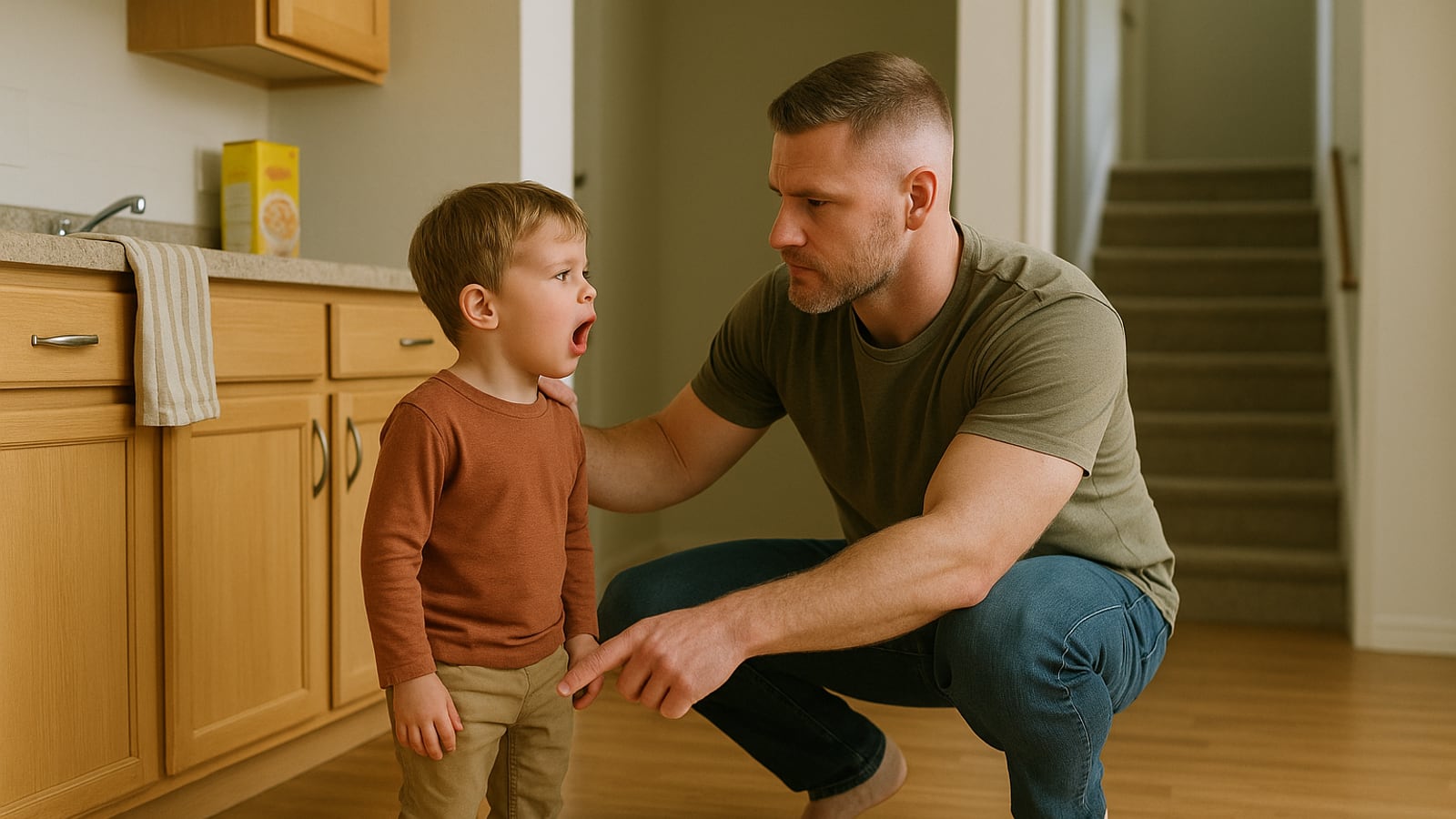
Half five, the kitchen, and the four-year-old has thrown a beaker across the floor because the milk went in the blue cup and he wanted the green one. You've been home eleven minutes. What you do in the next thirty seconds matters far less than whether you'll do exactly the same thing on Thursday.
That's the whole business, and it's deeply unglamorous. Discipline isn't a moment. It's a pattern your kids can predict, and the only thing that makes it work is that you can keep it up on a bad day.
Certainty beats severity
Children are superb odds-readers. They don't consciously calculate, but they learn fast whether a rule is real or whether it depends on your mood, the audience, and how much of the match is left.
A small consequence that lands nine times out of ten teaches more than a huge one that lands twice out of ten. The huge one is a lottery, and a lottery is worth playing.
So choose consequences you can actually deliver while tired, ill, in a supermarket car park, or standing in front of your mother-in-law. "No screens for a week" is a sentence you won't serve. By Wednesday you'll want the peace and you'll fold, and the folding is the lesson.
Things you can deliver: three minutes on the bottom stair. The toy goes on top of the fridge until tomorrow morning. We leave the park now, this minute, mid-slide. The tablet is mine for the rest of today. Each one is small. Each one is survivable for you, which is the point.
Shorten the gap
For anyone under about seven, the consequence has to arrive close enough to the behavior that the two are still holding hands. Minutes, not hours. "Wait till your father gets home" is the worst discipline system ever devised, partly because it outsources your wife's authority and partly because by six o'clock the crime is ancient history and all that's left is a frightened kid and a man who has to perform anger he no longer feels.
If you weren't there, you weren't there. Back your wife's call, don't re-run the trial.
Say it once
Most of us hand out warnings we then extend. "Last time." "I'm not telling you again." "Right, that's it." Four rounds later, something finally happens.
You've just taught the number four. They'll take the first three every time, because the first three are free.
Say the thing once, plainly, at normal volume, with what happens next attached. "Boots off the sofa, or the sofa's out of bounds for the rest of the evening." Then count to five in your own head and act. No second speech. No explaining the reasoning while you act, either. The reasoning is for calm times, and calm times are when the real teaching happens anyway.
Most of it is decided before anything starts
Sit down and work out the two or three windows when your house goes wrong. In most families it's the hour before dinner, the ten minutes before leaving the house, and bedtime. Not much else is genuinely random.
Then attack the window, not the child. Feed them something at five. Put shoes and bags by the door the night before. Give a five-minute warning before you turn off the television, and stick to five minutes, because a "five minutes" that means ninety seconds is a lie they'll notice.
Before you go into the shop, in the car park, say the whole thing out loud: we're getting four things, you're carrying the bread, there's nothing from the checkout, and if you help we'll walk the long way home past the diggers. Half of that's a deal. Fine. Deals are legitimate. Bribery is what you offer mid-meltdown to make it stop, and that's the one that teaches the meltdown.
On smacking
Leave the law to one side for a second, though you should know it: in Scotland and Wales any physical punishment of a child is a criminal assault, and the rules elsewhere in the UK are narrower than most fathers assume.
The practical case is this. Smacking asks you to use physical force at the precise moment your self-control is lowest, which is a system with no margin in it. It also has no upward path. What stops a four-year-old doesn't register on a nine-year-old, so it has to get harder to keep working, and there's no sensible place for that to end. And it ends the lesson early. The child spends the next few minutes processing the sting and your face, not the thing he did.
Plenty of good men were smacked as boys and are fine, and your father probably wasn't a monster. But "it didn't ruin me" is a low bar for a method, and the method has a ceiling you'll hit by about year eight.
Shouting is the same problem at a cheaper price. Volume is currency. Spend it daily and it buys nothing; keep it for the road and the hot oven and it still works.
The morning after you lose it
You will lose it. Not often, ideally, but you will.
Repair it specifically and briefly. "I shouted at you in the hall last night. That was mine, not yours. I'm sorry." Then stop. Don't perform remorse for ten minutes, because that hands a seven-year-old the job of managing your feelings, and he's got enough on.
And don't cancel the consequence out of guilt. If the bike was off-limits for the day, it stays off-limits for the day. Guilt reversals teach a simple equation: big enough scene plus sad enough dad equals rule gone.
Can't, or won't
This is where the whole approach breaks, and you need to be honest about it.
A consequence only makes sense for something the child can do and chose not to. Punishing a kid repeatedly for something he genuinely can't manage yet just grinds you both down and convinces him he's bad.
Ask one question: has he ever done this reliably, calmly, on a good day? If the answer is no, it's a skill he hasn't got, not a rule he's flouting. Sitting still through a forty-minute service, reading aloud without panic, keeping his hands to himself when overwhelmed in a crowd. Teach those at a quiet moment, in pieces, when nobody's angry.
If the same battle keeps repeating for months regardless of what you do, that's worth raising with your GP or the school SENCO rather than escalating at home.
When they get taller than you
Around thirteen the tools change. Stairs and confiscated toys give way to access, money, lifts and trust, and the whole thing runs on a relationship you have to keep in credit.
Negotiate rules on a Sunday afternoon, never at eleven at night in a doorway. Write the phone rule down, both of you, and treat it like a contract rather than a mood. Let natural consequences do work you used to do yourself: if he leaves his kit at home, he does the session without it once, and he'll never leave it again. That lesson costs you nothing and teaches more than you could.
Expect to be argued with. A teenager arguing the rule isn't the same as a teenager breaking it, and treating the two identically is how you end up with a boy who stops telling you things.
The aim was never obedience at seven. It's the nineteen-year-old who rings you at one in the morning from the side of a road, before he rings anyone else.
Cal Brennan
Fitness
Strength coach. Trains fathers, tradesmen and desk workers, which means programmes that survive a bad week.

Watch
Worth an hour of your evening
More from Dads.
From channels we rate. Plays on YouTube.
Read next