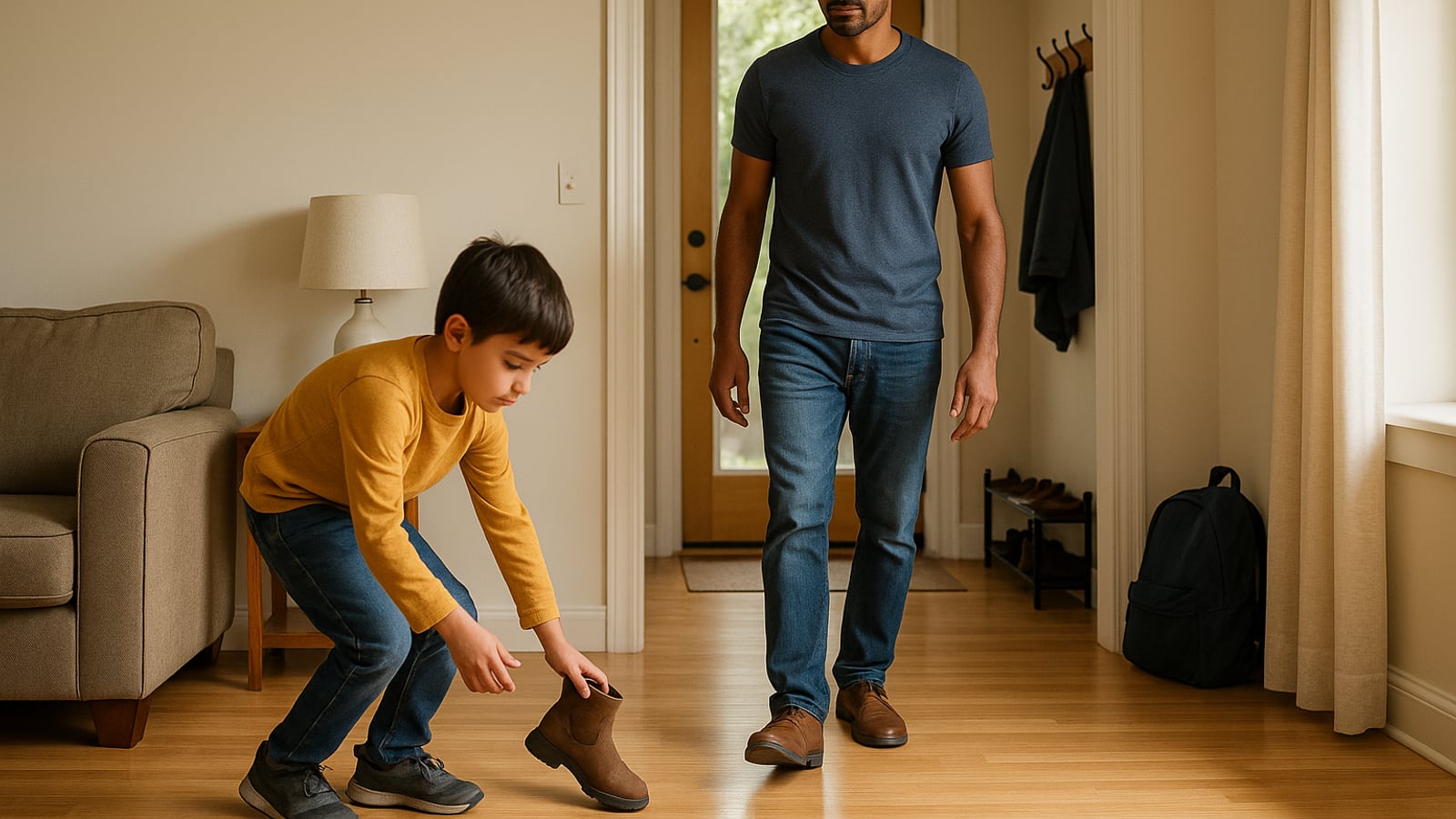
You ask your son to put his boots in the rack. He doesn't. You ask again from the kitchen, louder. Third time, you're using his middle name and the vein has arrived. By the fourth, either he moves or you've lost, and both outcomes cost you something.
The fix is four seconds of walking.
Get up. Cross the room. Stand close enough that he has to look at you. Say it once, quietly, then stay there until it's done. That's the whole technique. It works on a four-year-old and it works on a fourteen-year-old, and the reason it works has nothing to do with intimidation. It's that you've made the instruction real instead of ambient.
Kids calibrate to your follow-through rate, not your volume
Every child in your house is running a rough tally of how often Dad's words turn into events. Not consciously. But they know the number, and they know it better than you do.
If you follow through eight times in ten, they comply early, because waiting isn't worth it. If you follow through three times in ten but shout impressively on those three, they'll gamble every time. You've taught them that instructions are a lottery with good odds.
This is why escalating doesn't work and why lowering the temperature usually does. A dad who says things once and means them doesn't need to raise his voice. A dad who says things five times has to shout by the fifth, because volume is the only currency he has left.
So the practical rule: don't issue an instruction you're not willing to enforce in the next sixty seconds. If you're on a call, don't say "put your shoes away." Wait until you can get up. An unenforced instruction is worse than none, because it's a deposit into the wrong account.
What actually does damage
Not consequences. Kids handle consequences fine. Four things do the damage.
Unpredictability. The same behavior getting a laugh on Friday and a fifteen-minute lecture on Sunday. Children who can't predict you stop trying to predict you and start managing you instead. That's where the lying comes from.
Rage. Not firmness, not a raised voice once in a while. Actual loss of control, where your face changes and your child's body goes still. They remember your face. They won't remember what they did.
Humiliation. Doing it in front of his friends. Doing it in front of his younger sister so she can enjoy it. Mocking the thing he cares about. You can correct a boy hard in private and he'll be fine. Correct him in front of an audience and you've traded a behavior change for a resentment that'll still be there at twenty-five.
Withdrawal of warmth as the penalty. The silent treatment, the cold shoulder for an evening. It's effective, which is why dads reach for it, and it teaches a child that your affection is a variable rate. Take away the tablet. Don't take away yourself.
If you were raised with more physical discipline than you'd use now, you're not obliged to relitigate your own childhood to make a decision about your kids. Whatever your line is, put one thing above it: nothing you do in anger counts as discipline. It's just anger with a justification attached. The moment you notice heat in your chest, the correction has to wait.
The four consequences that actually do something
Keep the toolkit small so you can reach for it while tired.
- Removal. Out of the situation, somewhere boring, short. Rough guide: a minute a year of age, and end it when it ends, not when you feel better.
- Loss tied to the offense. He threw the controller, the console's gone for two days. He was late back, he goes nowhere tomorrow. The link has to be obvious enough that he could have predicted it.
- Repair. He broke it, he pays part of it out of pocket money. He was rude to his mother, he apologises properly, face to face, no mumbling from the doorway. This is the best one and the most underused.
- Nothing. Let the natural consequence land. He didn't pack his kit, he sits out the session. Say nothing on the drive home. The silence is doing the work.
Two things stay off the list. Don't take away something that hasn't happened yet and is three weeks out, because a child can't hold that shape and you'll end up commuting the sentence anyway. And don't add consequences while you're still cross. You'll go from a day to a week to Christmas in about forty seconds.
Get yourself under control first
You can't teach self-control while visibly not having any. Kids clock the contradiction before they can articulate it.
The pause is the skill. Ten seconds between the thing happening and you responding. Say out loud, "I need a minute," and go into another room. It looks weak. It isn't. Your children watching you leave the room rather than lose your temper is a more useful lesson than anything you'd have said in there.
If your wife is around and you're cooked, hand it over. Then back her judgement in front of the kids, even if you'd have done it differently, and take the disagreement up later with the door shut. A child who learns he can get a different answer from each of you will spend the next decade working that seam.
The version that changes with age
Under five, you're mostly managing the conditions. Most meltdowns at that age are sleep, hunger or a transition sprung without warning. A five-minute heads-up before leaving the park prevents more trouble than any consequence fixes.
Five to ten is the sweet spot for clear rules and immediate follow-through. Short sentences. One instruction at a time. No negotiating in the moment, and if the rule's wrong, change it tomorrow, calmly.
From about eleven, straight enforcement starts losing power and influence starts gaining it. You still hold lines on safety, honesty and how he speaks to his mother. But more of it has to happen in conversation, sideways, in the car, where nobody has to make eye contact. Keep issuing decrees to a fifteen-year-old and you'll win the argument and lose the access.
When you get it wrong, and you will
You'll overreact. Some Tuesday when work's gone badly you'll come down on a spilt drink like it was arson.
Go back within the hour. "I was too harsh. The drink wasn't the problem, I was in a bad mood. The rule still stands, but I shouldn't have spoken to you like that." Specific, short, no grovelling. Then move on and don't bring it up again for the rest of the evening.
Apologising doesn't cost you authority. It's the clearest demonstration available that the standards apply to you as well, which is the only reason he'll ever believe they're real.
Here's the part worth holding onto on a bad week. You're not trying to produce a child who behaves because you're in the room. You're trying to produce a twenty-five-year-old who turns up when he said he would, pays what he owes and says the hard thing to someone's face.
You'll get your first sign of it years before he's grown. He'll do the right thing when you weren't watching and won't mention it, because it didn't occur to him that it was worth mentioning.
Cal Brennan
Fitness
Strength coach. Trains fathers, tradesmen and desk workers, which means programmes that survive a bad week.

Watch
Worth an hour of your evening
More from Dads.
From channels we rate. Plays on YouTube.
Read next