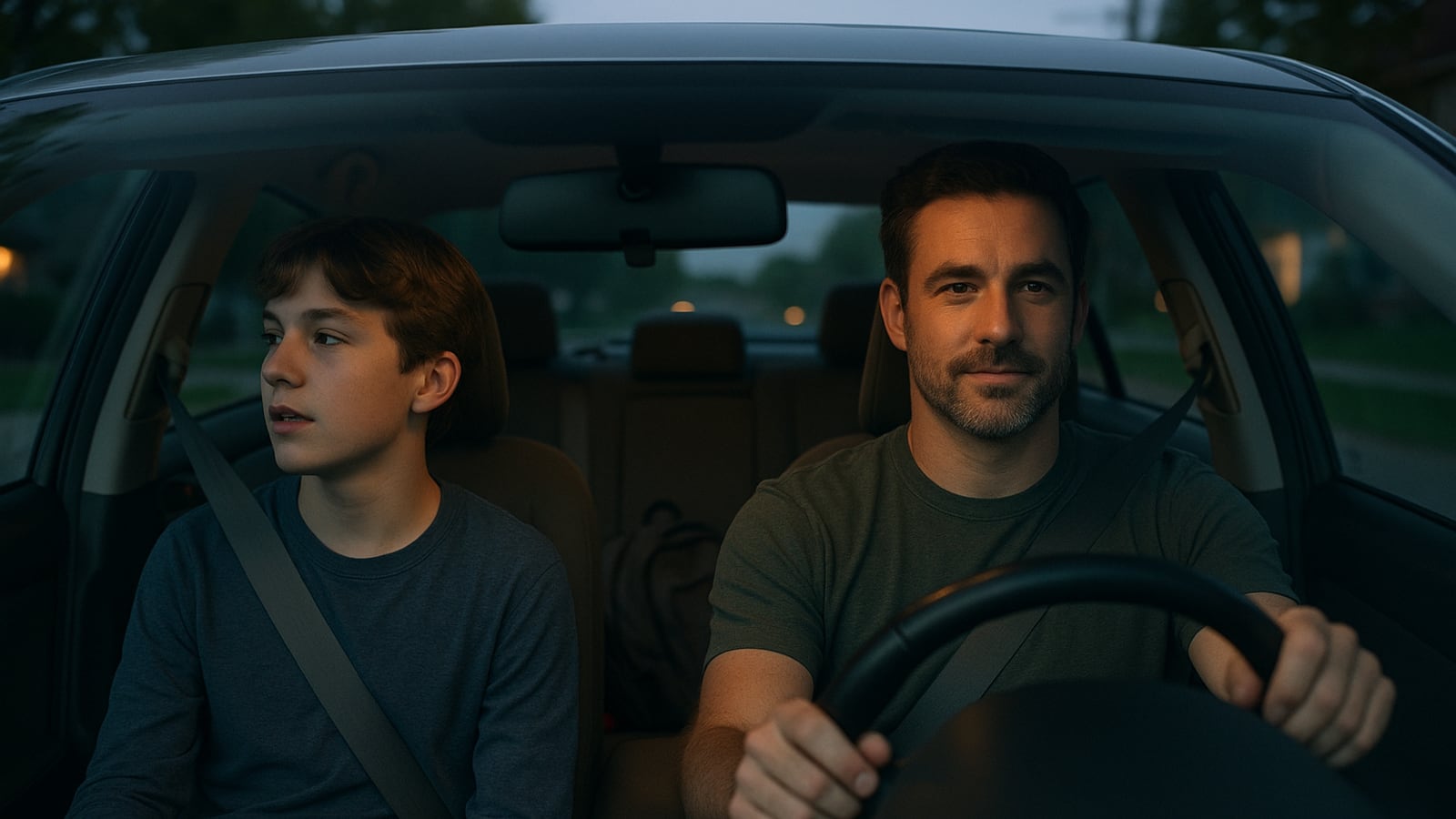
Volunteer for the school run. Take the airport pickup. Offer to drive them to practice even when their friend's mom already offered. Do this for a year and you'll know things about your kid that you would never have learned across a kitchen table.
The car works because it removes the two things that shut teenagers down: eye contact and an open-ended situation. You're both facing forward. Neither of you has to hold a gaze. The conversation has a natural end, and both of you know exactly when it comes, which means nobody feels trapped. A twenty-minute drive is a twenty-minute conversation, and your son or daughter can see the clock ticking down the whole time. That's not a limitation. That's the safety valve that makes them willing to start.
Sit a fifteen-year-old down on the sofa and say "we need to talk" and you'll get a wall. Put the same kid in the passenger seat on a dark road with the heater on and they'll tell you about the friend who's drinking, the teacher who humiliated them, the thing they're scared of in three weeks' time. Same kid. Different geometry.
Do the driving yourself
This only works if you're the one at the wheel, regularly, without it being an event.
The trap is efficiency. Carpools are efficient. Letting them get the bus is efficient. Handing them the keys the week they pass their test is efficient. Every one of those decisions is defensible on its own and the cumulative effect is that you stop being in the car with your kid.
So protect a few runs and make them yours. Morning drop-off if the timing works. The Tuesday practice. The long haul to a tournament. Pick the ones nobody else wants — the 6 a.m. and the 11 p.m. — because those are the two times of day a teenager's guard is lowest. Tired people talk.
Don't announce any of this. The moment it becomes The Special Time With Dad, it's dead.
Kill the radio, keep the phone rule simple
Music on low is fine. Music loud enough to talk over is a decision you've made not to talk.
On phones, one rule, applied to you as well: nobody's on it in the car unless there's a reason. Navigation, a text to the person we're collecting, the playlist. That's it. If you're scrolling at a red light, you've lost the argument before you started it.
Expect resistance. Expect a few drives where they put earbuds in anyway and you let it go, because fighting about it turns the car into a battleground and you need the car. Hold the rule lightly the first few months and firmly after that.
The opener matters more than you think
"How was school?" gets you "fine." It's not laziness on their part. It's an impossible question — seven hours, forty people, no idea what you actually want to know.
Ask about someone else instead. "Is Jake still doing the tryouts?" "Did that thing with the group project get sorted?" "Who's the teacher everybody hates this year?" Third-party questions let them talk without being the subject, and nine times out of ten they route back to themselves within a couple of minutes anyway.
Specific beats broad. "What did you have for lunch" is a better question than "how are you" because it's answerable, and an answered question builds momentum.
And ask for their opinion on something you genuinely don't know. A news story. Whether you should take the job. What they make of some situation at your work. Teenagers spend all day being assessed. Being consulted is rare enough that they lean in.
Learn to sit in the silence
The single most common mistake is filling the gap.
They say something half-formed. Then nothing. Five seconds pass, and it feels like thirty, and you jump in with a question or a reassurance or a story about when you were their age. And the thing they were three-quarters of the way to saying goes back down.
Count to ten in your head. Watch the road. Nine times out of ten they'll keep going, and the second half is the part that mattered.
Don't fix it
This is the discipline that takes the longest to learn, and it's the one that decides whether they come back to you.
Your kid tells you about a problem. Your instinct is to solve it, because you're a man and you've seen this problem before and you're right about what they should do. Resist. Ask "what are you thinking of doing?" and then shut up.
If you fix it, you've taught them two things: that their judgment isn't trusted, and that telling you about a problem results in losing control of it. Do that three or four times and they'll stop telling you about problems. They won't stop having them.
When they genuinely ask for your view, give it straight. When they don't, hold it. The line is usually obvious.
Never use the car as a courtroom
Consequences happen at home. Hard conversations about grades, curfew, whatever they did on Saturday night — those happen face to face, sitting down, when you've both had time to cool off.
The minute the car becomes the place where you ambush them with a grievance, they will treat every drive as a possible ambush. You'll have traded one satisfying lecture for the whole channel.
There's an exception and it's narrow. If something needs saying that's hard to say while looking at each other — an apology from you, a fear you have, something about your own father — the car is the kindest place to say it. Once. Then let it lie.
The drop-off is the part you'll get wrong
You pull up outside the school. You've had a good twenty minutes. And you can't resist one last piece of wisdom as they reach for the door handle.
Don't. The last thirty seconds is what they carry in with them. Make it light. "Good luck with the test." "See you at six." A word about the game. Send them out the door feeling fine, not summarized.
Same at the end of a long drive. Whatever was said in the dark stays in the dark. No follow-up text. No bringing it up at dinner in front of their sister. If they learn that what goes into the car stays in the car, they'll keep loading it up.
When their friends are in the back
You become furniture. Accept it.
Drive, say almost nothing, don't try to be funny, and listen. You'll get an unvarnished look at your kid's world — who has status, what they think is funny, how they talk when they think no one's parsing it. It's not eavesdropping if you're sitting right there in a car you're driving.
Don't repeat any of it back to your kid. Ever. One mocking impression of their friend's voice and you'll never hear another word.
Teaching them to drive is a different job
While they're learning, their entire brain is on the road. Don't fill the cabin with anything but instruction, calmly delivered. Save the conversation for when they park.
But the months after the test are gold. Let them drive you places. Sit in the passenger seat and ask for the route you'd never take. Being the one in charge of the vehicle changes how a seventeen-year-old talks to you, and mostly for the better.
Then they get their own car, and the runs dry up faster than you expect. Which is why you take the early ones now, while a fourteen-year-old still has no choice but to ride with you.
You've got maybe a thousand of these drives left. Most of them will be nothing. Twelve of them will be the reason your kid calls you when they're thirty.
Cal Brennan
Fitness
Strength coach. Trains fathers, tradesmen and desk workers, which means programmes that survive a bad week.

Watch
Worth an hour of your evening
More from Dads.
From channels we rate. Plays on YouTube.
Read next