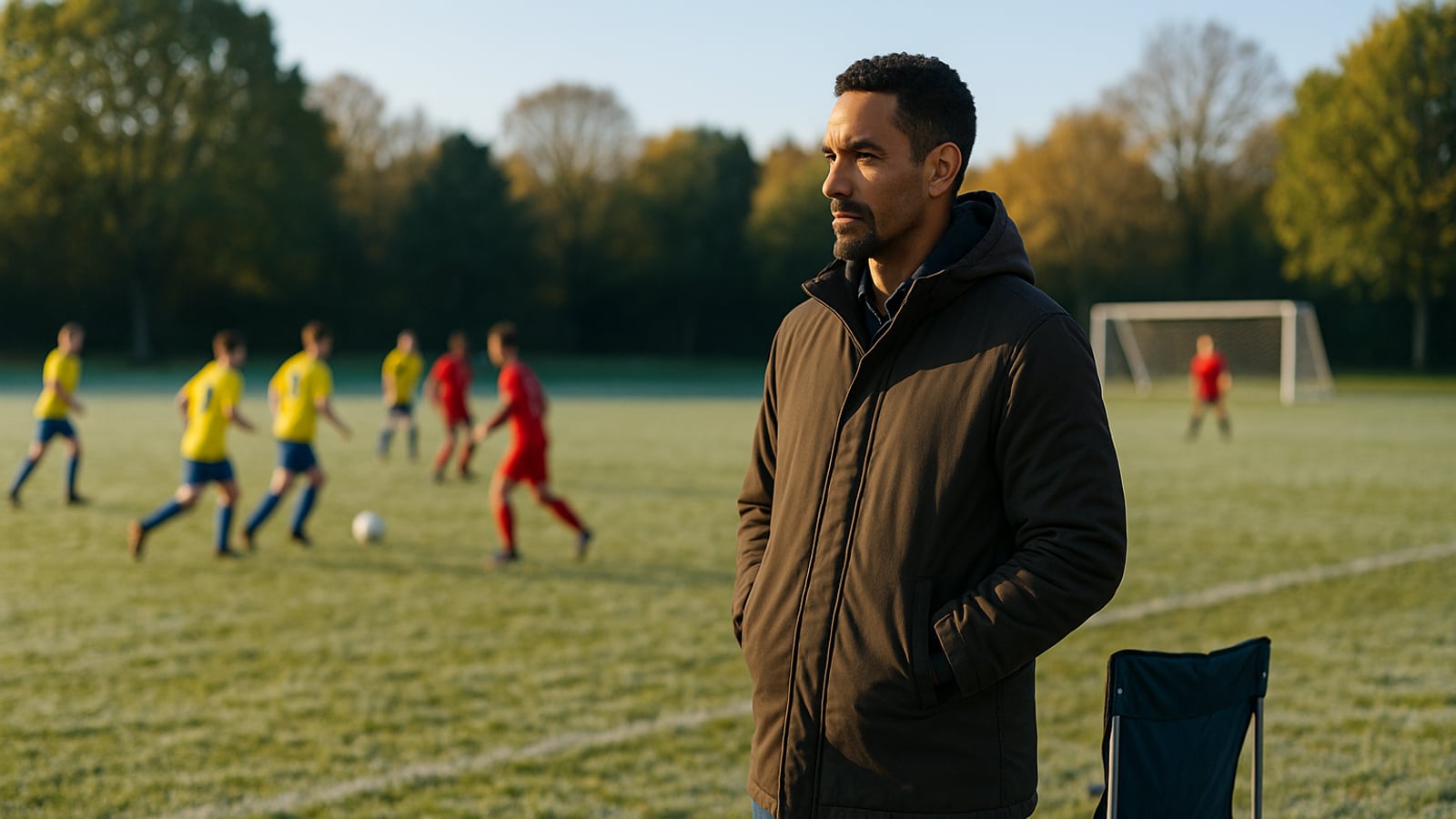
Eight forty on a Saturday, pitch two, frost still sitting on the far touchline. Under-11s. A boy gets the ball at his own corner flag with nobody near him and he does something you see at every ground in the country: he looks up at the touchline before he looks at the pitch.
That's the tell. Whose voice is he waiting for?
If it's yours, you've got a problem, and your son has a bigger one. He's playing with half his attention on a man in a coat who isn't on the pitch, can't see the angles he can see, and hasn't kicked a ball in fifteen years. He's slower because of you. Not metaphorically. Measurably slower, half a second on every touch, which at that age is the difference between a pass and a tackle.
One voice, and it isn't yours
The coach gets to talk. That's the deal. If the coach is useless, that's a conversation for Tuesday in the car park, not a running commentary you deliver over the top of him while eleven kids try to work out which adult to obey.
So what can you say? Two categories. Encouragement that isn't an instruction, and the kid's name.
"Good challenge." "Unlucky." "Well in." Nothing with a verb pointed at a decision. The second you shout "man on" you've taught him to outsource his scanning to you, and you won't be at the away game in March when he actually needs it.
The hardest version of this is when you're right. You can see the overlap. You can see the far post is empty. Swallow it. Being right from the touchline is worth nothing and costs him the habit of looking for himself.
I'll concede the exception. Some kids genuinely run hotter with noise, and some sports are built for it. If you're not sure which yours is, ask him. Not after a bad game, and not in a way that invites him to say what you want. Ask on a Wednesday. "Do you like me shouting, or do you not care, or does it do your head in?" Take the answer at face value, even the third one. Especially the third one.
The referee thing
At grassroots level the official is often a teenager three or four years older than the players, doing it for pocket money, learning on the job in front of forty adults who think they know the laws and mostly don't.
You say nothing. Not a groan, not a raised palm, not the sarcastic clap. Your son is watching how you treat a person with authority over you who has just got something wrong. That's a lesson he'll apply to teachers, to managers, and eventually to you.
There's a practical angle too. Leagues lose referees faster than they can recruit them, and the reason they give when they quit is the parents. Every game your kid plays exists because somebody agreed to stand in the cold and be shouted at. Don't be the reason there's nobody next season.
If there's a genuine safety issue, a kid going in studs-up repeatedly, that goes to your coach, who goes to the official. There's a chain. Use it.
Be the dad who knows where the kit is
Presence isn't only the ninety minutes. Most of the value you add happens before the whistle, and it's dull.
Know the kick-off time yourself instead of asking him at eight o'clock. Have the boots cleaned Friday night, not scraped in the boot of the car. Spare socks. A flask. Gloves in the bag from October, because his hands will be freezing and he won't say so.
Arrive early enough that he warms up with the team rather than jogging on at the last minute looking flustered. That one matters more than people think. The kid who's always the last to arrive starts every match slightly outside the group.
And learn the names of his teammates. All of them, including the substitute who barely plays. When you shout "well done Josh" at somebody else's child, you become part of a team rather than a man watching his own son. Josh's dad notices too.
The drive home
This is where most of the damage gets done, and it's entirely avoidable.
Say nothing for the first ten minutes. Not one word about the game. Put music on. Ask if he's hungry. Let his heart rate come down and let him have his own feelings about it before you hand him yours.
Then, if you say anything, make it an observation rather than a verdict. "You tracked that lad back in the second half when you were knackered. I noticed." Specific, true, and about something he chose to do rather than something that happened to go in.
Never open with a question that has a right answer. "What went wrong with that clearance?" isn't a question, it's an accusation with a question mark. He knows what went wrong. He's been thinking about it since the seventy-third minute.
The line worth keeping in your pocket is the oldest one there's. "I love watching you play." Say it occasionally and mean it, and don't append anything to it. The "but" ruins it entirely.
When he actually deserves a word
Effort and attitude are yours. Skill isn't.
If he sulked, kicked out at somebody, argued with the ref, stopped running because the team was three down, that's a character matter and you address it. Not on the touchline in front of his mates. At home, short, calm, once. "You stopped trying at three-nil. We don't do that. Next week you run until the whistle." Then it's finished, and you don't bring it up again on Thursday.
If he was simply bad, you say nothing corrective at all. He's eleven. He had a bad day at a hard thing in front of people. He doesn't need analysis, he needs his dad to be normal with him.
The distinction holds all the way up. I've watched fathers destroy a talented fourteen-year-old's enjoyment over technique while ignoring the fact that he never once congratulated a teammate. Wrong target.
Going less might be the upgrade
The attendance streak isn't the point. A father who makes every fixture and is tight-jawed and disappointed at eighty percent of them is worse for a kid than one who makes two thirds and is genuinely good company at all of them.
If you're arriving stressed from work and you know you'll be short with him afterwards, that's a game worth missing. Tell him straight, in advance, without theatrics. "I can't make Sunday, I'll be at the one after." Kids handle honest absence fine. What they don't handle is a present father who's clearly annoyed to be there.
And if you go and he's a substitute for the whole match, you stay for the whole match, and you talk to him about it afterwards the same way you would if he'd played. The boy who sits on the bench in the rain and still has his dad there at full time learns something about being wanted that has nothing to do with sport.
Full time, he'll look over. They all do it, even the teenagers pretending they aren't.
Have your hands out of your pockets.
Cal Brennan
Fitness
Strength coach. Trains fathers, tradesmen and desk workers, which means programmes that survive a bad week.

Watch
Worth an hour of your evening
More from Dads.
From channels we rate. Plays on YouTube.
Read next