Coaching your kid's team without becoming that parent
The hardest player on the roster is yours. A practical way to run the season so both of you still enjoy it in October.
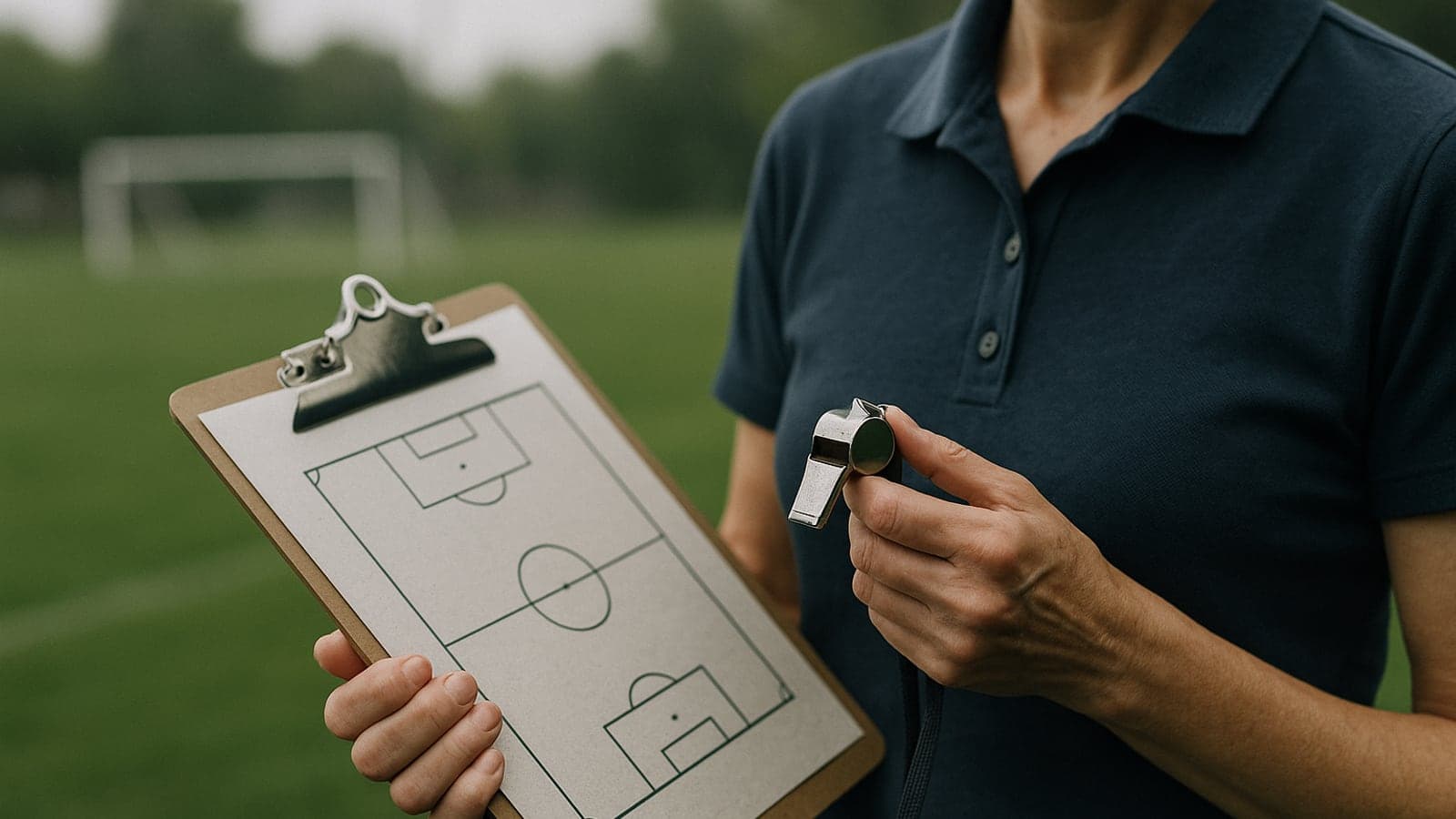
Decide your playing-time policy before the first practice, write it in one sentence, and say it out loud to every parent in the room.
That one move prevents most of what goes wrong in a youth season. Not all of it. But most.
Because almost every ugly moment in rec sports traces back to an unspoken expectation. A dad assumed his kid was a starter. A mom assumed "equal time" meant equal minutes in the fourth quarter. You assumed everyone understood that the two kids who show up to practice get the ball more. Nobody said any of it, and by week five it's a group text nobody enjoys.
Say it first. Then coach the season you described.
Pick the policy you can actually live with
There are really only three, and each one costs you something.
Equal minutes, no exceptions. Cleanest to defend, hardest on close games. You will sit your best player in the last two minutes and some parent will lose their mind. You'll survive it. This is the right call for anything under about ten years old, and honestly for most rec leagues above it.
Equal minutes as a floor, extra for effort and attendance. Everyone plays at least half. Beyond that, practice attendance and effort decide. Fair, but you have to actually track it, and you have to be willing to bench a talented kid who skipped two practices for a birthday party. If you won't do that, don't claim this policy.
Competitive minutes. Appropriate at select or high school level, where kids tried out knowing the deal. Not appropriate in a league where the fee was ninety dollars and everyone who signed up made the team.
Pick one. Don't hedge. A coach who says "we'll try to get everyone in" has already promised nothing and will be accused of everything.
Your kid is the hardest job on the roster
Two failure modes, and you'll feel the pull of both.
The first is obvious: your kid plays the premium position, takes the free kicks, bats third. Everybody sees it, including your kid, and it does him no favors. He learns that his last name is worth more than his work.
The second one gets less attention and does more damage. You overcorrect. Your kid gets the shortest leash on the team, gets pulled first, gets corrected loudest, and hears the coaching voice all the way home. You think you're being scrupulously fair. He thinks his dad is disappointed in him in front of his friends, twice a week, for three months.
A practical fix: pick one thing to work on with your kid, and only address that one thing during team hours. Everything else waits for the driveway. If it's "your head is down on the dribble," then his defensive positioning is somebody else's problem this month. Give the correcting to your assistant.
And use his name, not "son," and not "buddy" in a tone the other kids can read.
Run a practice where nobody stands in a line
Most bad youth practices are bad in the same way. One ball, eleven kids, ten of them watching.
A ninety-minute practice that works looks roughly like this:
- Ten minutes of movement that's also a game. Tag, relays, anything with the ball at their feet or in their hands. No laps. Laps teach kids that the sport starts after the punishment.
- Twenty-five minutes of stations. Three groups, three skills, rotate on a whistle. You need two other adults for this, which is why you recruit them in week one.
- Thirty minutes of small-sided play. Three-on-three, four-on-four. More touches, more decisions, more mistakes per minute, which is the point.
- Twenty minutes of scrimmage or situational work. Down by one, ninety seconds left. Bases loaded.
- Five minutes at the end, all of them sitting, you talking. Not more.
Total talking time across the whole session should be under eight minutes. Set a rule for yourself: no instruction longer than thirty seconds while kids are standing. If you need longer, you needed a different drill.
Hold the parent meeting, and keep it to fifteen minutes
Before the first game, get the parents together. Fifteen minutes, standing up, at the end of a practice so nobody has to make a special trip.
Cover five things:
Your playing-time policy, in the sentence you already wrote. The schedule, including the ones you'll probably miss. How you'll communicate, and that you won't answer texts during a game. The twenty-four hour rule: nothing about playing time gets discussed in the parking lot after a game, only by phone the next day or later. And the one job each family owes the team, whether that's snacks, scorebook, or lining the field.
Then ask for an assistant and a team manager, and don't leave until you have both. The manager handles emails, uniforms, and schedule changes. That role is worth more to your sanity than a good point guard.
You set the temperature on referees
The official is sixteen years old and getting paid less than a shift at the coffee shop. He will miss calls. Some of them will matter.
When you yell, three things happen. Your parents feel licensed to yell. Your players learn that losing is somebody else's fault. And the calls do not change.
The standard to hold yourself to: one question per game, asked in a normal voice, at a stoppage. "Can you tell me what you had there?" That's it. When a parent starts in from the sideline, turn around and say, quietly, "We're not doing that." You only have to do it once or twice a season, and doing it once buys you the rest of the year.
The car ride home is the whole thing
More kids quit sports over the car ride than over playing time.
You just spent ninety minutes coaching. You're full of observations. He's twelve, he's tired, and he's still carrying whatever happened on that last play.
Say "I loved watching you play." Then talk about something else. If he wants to review the game, he'll bring it up, and then you can go as deep as he wants. If he doesn't, the film session can happen Tuesday, or never.
The other thing worth protecting: your other kids. A coaching season quietly eats four to six hours a week, and every one of them comes from somewhere. Usually from the sibling who isn't on the team. Put one thing on the calendar with that kid every week, at a fixed time, and defend it the way you'd defend a game.
Know when to hand it off
Coach your kid as long as it's good for your kid. Not one season longer.
Three signals it's time. He stops talking on the way home. He starts playing like he's checking with you before every decision. Or he asks, in whatever roundabout way an eleven-year-old asks, whether somebody else could coach.
None of that is a failure. It's the job working. The point was never to be his coach. It was to be the reason he had one.
Some season soon you'll be in the stands with a coffee, watching a man you don't know very well tell your son something you've told him forty times, and watching your son hear it for the first time. That's a good day. Go early and get a seat where he can find you.
Sam Ortiz
Dads & Family
Father of three. Writes about presence, discipline and the long game, without pretending any of it's tidy.

Read next