Quick answer: Wear a dark suit, take a kippah from the basket at the door, and bring a check in a multiple of $18. Show up at the first time printed on the invitation. When the circle forms, get in it.
That last one matters more than all the others. Jewish tradition treats making the bride and groom happy as a guest's duty, not a courtesy. You aren't an audience. You're part of the machinery that makes the night work.
The invitation tells you which wedding you're going to
Jewish weddings run from Reform ceremonies that feel close to any other American wedding to Orthodox affairs with separate seating and dancing that goes past midnight. The invitation is your first clue.
Two times printed on it, something like "Kabbalat Panim 6:00, Chuppah 7:30," means a traditional wedding. The first time is the one you want. Plenty happens in that first hour, and walking in at 7:25 means you missed half the good parts. Hebrew text or a note about seating is another tell.
One time and a hotel ballroom usually means a more liberal wedding. You'll still see the canopy and the broken glass, but the rest will feel familiar.
Watch the date, too. Jewish weddings don't happen on the Sabbath, which runs from Friday sundown to Saturday nightfall. A Saturday wedding starts after dark. In December that might be 6:00. In June it could be 9:30, with dinner closer to 11. Eat something first.
Not sure what you're walking into? Ask the couple or a family member, "Anything I should know as a guest?" Nobody has ever been offended by that question. Most people light up.
The part before the part
At a traditional wedding, the couple often hasn't seen each other for the week before, and both are usually fasting until after the ceremony. So the first hour runs as two separate receptions.
The bride sits in a decorated chair and greets guests. Women tend to cluster there, and men are welcome to come by, say "Mazel tov," and move along.
The groom sits at the tisch, which just means "table." Picture a long table of men, platters of food, a bottle or two of whiskey, and a nervous groom trying to give a short talk on a passage of Torah. He won't finish it. His friends will break into song and drown him out on purpose, again and again. That's the tradition, and it's the best inside joke of the night. If you're a guy, grab a seat and bang the table when everyone else does.
Somewhere in there, two witnesses sign the ketubah. It's a marriage contract, traditionally written in Aramaic, spelling out what the husband owes his wife. Couples frame them and hang them in the living room. It's a striking thing to watch: centuries before prenups, this tradition put the obligations of marriage in writing and had them witnessed. If you've ever wondered what marriage gives you that living together doesn't, this is the answer on a single sheet of paper.
Then comes the bedeken. The groom gets marched by a singing crowd to the bride, looks at her, and lowers the veil over her face. It's loud and fast and a little chaotic. Follow the crowd and you'll be fine.
Under the chuppah
The ceremony happens under a chuppah, a canopy held up on four poles and open on the sides. It stands for the home the couple is about to build.
In traditional weddings the bride circles the groom seven times. Some modern couples circle each other. The groom gives her a ring, traditionally a plain band with no stones, and says a short line in Hebrew. The ketubah gets read aloud. Then come seven blessings over wine, often handed out to grandparents, rabbis or old family friends as an honor.
You won't follow the Hebrew. That's fine. Stand when people stand. Sit when they sit.
Many couples ask for no phones under the chuppah. Watch for a sign or an announcement. If you see neither, keep yours in your pocket anyway. The couple hired a photographer.
Then the groom stomps on a glass wrapped in cloth, and the room yells "Mazel tov!" That's your cue. Yell it like you mean it. The band will kick in before the shards settle.
It's a public promise made in front of everyone who matters to them, which is the whole case for marriage, made without a sermon, acted out in about twenty-five minutes.
The gap nobody warns you about
Right after the ceremony, the couple disappears. This is yichud: a few minutes alone together in a private room, often their first quiet moment all day and the moment they finally eat. Guests head to cocktails or dinner.
Don't go looking for them for a photo. They'll come back.
The food will be kosher. At a meat meal, kosher rules mean no dairy, so your coffee comes with nondairy creamer and dessert is sorbet, not cheesecake. Don't bring outside food or a bottle as a gift unless you know it's certified kosher. Just enjoy the brisket.
The dancing is the point
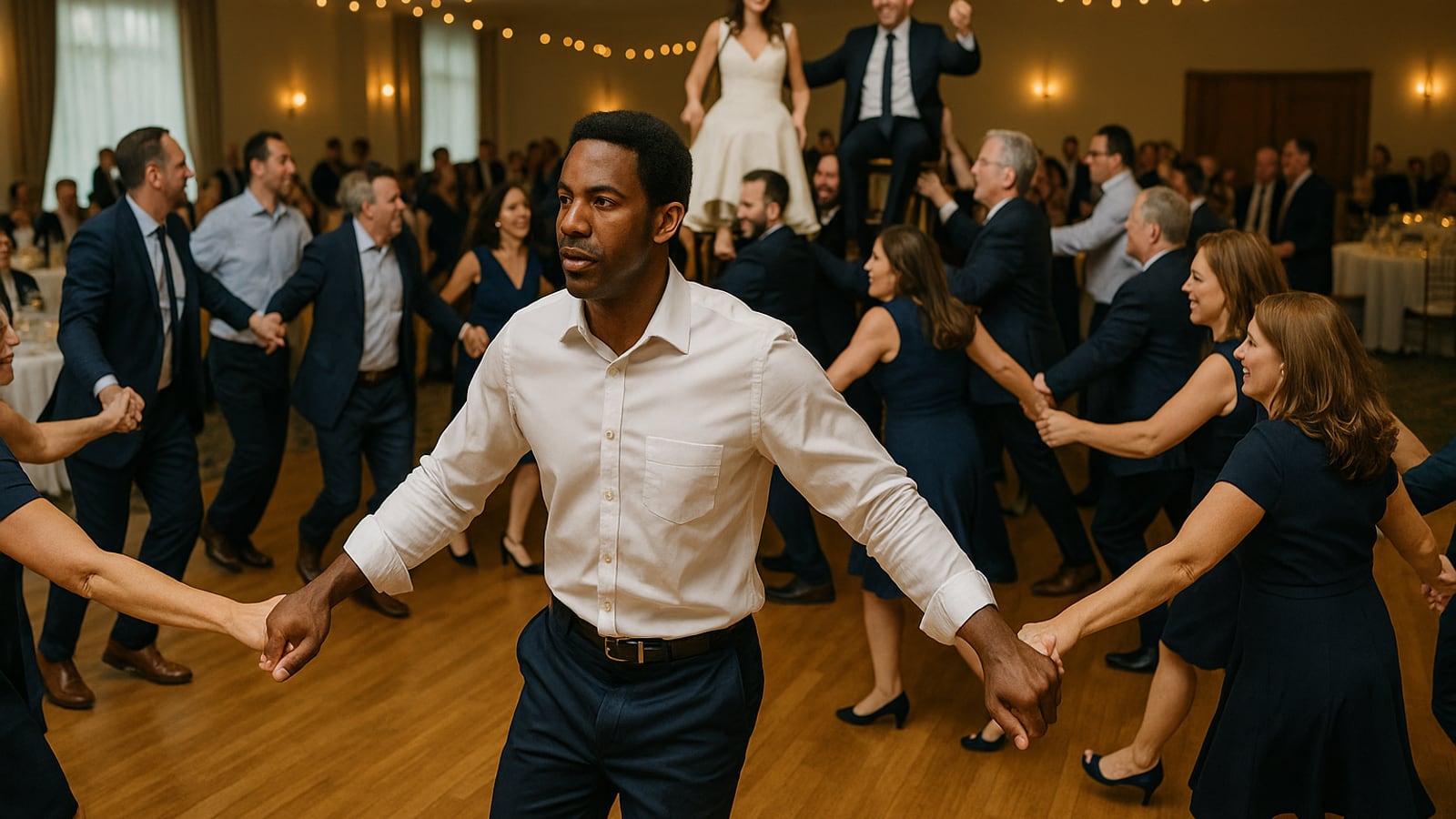
When the couple walks back in, the band launches into the hora and a circle forms. At an Orthodox wedding there'll be a men's circle and a women's circle, sometimes separated by a divider called a mechitza. Elsewhere it's usually one big mixed ring.
Get in.
The step is a simple grapevine: step to the side, cross behind, step, cross in front. Hold hands or put your hands on the shoulders of the guys next to you. Within ninety seconds you'll have it, and nobody's watching your feet anyway. They're watching the couple get hoisted up on chairs by a few strong volunteers and bounced over the crowd.
You'll see it happen. A coworker from the groom's office stands against the wall with his drink, clearly planning to wait it out. Then somebody's uncle in a sweater vest grabs his wrist and pulls him in. Ten minutes later he's in the middle, red-faced and laughing, and he's the one telling the story on Monday.
Be that guy without needing the uncle.
At traditional weddings the groom's friends also do shtick: juggling, costumes, jumping rope, anything goofy to entertain the couple. If you've got a party trick, this is the one room where it's welcome.
One concession. If you've got a bad knee or a bad back, stand at the edge and clap along with the rhythm. That counts. Feeling self-conscious doesn't count, though. Everyone out there felt it once.
What to wear and what to give
Men: a dark suit and tie unless the invitation says black tie. Kippahs usually sit in a basket at the entrance. Non-Jewish men wear them at Jewish weddings all the time. It's a courtesy, like taking off your hat indoors, not a statement of belief. Wear it at least through the ceremony. If it won't stay put, look for the little clips that are often in the basket, too.
Women at a traditional wedding: a dress or skirt that covers the knees, sleeves to the elbow and a modest neckline. At a Reform wedding, anything you'd wear to a nice evening wedding works.
Handshakes: some Orthodox men and women don't touch anyone of the opposite sex outside their family. If you offer your hand and it isn't taken, it's not a snub. Let the other person go first and you'll never have the awkward moment.
Gifts: use the registry or give a check. Cash gifts often come in multiples of 18, because the Hebrew word chai, meaning "life," adds up to 18. So $180 or $360 carries a little extra warmth. There's usually a card box at the reception. Just make sure it's the card box and not the centerpiece.
The short version to screenshot
- Arrive at the first time on the invitation.
- Eat before a late Saturday night wedding.
- Yell "Mazel tov!" when the glass breaks.
- Don't offer your hand first at an Orthodox wedding.
- Keep the phone away under the chuppah.
- Get in the circle.
Nobody will remember whether you knew the words to the blessings. The couple will remember exactly who was dancing.
Cal Brennan
Fitness
Strength coach. Trains fathers, tradesmen and desk workers, which means programmes that survive a bad week.

Watch
Worth an hour of your evening
More from Family.
From channels we rate. Plays on YouTube.
Read next