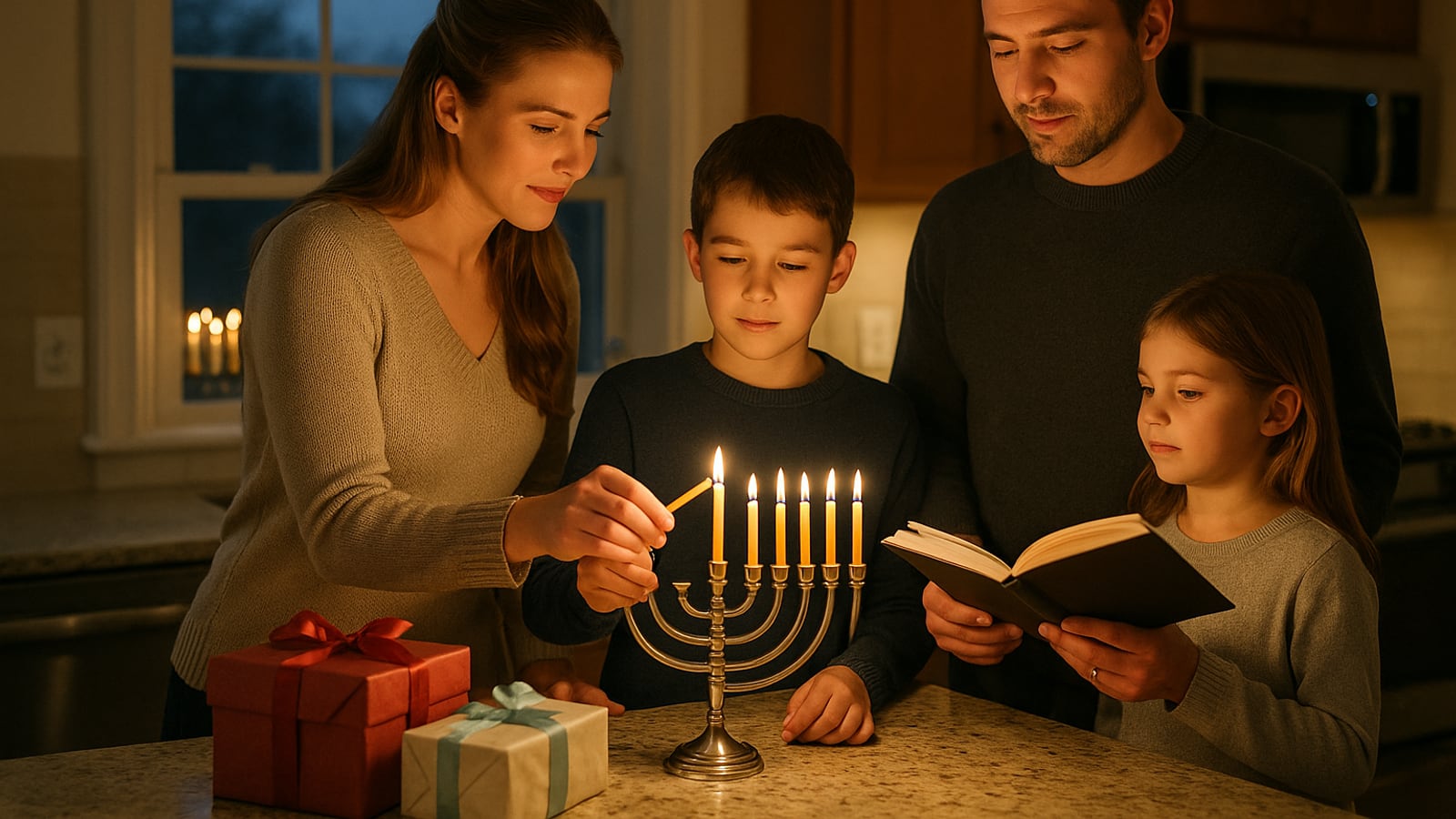
Quick answer: Build one ten-minute ritual you repeat identically all eight nights, then hang exactly one small thing on each night. Buy the 44-candle box, put the menorah in a window, and decide the gift rules with your spouse in November, not on night three.
Night one always goes great. Everybody's home, somebody took a picture, the kids are wound up, there are doughnuts. Night five is a Tuesday. One kid has practice, you got home at 7:40, and somebody says "do we have to do it tonight?"
That's the whole problem. Hanukkah isn't one big evening you can throw resources at. It's eight consecutive evenings in the busiest month of the year, and the families who keep it well aren't the ones with the most elaborate plan. They're the ones whose plan is small enough to survive a Tuesday.
The ten minutes that never move
Strip it down to what actually has to happen, because it's shorter than people think.
You light the shamash, the helper candle that sits higher or off to the side. You say the blessings. You use the shamash to light the night's candles. Somebody sings something. You sit there for a few minutes and look at it.
That's it. Ten minutes, and eight of those minutes are optional. The candles do the rest of the work by themselves.
Standard Hanukkah candles burn somewhere between half an hour and an hour, which is exactly right. The ritual has a built-in end. You're not committing your evening, you're committing the length of one candle. Tell the kids that on night five. "It's twelve minutes. Shoes off, come here."
A box holds 44 candles, which is the math of the whole holiday: one on the first night, two on the second, all the way to eight, plus a shamash every night. Buy two boxes. One gets knocked over, one gets left at your mother-in-law's, and running out on night seven is a genuinely annoying errand.
Getting the mechanics right
The part people fumble in the first few years: you load the menorah right to left, adding the newest candle on the left each night, and you light left to right, so the new one goes first. Newest candle, first flame. Once somebody in the house knows this cold, make it their job.
Two blessings each night, over the kindling of the Hanukkah light and over the miracle. On the first night you add the Shehecheyanu, the blessing for reaching this season again. If you're not confident in the Hebrew, transliterations are on the back of most candle boxes and nobody has ever been graded on it.
Let the candles burn out on their own. Don't blow them out, and don't use their light to find your phone. That's what the shamash is for.
Friday is the one night that needs planning. Hanukkah candles go up before the Shabbat candles and before sunset, which means an earlier light than you're used to and candles long enough to still be burning well after dark. Some people keep a separate box of longer candles just for Friday. Saturday night waits until Shabbat is out. Customs vary here more than anywhere else in the holiday, so if you want it exactly right for your household, ask your rabbi rather than the internet.
Put it in the window
The point of the menorah is that people outside can see it. A hanukkiah on the kitchen counter facing the refrigerator is a candle. A hanukkiah in the front window is a statement, and your kids clock the difference without anybody explaining it.
Practical version of that: set it on a metal tray or a sheet pan, not directly on the sill. Keep a foot of clearance from the curtains and pull the blinds up out of the way. Wax on a painted sill is a January chore you don't need. If a candle does drip, let the wax harden completely, then crack it off with a plastic scraper and hit the residue with hot water.
If you've got a toddler, buy a second small menorah for them, an electric one, and let them run it themselves. A three-year-old with a job doesn't grab at yours.
The gift problem, settled in advance
Somewhere along the way, eight nights turned into eight presents, and a lot of families got dragged into a nightly escalation nobody enjoys and nobody chose. Then the cousins get involved and now it's a competition.
Kill it early. Pick one night as the gift night, do something small on a second night, and leave the other six alone. Gelt counts. A book counts. One family I know does a single real gift on the fifth night specifically because the fifth night is the one that sags.
The conversation to have is with your wife, in November, before anybody's feelings are attached to anything. What's the number per kid. What do we do about the grandparents who ignore the number. What do we tell the kid who comes home from school comparing hauls. Get that agreed and you've removed the single most common December argument in the house. If money talk in your marriage tends to go sideways, that's a fixable pattern, and this is a low-stakes place to practice.
The nights with no gift are the ones your kids will actually remember, because they're the ones where something happened instead of something arrived.
What to hang on the other nights
One thing per night. Not three. Write the list on an index card and stick it inside the cabinet with the candles, because you will not remember it in real time.
- Latke night. One night, not eight.
- Dreidel night. Real gelt, real stakes.
- Doughnut night. Buy them. Sufganiyot from a bakery beat anything you'll fry at 9 p.m.
- Give night. Everybody, including the adults, puts money in one envelope and the kids decide where it goes.
- Invite night. One family who isn't yours. Feed them.
- Phone basket night. Everything in the basket until the candles are out.
- Story night. The Maccabees, the Temple, the oil. Ten minutes. A kid who can tell you why there are eight nights is a kid who owns the holiday.
- Eighth night. All nine flames going. That's enough of an event on its own.
Latkes, honestly
They're a mess and they're worth it once.
Russets, grated on a box grater along with half an onion. Then the step everybody skips: wring the shreds out in a dish towel until you're embarrassed by how much water comes out. Wet potato means soggy latke. Egg, a few spoons of flour or matzo meal, plenty of salt.
Quarter inch of neutral oil in a cast iron skillet, medium-high, around 350. Two to three minutes a side. Drain them on a wire rack instead of paper towels, or the bottoms steam themselves limp. Salt them the second they come out of the pan.
You'll be standing at the stove for forty minutes while everyone else eats. Accept it or draft a teenager.
Dreidel, with the rules people forget
Everyone antes one piece of gelt into the pot. Nun, you get nothing. Gimel, you take the whole pot. Hey, half. Shin, you put one in. When the pot empties, everybody antes again.
Play it for real chocolate and it's a game. Play it for nothing and it's a spinning top.
When it's hard
Some years the eight nights land across a work trip, a sick kid and a fight about your in-laws' house. You'll miss a night. Light two candles late and don't turn it into a referendum on the family.
The thing that makes a tradition stick isn't intensity, it's sameness. Kids don't remember the best year. They remember the one thing that happened every single year, in the same spot, run by the same parent, in the same slightly off-key way. That's the deposit. Ten minutes a night, eight nights, compounding for eighteen years. Consistency at home is a standard you hold, not a mood you have, and a holiday is just that standard with better food.
On the eighth night, turn off the lights in the room. Nine flames in a window is a lot brighter than anyone expects the first time they try it.
Nina Castellan
BRO for Her
Runs the women-facing desk. Same standard, same tools, written for a different reader — not a softer one.

Watch
Worth an hour of your evening
More from Family.
From channels we rate. Plays on YouTube.
Read next