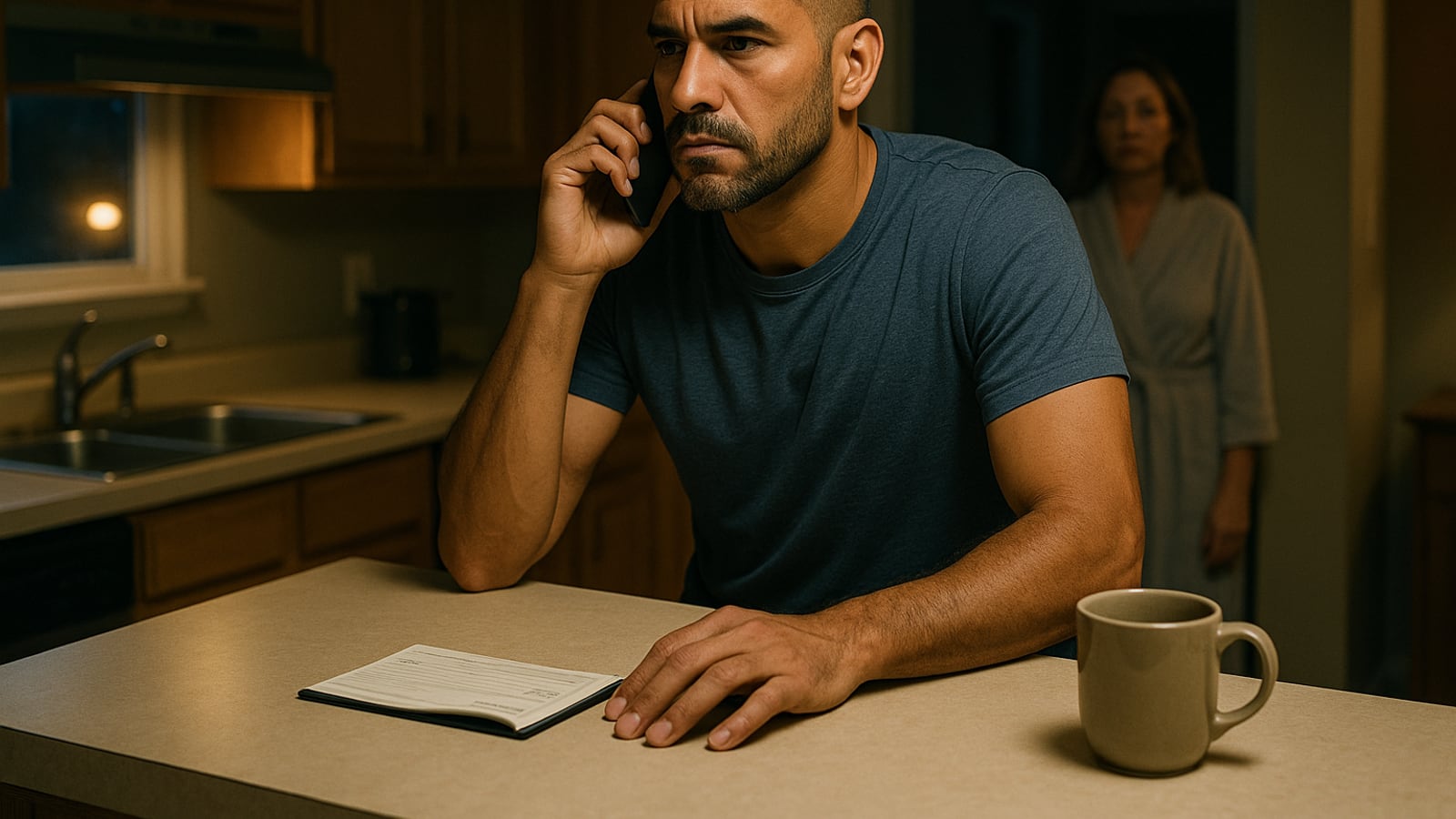
The call comes at 2:40 in the morning and it's about money. Two hundred dollars for rent, or the car's getting towed, or there's a guy who needs paying tonight. You're standing in the kitchen in the dark and your wife is awake now too, and whatever you say in the next ninety seconds you'll be living with for a year.
Don't say no. Say a specific yes to a specific thing.
"I'm not sending money. I'll drive you to detox at seven and sit with you through intake." That sentence does two jobs at once. It refuses the thing that feeds the problem and it offers something real in the same breath, which is the only version of a boundary that doesn't feel like a door slamming.
The trick is that you can't build that sentence at 2:40 a.m. You build it on a Tuesday afternoon, months earlier, when nobody's in crisis.
The line between help and enabling is simpler than it sounds
Help moves a person toward carrying their own weight. Enabling carries it for them so they never have to feel how heavy it's.
That's the whole test. Run every request through it. Paying a rehab deposit directly to the facility, help. Cash for rent that frees up the money they already had, enabling. Driving them to an appointment, help. Calling their boss and inventing a stomach bug, enabling, and it's the single most common one in American families because it feels like loyalty.
You're not the last line of defense against consequences. You're the person who'll still be standing there after the consequences land.
Decide the money rules before the phone rings
Do this with your spouse, at the table, sober and unhurried. Write it down. Actually write it, in your phone or on an index card, because at 2:40 in the morning your memory is worthless and your guilt is very persuasive.
Decide three numbers. What you'll spend on treatment. What you'll spend on direct essentials, paid to the vendor and never to the person. What you'll spend in cash, which should be zero.
Then agree the rule that saves marriages: neither of you moves those numbers alone. No quiet Venmo. No "I just handled it, I didn't want to bother you." One spouse secretly funding an addicted relative while the other holds the line is how a family problem becomes a marriage problem, and the marriage usually loses.
Also decide who answers the phone. If it's your brother, it's your call to take, and your wife doesn't have to be the one negotiating with him at dawn.
Make your offer real before you offer it
An offer you haven't researched is just a nice noise.
So do the homework on a normal afternoon. Call the SAMHSA National Helpline at 1-800-662-4357, which is free, confidential and staffed around the clock, and ask what's actually available in your area. Call two treatment centers. Ask what they take for insurance, what the cash price is, how long the wait is, whether they do same-day intake, and what happens if somebody shows up at 6 a.m. Write the answers on the same card as your numbers.
Now your offer has a name, an address and a time. "There's a bed at the place on Route 9, they'll take you Thursday, I'll drive." That's a different conversation than "you should really get some help."
Keep in mind the window is small. When somebody finally says yes, they mean yes for about four hours.
Secure your own house
This part gets skipped because it feels like an accusation. Do it anyway.
Clear the medicine cabinet of anything left over, especially painkillers, and take the rest to a pharmacy take-back box. Keep current prescriptions in a lockbox. Cheap ones run about thirty dollars.
If you own firearms, and plenty of us do, responsibility is the other half of that right. A safe with a combination only you and your wife know isn't a statement about your son's character. It's what a serious owner does when someone in the house isn't in control of himself right now. You'd do the same for a family member in a mental health crisis, and you wouldn't feel bad about it.
Move checkbooks, cards and Social Security cards out of the kitchen drawer. Consider freezing your credit and your kids' credit, which is free at all three bureaus. If the person has been in your home, check your accounts monthly for a while. Theft inside a family is common enough that you should plan for it and quiet enough that most people find out too late.
If opioids are anywhere near the picture, keep naloxone in the house and know how to use it. In most states you can get it at the pharmacy counter without a prescription. Ask your pharmacist to walk you through it, and show your spouse too. It's the difference between a bad night and a funeral.
Don't let the whole family orbit one person
Here's what quietly happens: every dinner becomes a status report. Christmas gets planned around whether he's using. Your fourteen-year-old learns that the way to get attention in this family is to be in trouble.
Fight that. Protect the ordinary. Your daughter's game still happens. Your anniversary still happens. Keep some conversations in your marriage that have nothing to do with the crisis, or the crisis eats the marriage as a side dish.
Tell your kids the truth at their level. "Uncle Danny has a disease that makes him drink, he's not safe to drive you, and it isn't your job to fix him." Children make themselves responsible for adult chaos when nobody explains it to them. Say plainly that none of it is their fault, and never make a kid the one who has to say no to an adult. That's yours.
Plan for the relapse now
Most recoveries include at least one. Decide in advance what a relapse costs, so you're not inventing policy in a parking lot.
Something like: relapse doesn't end the relationship, it ends that round of help. You don't get the spare room again until you've been back in treatment two weeks. You're welcome at Sunday dinner sober and not welcome otherwise, and if you show up otherwise you'll be asked to leave without a scene.
Then follow it. Every time you don't, the rule becomes a suggestion.
Where the advice bends
Some of this doesn't hold in an emergency. If someone's overdosing, unresponsive or talking about ending their life, you call 911 or 988 and you sort out the philosophy afterward. Nobody ever regretted making that call.
And sometimes paying the rent directly is the right move, because a person sleeping in a car isn't going to get sober. Judgment beats a rulebook. The card in your pocket exists so you're making that call with a clear head, not because a voice on the phone at 2:40 a.m. is very good at this and you're very tired.
Get your own people too. Al-Anon and Nar-Anon meet in church basements and community centers in nearly every county in the country, they cost nothing, and they're full of people who already made every mistake you're about to make.
You can't make a grown man want to get sober. You can make sure that on the day he does, somebody picks up the phone, knows exactly where the bed is, and has gas in the truck.
Cal Brennan
Fitness
Strength coach. Trains fathers, tradesmen and desk workers, which means programmes that survive a bad week.

Watch
Worth an hour of your evening
More from Family.
From channels we rate. Plays on YouTube.
Read next