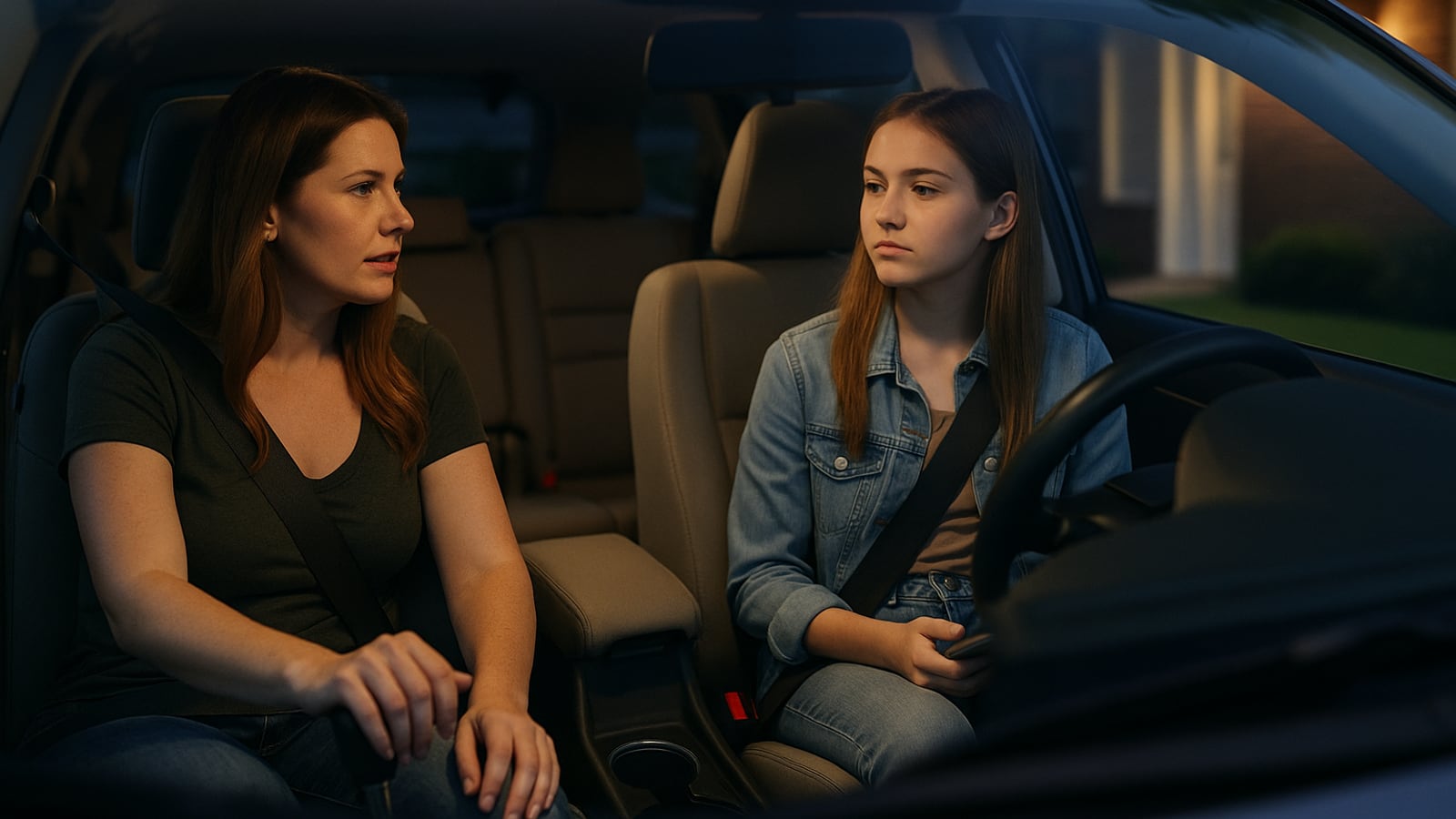
Start with the ride home. Before you say a word about nicotine or beer or peer pressure, give your kid a way out of a bad room at eleven at night.
It's simple. Agree a code. They text you a single word or an emoji, anything that looks like nothing to a friend reading over their shoulder. You call within two minutes and say something they can blame you for. Grandma's in hospital. The dog's out. Whatever. You're in the car in fifteen minutes and there are no questions that night, and no punishment for the call. Ever. Not once.
That last clause is the whole thing. A kid who thinks the ride home costs them a month of freedom will get in a car with a drunk seventeen-year-old instead. Kids are rational. They price the consequences you set. So price the phone call at zero.
Tell them the escape hatch works for anything. Not just drinking. A party that's turned, a fight brewing, a friend who's gone quiet in a bathroom, a house with no adult and forty people in it. They don't have to justify it. They don't have to be sure. "I want out" is enough.
Do it in the car, not across the table
Sitting a teenager down opposite you and announcing a conversation is the fastest way to get monosyllables. Faces are hard. Side by side is easy.
Drive somewhere. Twenty minutes each way is plenty. Do the dishes together. Walk the dog. The talking happens in the gaps, and the gaps only open when nobody has to hold eye contact.
And don't do it once. The single big talk is a myth that lets parents off the hook. Six two-minute conversations over a year beat one forty-minute lecture by a distance, because six conversations tell your kid the topic is open. One tells them it's closed and filed.
Short is better. "Anyone at school vaping?" is a better opener than anything you'd write down in advance. Then shut up and let the silence do the work. Most teenagers will fill it if you can stand three seconds of nothing.
On vaping, don't lead with lungs
Every kid has heard the lung line and most of them have decided it's exaggerated. You won't win there, and if they catch you overstating anything, they'll discount everything else you say for the next four years. Credibility is your only real currency. Guard it.
Lead with ownership instead. Nicotine is genuinely addictive, it grabs faster in a young brain, and a disposable vape delivers a lot of it in a form that's easy to use all day without noticing. The pitch is: something you buy for a laugh in Year 10 can end up deciding how your afternoon goes. You get twitchy in a double lesson. You can't sit through a film. You're spending money every week on something you stopped enjoying months ago.
Teenagers care enormously about not being played. Frame it as being played, because it mostly is.
Say the honest thing about what you don't know. Nobody has decades of data on this. You're not going to pretend you do. That admission buys you more trust than a scary claim would.
On drinking, be specific about what actually goes wrong
Vague warnings bounce off. Concrete ones stick.
The things that ruin nights aren't abstract. Drinking fast on an empty stomach, because the aim was to be drunk before the parents arrive. Spirits, which nobody measures. Being sick and being alone while it happens. Water and pools and getting in a car. A phone camera and a photo that goes around the year group by Monday morning. A fight with someone who was never going to remember starting it.
Give them the practical stuff you'd give an adult. Eat first. Know what's in your cup, and never leave it. Never accept an open drink from someone you don't know. Stay with the people you arrived with. Nobody gets left behind, and nobody sleeps on their back after a heavy night — you roll them on their side and you stay in the room.
If your household position is that they don't drink at all until they're legal, say that plainly and hold it. But also give them the survival information anyway, because the plan has to cover the night the plan fails.
Answer the question about yourself
They'll ask. Some version of "did you?"
Lying is worse than anything you did at sixteen. If they ever find out, and they usually do, every rule in the house gets reclassified as theater.
Tell the truth at a level you're comfortable with, and put the point at the end rather than the start. Yes, I drank before I should have. Here's the night I still think about. Here's what it cost a friend of mine. You don't owe them a full accounting of your twenties. You do owe them honesty about the shape of it.
The version that lands isn't "I did it and I turned out fine." It's "I did it, some of it was stupid, and I'd like you to skip the part I regret."
Sort out your marriage on this first
Two parents who disagree in front of a teenager have handed that teenager a negotiating position. Kids find the softer parent in about a week and route everything through them, and the harder parent ends up angrier and more isolated with every month.
So decide together, before the first party, in private.
- What's the curfew, and what happens if it's missed by twenty minutes versus two hours
- Do you phone the host parents, and do you tell your kid you're phoning
- What's the consequence for drinking, and is it different if they told you themselves
- What's the consequence for lying about where they were, which should be heavier
- Who handles it at one in the morning, and who handles it the next day
Split those last two on purpose. The parent who does the late-night pickup should be the calm one, and the real conversation happens after breakfast when everyone's slept. Nothing useful has ever been said at 1am by a parent who's been awake and worried for three hours.
When it's already happened
You find a vape in a coat pocket. They come home and you can smell it. The instinct is to go straight at it, loudly. Don't.
That night: water, a bin next to the bed, on their side, door open, check on them. If they can't be roused, if their breathing is wrong, if their skin's cold and clammy, that's a medical call, not a parenting one. Phone for help and don't sit on it out of embarrassment.
The next day, ask more than you tell. How much, how often, who with, how long has this been going on. You're gathering facts, not building a case. A kid who's genuinely hooked on nicotine and trying to stop may need your GP, and that's a normal thing to ask for, not a failure.
Then set the consequence, deliver it, and let it end. Punishment that runs for six weeks and gets referenced at every meal doesn't teach anything. It just teaches them to get better at hiding.
The thing you're actually building
Rules matter, and you should have them. But rules only work while you're in the room, and in a few years you won't be.
What you're really doing across all these short, awkward, badly-timed conversations is making yourself the person they call. Not the person they manage. There's a difference, and it gets decided long before the first party, in how you react to the small stuff they tell you when they didn't have to.
Take the call at midnight. Say thank you for ringing. Ask the questions in the morning.
Cal Brennan
Fitness
Strength coach. Trains fathers, tradesmen and desk workers, which means programmes that survive a bad week.

Watch
Worth an hour of your evening
More from Family.
From channels we rate. Plays on YouTube.
Read next