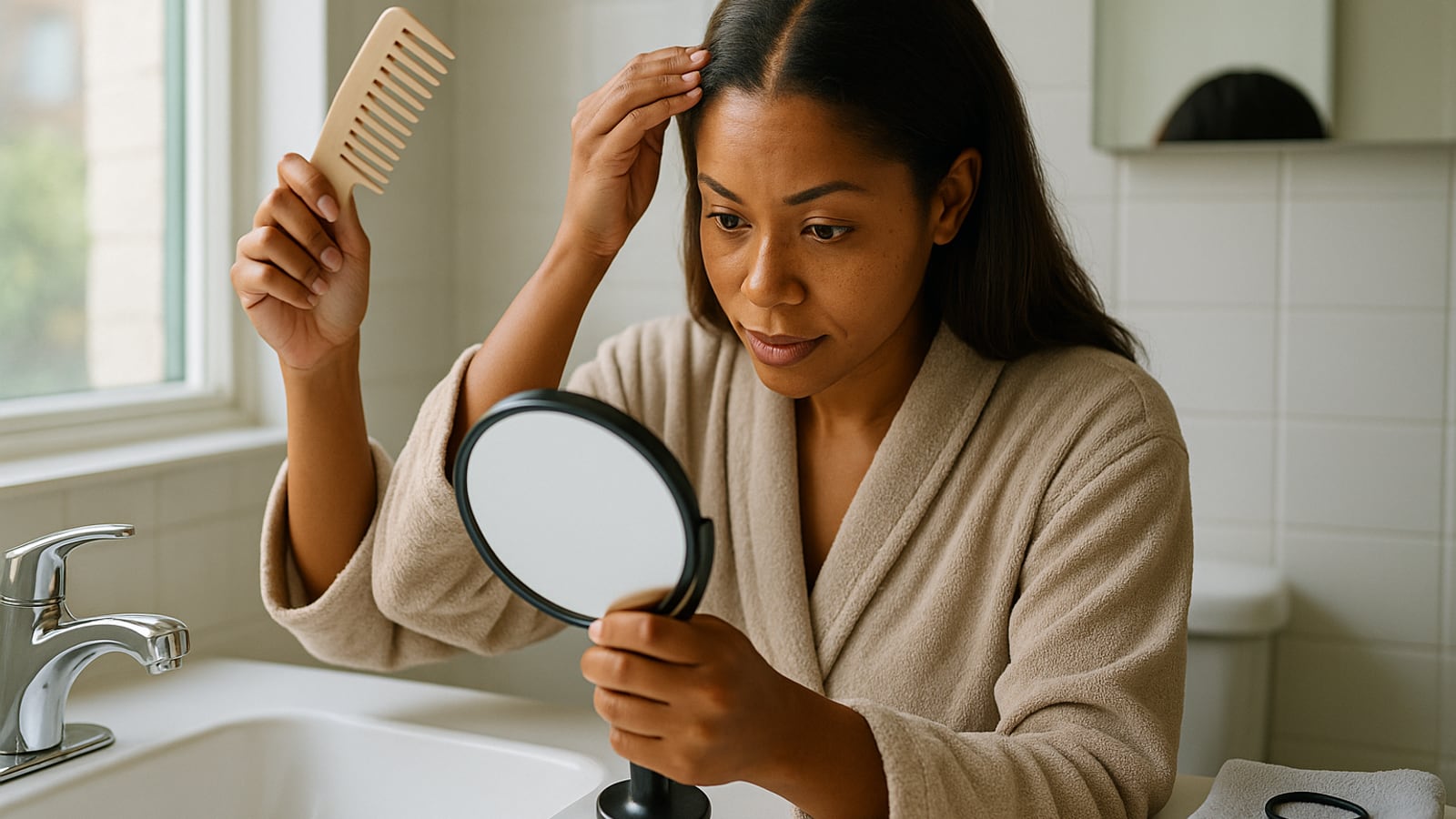
The elastic tells you before the mirror does. It used to take two wraps. Now it takes three, and the third one is tight. Then you catch the part line in a car visor mirror at 2 p.m. with the sun straight overhead, and there's more scalp than there was in the spring.
That's the point most women start buying things. Thickening shampoo, rosemary oil, a $60 serum with a dropper. Skip that step for six weeks and spend the money on a blood draw and a dermatology appointment instead. Hair loss in women is usually a symptom of something with a name, and most of those names show up on a standard panel that costs less than the serum.
First, figure out which pattern you have
The pattern matters more than the amount, because it points at the cause.
Diffuse shedding. Hair comes out everywhere, all at once. Handfuls in the shower, a visible mat on the bathroom floor, hair on your pillow and in your food. Your part isn't dramatically wider, there's just less of everything. That's usually telogen effluvium, which means a batch of follicles all got shoved into the resting phase at the same time by a single event. Childbirth. A bad flu with a high fever. Surgery and anesthesia. A crash diet or fast weight loss. Starting or stopping hormonal birth control. A genuinely brutal few months.
A widening part. The shed may be mild or nonexistent, but the center part keeps getting wider toward the front, and the crown thins while your hairline at the temples stays put. Some people call the shape a Christmas tree. That's female pattern hair loss, it's gradual, it often runs in families, and it responds best to early treatment.
Round, smooth bald patches. Coin-sized, appearing over days, skin totally smooth. That's alopecia areata and it needs a dermatologist, not a supplement.
Loss along the hairline where you pull. Tight ponytails, braids, extensions, a bun you've worn every workday for nine years. Traction alopecia thins the temples and the front edge first, and it becomes permanent if you keep pulling.
The one thing that means you call this week
If your scalp itches, burns, stings or feels tender, or the bald skin looks shiny and smooth with no visible pore openings, stop reading comparison charts and get a dermatology appointment. Scarring alopecias destroy the follicle. Whatever you lose isn't coming back, and the goal of treatment is to stop the spread. A scalp biopsy is a few minutes and a couple of stitches. Waiting six months to see if it improves is the expensive choice.
The four-month lag that makes everyone blame the wrong thing
Telogen effluvium doesn't start when the trigger happens. Hair sits in the resting phase for roughly two to four months before it lets go. So the shed you're panicking about in October traces back to something in June or July, and the shampoo you started in September is innocent.
Run the calendar backward. What happened three to four months ago? Illness, a hospital stay, a death in the family, a move, a 20-pound drop, a new prescription. Write it down and bring the date to your appointment. Doctors love a timeline and almost nobody brings one.
The same lag works in reverse, which is the cruel part. Fix the cause today and you'll see baby hairs in two to three months and real density in six to twelve. Don't judge anything at week four.
The labs to ask for by name
Write this down and hand over the paper. Asking for "some blood work for my hair" gets you a TSH and a pat on the arm.
- CBC — anemia, and general red flags.
- Ferritin — your iron stores. This is the one that gets skipped, and the one that most often comes back low in a woman with heavy periods.
- Iron, TIBC, transferrin saturation — the rest of the iron picture, because ferritin alone can mislead.
- TSH and free T4 — thyroid, both directions. Under and over active both shed hair.
- Vitamin D, 25-hydroxy.
- Vitamin B12.
- Zinc.
- Comprehensive metabolic panel — liver, kidney, blood sugar.
- CRP — inflammation, which matters for reading the ferritin properly.
If you also have irregular or absent cycles, new acne along the jaw, or coarse hair showing up on your chin, ask about androgen labs: total and free testosterone, DHEA-S, prolactin, and 17-hydroxyprogesterone. Those are timing-sensitive. Ask the office when in your cycle to go and whether it needs to be a morning draw, because a same-day walk-in can waste the whole test.
If your iron keeps dropping no matter what you do, ask about a celiac screen.
Stop your biotin before the draw
High-dose biotin is in most hair, skin and nail gummies, and the FDA has warned that it interferes with common lab immunoassays. Thyroid panels are among the ones it can skew, which means your TSH and free T4 can come back looking wrong in a way that sends everyone chasing the wrong problem. Stop the gummies a few days before your appointment and tell the phlebotomist you were taking them. Then ask yourself why you were taking them, since true biotin deficiency is rare and the gummies are mostly sugar with a marketing budget.
"Normal" and "good enough for hair" aren't the same number
Get the actual figures, not a voicemail that says everything looked fine. Ask for the printout or pull it up in the portal.
Ferritin is where this matters most. Lab reference ranges run low at the bottom, low enough that a result that technically clears the line can still be a number a dermatologist wants to raise before expecting hair to behave. Don't argue about it from an internet article. Ask your doctor directly: "What's my ferritin, and what would you want it to be if hair is the concern?" That question gets a real answer. "Is my iron okay?" doesn't.
Don't start iron on your own
Iron isn't a vitamin you toss in the cart because you're tired. Too much iron is genuinely harmful, some people carry a condition that makes them store it, and supplementing before the test hides the answer you paid for. Get the number first, then take what your doctor tells you to take, in the dose and duration they specify. Then retest. Iron stores take months to rebuild, not weeks.
Things no blood test will catch
Pull up your medication list and check the dates. Some antidepressants, beta blockers, blood thinners, high-dose vitamin A and retinoids, and certain hormonal prescriptions can shed hair. Never stop anything on your own. Bring the bottles and let the prescriber decide.
Then look at the last year of eating. Rapid weight loss sheds hair almost every time, whether it came from a surgery, a strict diet or a GLP-1. So does chronically low protein. That's not a reason to abandon a health goal you're winning at. It's a reason to know the shed is coming and to get your protein intake honest while it happens.
Track it so you're not arguing with your memory
Once a month, in the same bathroom with the same light, take three photos: part line from directly above, crown from behind, and hairline straight on. Same day of the month, put it in your phone calendar. Also measure your ponytail circumference with a soft tape at the elastic and write the number down.
In four months, photos and a tape measure will tell you something. Your memory of how your hair looked in March won't.
Treatment comes after all of this, and there are real options with real evidence behind them. But every one of them works better when you already know what you're treating. Buy the answer before you buy the bottle.
Nina Castellan
BRO for Her
Runs the women-facing desk. Same standard, same tools, written for a different reader — not a softer one.

Watch
Worth an hour of your evening
More from BRO for Her.
From channels we rate. Plays on YouTube.
Read next