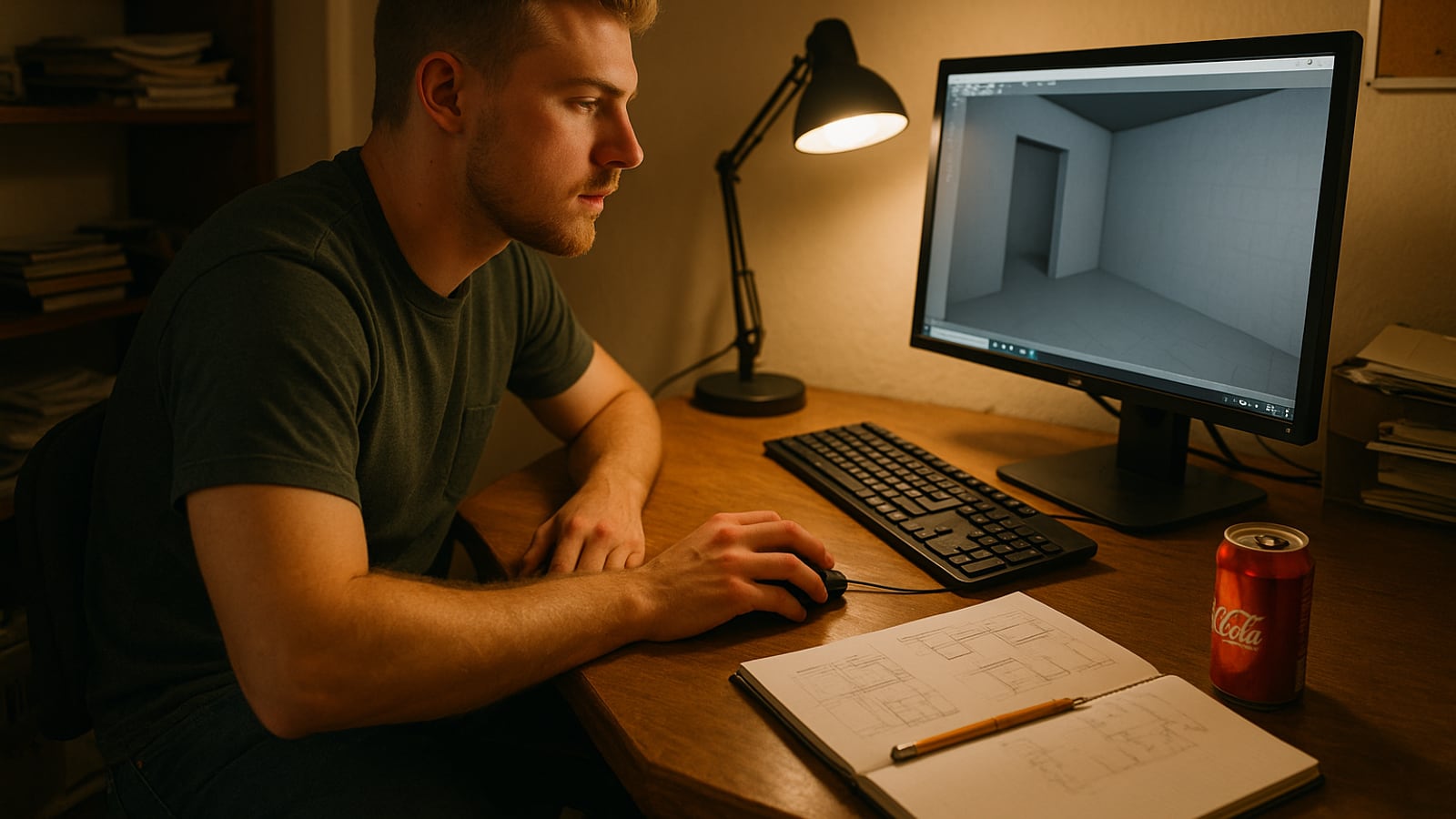
Open a level editor tonight and make a box. Five hundred and twelve units square, two hundred and fifty-six tall. Cut a doorway in one wall. Drop a light in the ceiling. Compile it, load it, and walk through the door.
That's a level. It's ugly and it takes eleven seconds to finish, and it's further than about ninety percent of people who say they want to make games ever get. They don't stall on talent. They stall because they started with a cathedral, a story bible and a twelve-hour YouTube series, and three weeks later the project folder is a graveyard.
The craft is real and you can learn it. But it starts small, and it starts with something somebody else can actually play.
Pick the tool with the shortest loop
The only spec that matters at the start is how long it takes to go from an edit to standing in the room. Everything else is negotiable.
Ultimate Doom Builder, paired with GZDoom, is still the best on-ramp in the hobby. Doom levels are 2D floor plans with height information stacked on top, so you can't drown in 3D modeling before you've learned to shape a space. You edit, you hit play, you're in. Free, mature, and thirty years of other people's maps to pull apart.
TrenchBroom does the same job for Quake. Brush-based geometry, forgiving, and a community that has never once stopped making maps.
Valve's Hammer, through the Source SDK, gets you into Counter-Strike and Half-Life 2 territory. It's a better teacher of modern shooter geometry than anything else on this list. The annoying part: lighting compiles get long fast, and once your map takes fifteen minutes to build, you stop experimenting and start committing. Use fast-compile settings for everything until the layout is locked.
Bethesda's Creation Kit for Skyrim or Fallout 4 is a different animal. You're placing prefabricated pieces, writing dialog and wiring quests more than you're carving rooms. If the part you love is stories and systems, go there first.
Unreal Engine and Unreal Editor for Fortnite will do literally anything, which is the problem. Enormous power, enormous menus, and no forcing function that makes you finish.
If there's a twelve-year-old in the house, Minecraft counts. Redstone is logic gates with better marketing.
Gray box everything, and look at it from eye level
Professionals block out a level in untextured gray geometry and play it for weeks before anyone makes it pretty. Do the same. Textures hide bad layout, and you want the bad layout visible while it's still cheap to fix.
Learn your engine's measurements and build to them instead of eyeballing. In Source, the player hull is 32 units wide and 72 tall, 36 when crouched, and steps up to 18 units without jumping. That gives you everything. Doorways at 96 tall and 64 wide feel generous instead of claustrophobic. Stairs at 16 units per riser read as stairs. Snap the grid to 16 for layout, drop to 8 for detail, and stay off the 1-unit grid until you genuinely need it, because a map built on odd numbers is a map that leaks.
In Doom, the player is 56 units tall with a 24-unit step height, and the classic lesson still holds: a room that looks cavernous in the top-down view plays like a closet.
That's the scale trap, and it gets everyone. The editor's overhead view is a lie. Your eyes are three feet above the floor in that view, mentally, while your character's eyes are six feet above it in a space with no reference objects. Rooms that look right from above play tiny. Build the box, walk it, then widen it by a third. You'll do this four or five times before your instincts calibrate.
The map should point, not tell
Good level design moves people without a marker on the screen. Light is the leash. A dim corridor with one warm pool of light at the far end pulls a player down it every time, and you didn't say a word.
Doom taught the second trick and nothing has improved on it: show the locked door before the key. Walk the player past the thing they can't have, let them note it, and the key becomes a reward instead of an errand. Sightlines do the same work. Frame the next objective through a window, an archway, a gap in a collapsed wall. Give a landmark that's visible from three different rooms so nobody ever fully loses their bearings.
And give them a breath. Combat, quiet, combat, quiet. A twenty-minute map that's loud the whole way through feels shorter and worse than a ten-minute one with a hallway to walk in.
Watch a stranger play it and keep your mouth shut
This is the hard part, and it's non-negotiable.
Hand the map to a friend who doesn't know it. Sit behind them. Say nothing. Not "you have to go left", not "the switch is over there", not even a sigh. Write down every second they spend turning in a circle.
If you have to explain the map, the map failed. That's the whole test. You'll watch them miss a door you thought was the most obvious door ever built, and the honest response isn't to blame them. It's to widen the door, light it, and point a hallway at it.
Do this with three people and you'll learn more about design than a semester of theory. Two of them will get stuck in the same spot. That spot is your homework.
Finish it and publish it, even if it's small
Cut scope until it fits the time you actually have. One room becomes three rooms becomes a ten-minute map, and a ten-minute map that people can download beats a sprawling masterpiece living on your hard drive.
When you publish to Nexus Mods, ModDB, the Steam Workshop or itch.io, do the boring part properly. Read the site's rules before you upload. Credit every asset you didn't make and check the license on each one, because "I found it on a forum" isn't a license and pulling a mod down after a thousand downloads is a miserable afternoon. Write a readme with the install steps and the engine version you built against. Take three screenshots that show the space, not your inventory bar.
Then expect eleven downloads and one comment, and the comment will be about a ladder you don't remember placing. That's the job. The next map gets forty.
The Saturday version
Two chairs, two laptops, one hour. You each build a single room, then swap files and play each other's. Winner is whoever's room made the other person go the right way without being told.
Kids get this immediately, because it's just building forts with better lighting. And somewhere in there, a boy who's spent four years consuming games figures out that games are made by people, and that he's one of them. That shift is worth more than any of the geometry.
The box is still open in your editor. Cut a second door. See where the player goes.
Dean Shaw
Gear & Garage
Tests things until they break, then reports what broke first. Trucks, tools, watches, and the cheap version that costs more.

Watch
Worth an hour of your evening
More from Gaming.
From channels we rate. Plays on YouTube.
Read next