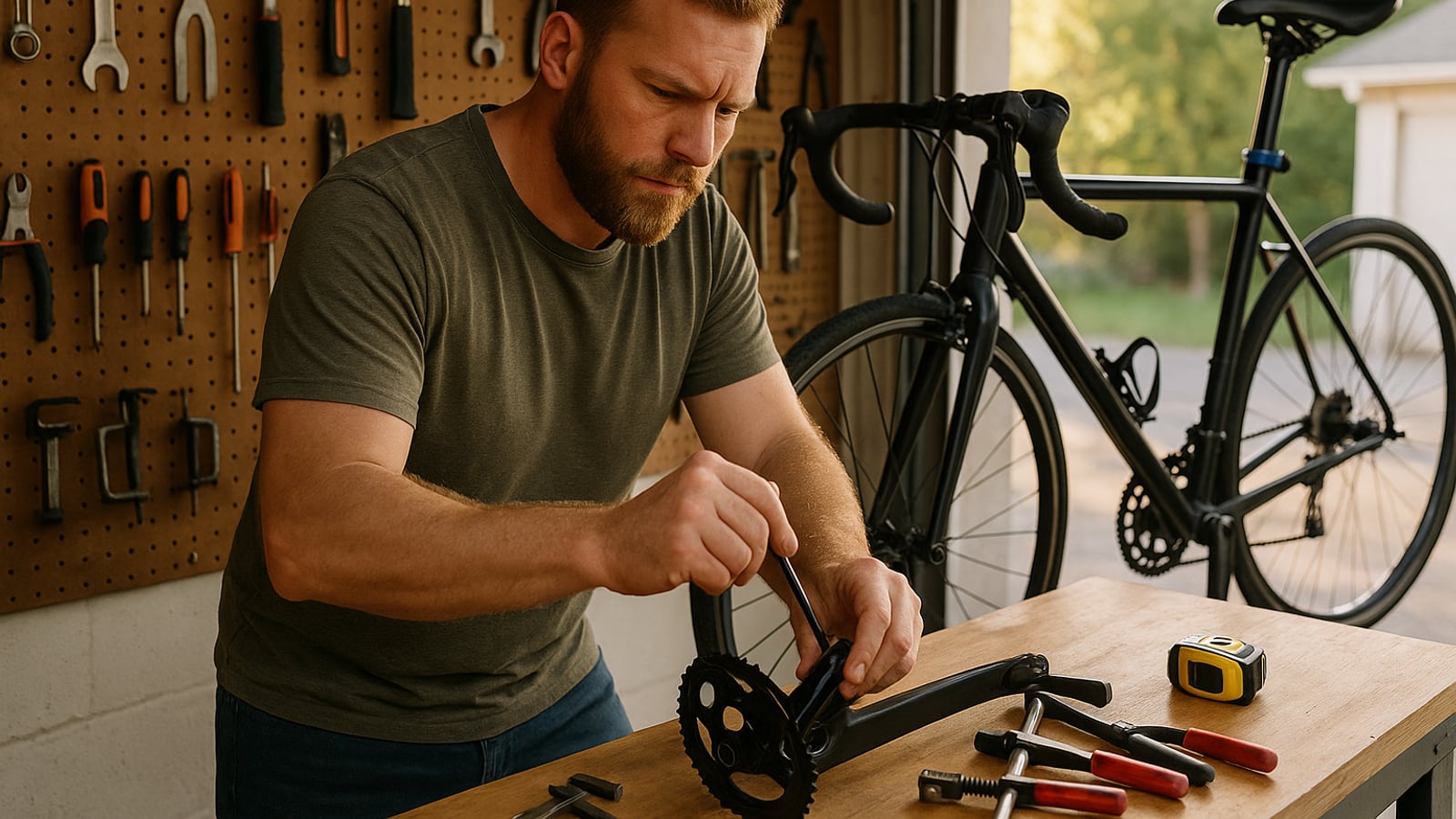
A nine-dollar hex key set cost me a Saturday. The keys were soft, the 5mm rounded off inside a bolt on a bike crank, and I spent four hours with a left-hand drill bit and an extractor getting it out. The correct set, made from decent tool steel, was about thirty dollars. So the cheap set cost thirty-nine dollars plus a weekend plus a scratched crank arm.
That's the whole calculation, and most people never run it. They compare the sticker prices and stop.
Here's the sorting rule I use now, and it isn't about brand loyalty. Buy cheap where the tool's only job is to hold a shape. Buy good where the tool transfers force into something you can't replace, holds your body weight, or tells you a number you're going to trust.
Buy cheap, and don't feel bad about it
Clamps. You need more of them than you can afford good ones. Eight mediocre F-clamps beat two excellent ones, because the failure mode of a cheap clamp is that it slips, and you notice immediately. Buy the cheap ones by the handful and one or two good parallel clamps for glue-ups that have to come out square.
Tape measures. The hook is riveted loose on purpose. That's not a defect, it's compensating for the thickness of the hook. A five-dollar tape and a thirty-dollar tape both measure. The expensive one survives being dropped off a roof more often. If you're on a roof daily, pay. Otherwise buy three cheap ones and put one in each place you lose them.
Pry bars, wrecking bars, demolition anything. You're using leverage, not precision. Forged steel is forged steel. The only thing a premium bar buys you is a nicer handle and a thinner, sharper nail slot.
Sawhorses, drop cloths, buckets, shop brooms, dust pans, extension ladders you'll... no, wait. Not ladders. I'll come back to ladders.
Sockets in sizes you touch twice a year. A full metric and SAE set from the discount rack is fine, because you'll use five of those sockets constantly and the rest almost never. The five you use constantly will eventually wear and you replace them individually with good ones. That's a perfectly sensible upgrade path.
Hand saws for rough cuts. If you're cutting through a wall, plaster and old nails will destroy the teeth of anything. Buy the cheap one and treat it as a consumable.
Never cheap, no exceptions
Anything that holds your weight. Ladders, step stools, jack stands, harnesses, roof anchors. The cheap version doesn't fail gradually. It fails all at once, sideways, with you on it. Buy a ladder rated well above your actual weight plus tools, and buy it from somewhere that will stand behind it.
Jack stands specifically. A hydraulic jack lifts. Jack stands hold. Never work under a car supported by the jack alone, and never buy the stands based on price. This is the single place in the tool world where I think price shopping is genuinely dangerous.
Anything that grips a fastener. Hex keys, Torx bits, screwdrivers, sockets you actually use, adjustable wrenches. Soft steel deforms into the fastener instead of turning it, and then you're drilling. A rounded-off screw in a piece of trim is annoying. A rounded-off bolt in an engine bay, or one in the back of an appliance you need working by tonight, is a different day entirely.
Cutting edges and consumables. Drill bits, saw blades, chisels, utility knife blades, hole saws. This feels backwards, because these wear out, so why spend? Because a good bit cuts faster, wanders less, and doesn't burn the workpiece. Cost per hole, the expensive bit usually wins. A cheap spade bit will walk across a stud and leave you with an oval you have to patch.
Measuring and marking that has to be true. A combination square that isn't square is worse than no square. Check any square you buy: draw a line off a straight edge, flip the square, draw again. If the lines don't sit on top of each other, the tool is lying to you. Torque wrenches, levels and calipers follow the same logic.
Electrical. Extension cords, surge protectors, multimeters, anything with a plug on it. Undersized cord gauge gets hot. Look for a UL or ETL mark and the right gauge for the run length. A 100-foot cord on 16-gauge wire feeding a circular saw is a bad afternoon.
Safety gear. Eye protection, hearing protection, respirators. Cheap safety glasses fog, scratch and get pushed up on your forehead, which means you're not wearing them. The expensive pair you keep on your face is the one that works.
The battery question, which is really a lock-in question
Cordless tools are priced like printers. The tool is bait. You're buying into a battery platform, and once you own four batteries and a charger, switching costs you hundreds.
So the drill isn't the decision. The platform is. Pick one from a manufacturer with a wide lineup, buy the bare tools after that, and stop cross-shopping. A mid-range drill on a good platform beats a premium drill that strands you.
One exception worth knowing. If you genuinely use cordless tools three times a year, a cheap single-brand combo kit is the correct purchase and the enthusiasts are wrong. You're not going to wear it out. You're going to charge it, use it, and put it back on the shelf.
When the cheap one is right, even for good tools
One-shot jobs. You're tiling one bathroom. Buy the cheap tile saw, or rent. Renting a good one for a weekend often costs less than buying a bad one, and the rental yard's machine is better than anything you'd buy at that price.
Tools you're learning on. Your first set of chisels will get ground at the wrong angle and dropped on concrete. Learn on cheap steel. Buy good steel when you know what you're asking of it.
Tools that live somewhere you'll lose them. The tape in the truck. The screwdriver in the kitchen drawer. The utility knife in the garden shed. Anything that migrates should be cheap and replaceable, because it will migrate right out of your life.
Specialty tools for a single repair. Spring compressors, bearing pullers, oil filter wrenches for one specific car. Many auto parts stores loan these out against a deposit. Ask before you buy.
How to actually upgrade
Don't replace your tool kit. Replace tools as they fail you, and pay attention to how they fail. A screwdriver that cams out on every third screw is telling you something. A blade that burns wood instead of cutting it's telling you something. That's your shopping list, written by the work itself.
And buy used where the tool is mostly steel and geometry. Hand planes, chisels, wrenches, anvils, vises, clamps. An old American or British made vise at a farm sale for forty dollars will outlive a new one at three times that. Rust cleans off. Cast iron doesn't care how old it's.
The tool I'd hand a new homeowner first isn't a drill. It's a decent set of six-point sockets and a 3/8 ratchet with fine teeth, because six-point grips where twelve-point rounds, and a fine-tooth ratchet works in tight spaces where a coarse one just clicks at you.
Go count your hex keys. If any of them have a shiny, slightly rounded corner, throw the set out before it costs you a bolt.
Wes Dunbar
Country & Skills
Grew up on an acreage and never quite left. Covers trucks, trades, land, and how to do the thing yourself.

Watch
Worth an hour of your evening
More from Gear.
From channels we rate. Plays on YouTube.
Read next