If the thing you're hanging weighs more than about 20 pounds, you have two good options and a lot of bad ones. Screw into a stud. Or use a steel toggle sized properly for the load. Everything else — the little plastic sleeves that came in the bag with the shelf, the self-drilling nylon anchors, the picture hooks with the angled nail — is for light work, and the packet is optimistic about what light means.
That's the whole answer. The rest is knowing which of those two you've got, and not drilling into a live wire on the way.
Work out what your wall actually is
Knock on it. A hollow, drummy sound with a thin echo is drywall over studs. A harder, denser tap with almost no give is plaster over lath, or plaster over masonry. A dead thud with no flex at all is block or brick behind the finish.
Better test: drill a small pilot hole somewhere it won't matter, low on the wall or behind where the thing will sit. Look at the dust. White and powdery is drywall or gypsum plaster. Gritty gray is cement or block. If the bit punches through and then hits something fibrous and stringy an inch in, you've got lath behind plaster.
Age of the house tells you most of it. Post-war and newer in the US is almost always drywall. Pre-war is usually plaster and lath. Neither is a problem. They just want different fasteners.
Find the stud, then prove it
Studs in most American framing sit 16 inches on center, sometimes 24 in newer or cheaper construction. Find one and the rest are predictable. Corners, window frames and door frames always have framing beside them.
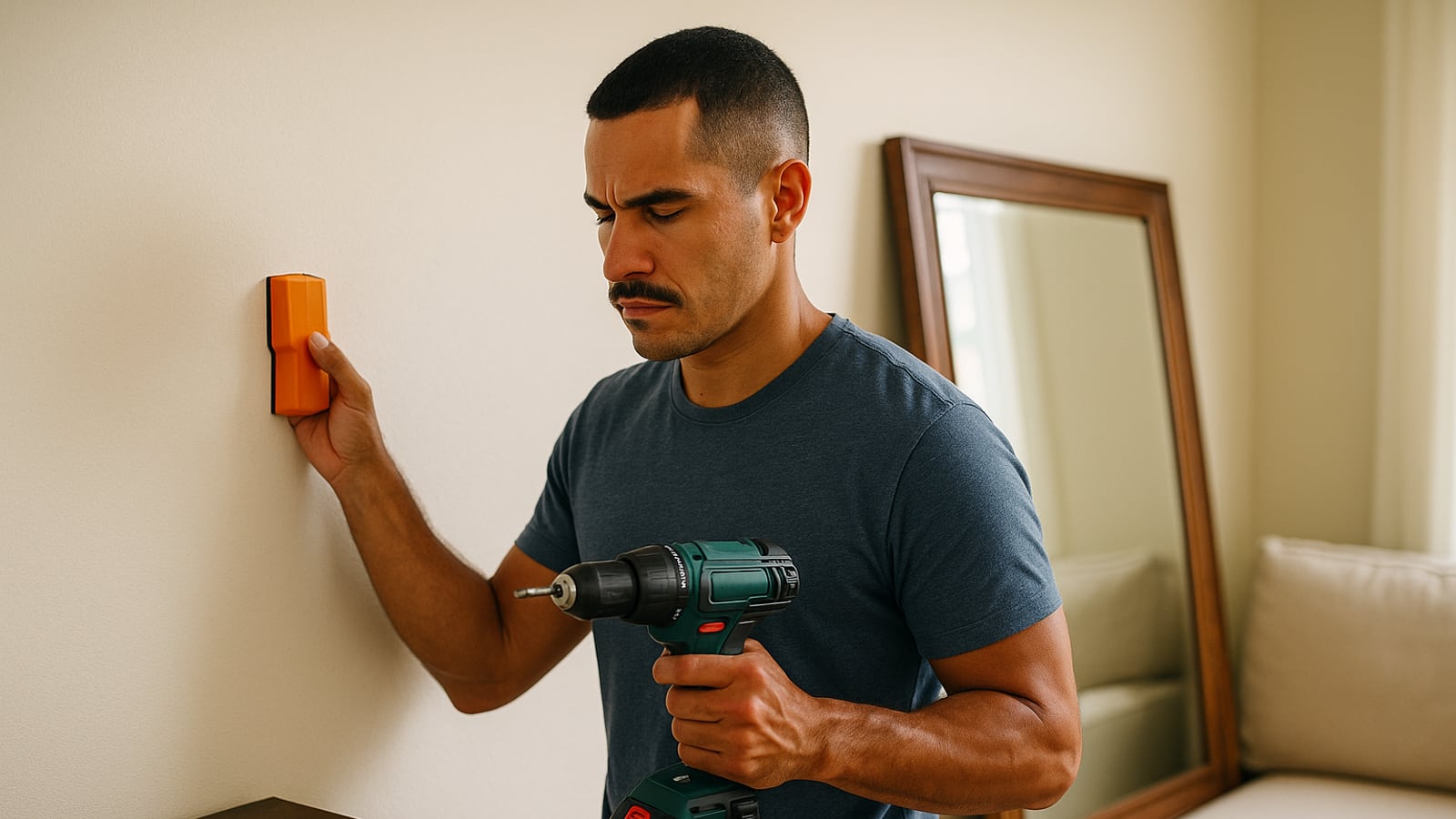
An electronic stud finder gets you close. It doesn't get you right. Calibrate it on a clearly hollow section, sweep slowly, and mark both edges of what it finds — a real stud reads as a band about an inch and a half wide, not a single beep. If it reads four inches wide, you've probably found a pipe, a duct or a doubled stud.
Then confirm. A strong magnet dragged across the wall will catch on the drywall screws running up the stud, and those screws are dead center. That's the cheapest and most reliable stud finder there's. Or push a fine finish nail through where you think the stud is. If it goes in an inch and stops hard, you're in. If it sinks to the head, you're not, and the hole is smaller than a pinhead.
Before you drill, think about what's inside the wall
Electrical cable runs vertically up stud bays and horizontally between outlets and switches. Assume there's a cable running straight up and straight down from every outlet and switch on that wall. Don't drill in that column.
Plumbing lives in kitchen and bathroom walls, and in the wall directly behind them. Exterior walls in cold climates sometimes have supply lines in them too.
Wrap a piece of tape around the drill bit at the depth you need and stop there. If you're going into a stud, you need maybe two and a half inches total. There's no reason to bury a six-inch bit in a wall cavity and find out what's behind it the hard way.
Shear versus pull-out, and why it decides the fastener
A picture hanging flat against a wall loads the fastener in shear — straight down. Fasteners are strong in shear.
A shelf with anything on it, a TV on an articulating arm, a cabinet, a coat rack that people yank on — those load the fastener in pull-out. The weight is trying to lever the top fasteners straight out of the wall. Fasteners are much weaker that way, and it's where failures happen.
The further the load sits from the wall, the worse it gets. A 30-pound TV on a fixed flat mount is nothing. The same TV on an arm extended 20 inches is a lever, and the top lag bolts are carrying multiples of that weight. Mount arms into studs. Not into drywall, not ever, no matter what the anchor packet says.
The fastener, in order of preference
Wood screw or lag into a stud. Best there's. Use a pilot hole slightly smaller than the screw's shank, and get at least an inch and a half of thread into solid wood. Structural screws with a star drive beat old-style lags for most jobs and don't need a wrench.
Steel toggle. When there's no stud where you need one. The strap or the winged bar flips open behind the drywall and spreads the load across a wide patch. The modern strap-style toggles are the best thing to happen to hanging heavy objects in thirty years, because unlike old spring toggles you can remove the bolt and the anchor stays put.
Plastic expansion anchors. Fine for a smoke detector or a small frame. Not for shelves. Not for anything your kids will hang off.
Whatever the packet says the anchor holds, treat that as a lab number achieved in perfect half-inch drywall at a fresh hole. I work to a fraction of it and I've never had anything fall.
French cleats for the heavy, wide stuff
For a big mirror, a long shelf, a wall-mounted cabinet or a heavy piece of art, a French cleat beats any single hanger. Two strips of plywood or aluminum, each cut at a 45-degree bevel, one screwed to the wall across multiple studs, the other on the back of the object. They interlock, and gravity pulls them tighter.
The advantages are real. The load spreads across several studs instead of one point. It hangs dead flat against the wall. It lifts off in seconds when you paint. And you can slide it left or right along the cleat to get the position right without drilling again.
Plaster and masonry
Plaster is brittle and the lath behind it's thin. Drill, don't hammer, and back the speed off. Put masking tape over the spot before drilling to stop the face from chipping. Over-tightening crushes the plaster and the fastener spins uselessly, so stop the moment it snugs up.
For brick, block or concrete, use a hammer drill with a masonry bit and a proper sleeve anchor or concrete screw. In brick, go into the brick face rather than the mortar joint when the load is serious — mortar is softer and crumbles. Blow the dust out of the hole before setting the anchor. Dust in the hole is why concrete screws strip.
When to stop and call someone
Anything hanging from a ceiling that will carry a person or take dynamic load — a hammock chair, a heavy bag, a porch swing, a big light fixture — is a different problem. Joists aren't always where you want them, and dynamic loads shock-load a fastener far beyond the static weight. Get a carpenter to look at it, or pay for blocking to be added between joists.
Call an electrician if you've nicked a cable, if you smell anything hot, or if you're mounting on a wall crowded with switches and you can't work out where the runs go. Call a plumber if water appears.
If the house is pre-1980 and you're about to drill into textured coatings or old plaster, find out what's in it before you make dust. That's a question for a licensed testing service, not for you and a drill on a Saturday.
And nothing heavy goes above a bed, a couch where people nap, or a crib. Not with the best anchor made. The math on that one isn't worth doing.
The last thirty seconds
Once the bracket's up and before the object goes on it, hang your own weight off it. Both hands, feet still on the floor, lean into it. If it creaks, moves, or dimples the drywall, take it down and do it again with better fasteners.
The wall will tell you the truth while you're standing there. The alternative is finding out at two in the morning, from the other room.
Wes Dunbar
Country & Skills
Grew up on an acreage and never quite left. Covers trucks, trades, land, and how to do the thing yourself.

Watch
Worth an hour of your evening
More from Home.
From channels we rate. Plays on YouTube.
Read next