Find something solid to hang from. A pull-up bar, a sturdy tree branch, the top edge of a door frame if your fingers will reach. Take hold of it, let your feet stay on the ground or a chair if you need them, take some weight off your legs, and count.
That number tells you more about how the next ten years will go than your cholesterol panel does.
Grip strength has become one of the most watched measurements in aging research for a simple reason: it's cheap, it's quick, and it's difficult to cheat. Researchers have found over and over that people with weaker grips tend to fare worse across a long list of outcomes, including recovery after surgery, falls, and how long they stay living independently. It isn't that your hands are running the show. It's that your hands are honest about everything else.
Why a squeeze predicts so much
Your grip is the last link in a long chain. To crush a handle hard, you need muscle mass in your forearms, yes, but you also need a nervous system that can recruit that muscle quickly, shoulders and a trunk that can brace against the effort, and joints that aren't so painful you unconsciously back off.
Muscle loss with age doesn't announce itself. You don't wake up one morning down five pounds of lean tissue. It leaks away quietly over years, and the scale hides it because fat moves in as muscle moves out. Your grip doesn't hide it. A hand that used to open any jar in the kitchen and now needs the rubber gripper has told you something real.
Nerve function shows up there too. So does inflammation from arthritis, and the general fatigue that comes with chronic illness. When something is going wrong systemically, grip is often one of the first places it registers.
That's the whole appeal. One measurement, taken in under a minute, catches a wide net.
Get an actual number
Guessing is useless. Measure.
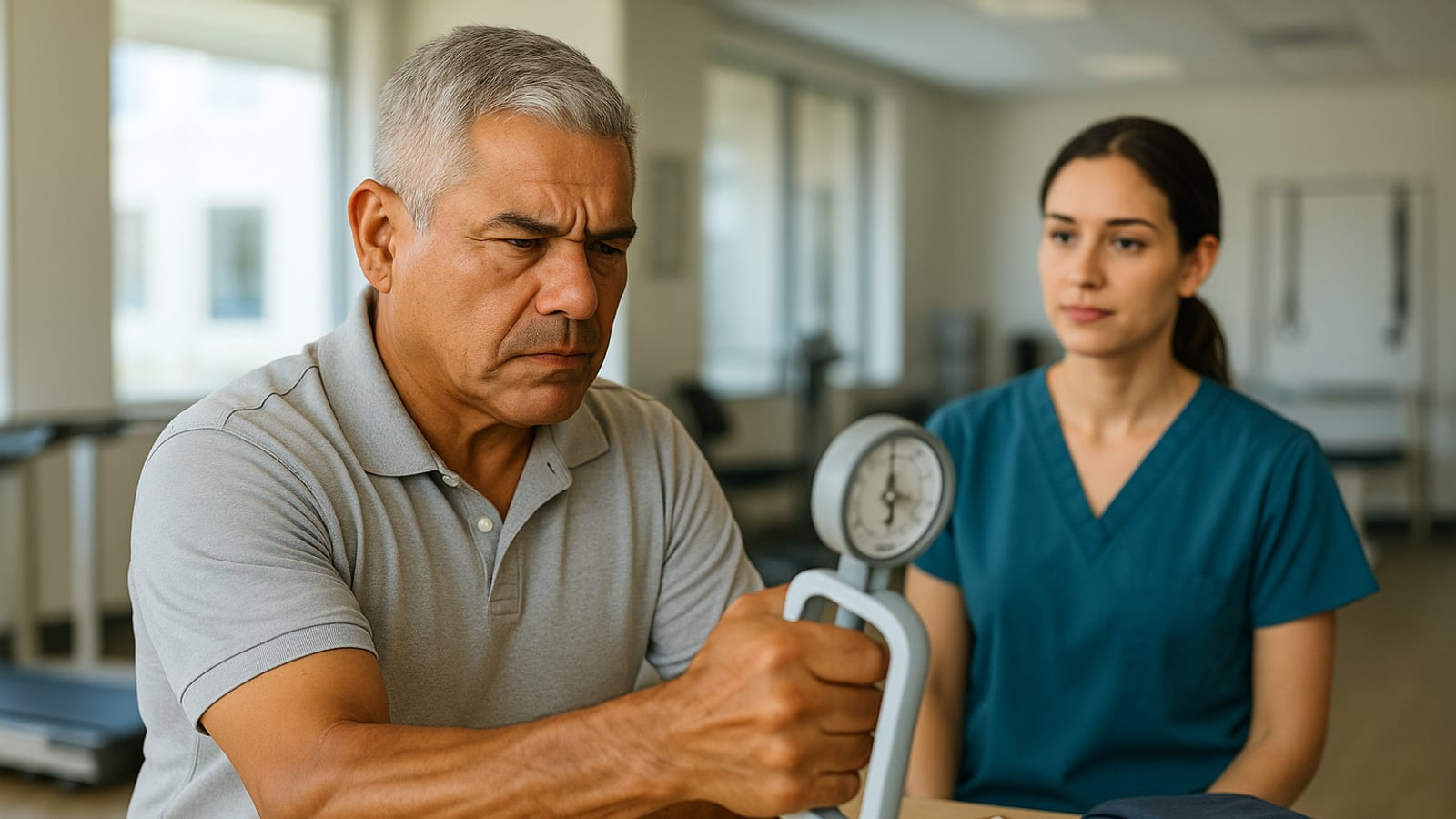
The clinical version. A hand dynamometer is the standard tool, and your doctor's office or a physical therapy clinic likely has one. Ask for a reading, and ask how it compares to typical values for your age and sex. This is worth doing once and then repeating each year, the way you'd track blood pressure. A physical therapist is the right person to interpret it, especially if the number surprises you.
The dead hang. Hang from a bar with both hands and time it until your grip fails. Not your shoulders, not your patience, your grip. If you can't support your full bodyweight, keep your toes down and hang from a low bar. The number matters less than the trend. Test it today, write it down, test it again in eight weeks.
The carry. Pick up something heavy in each hand — dumbbells, a pair of loaded grocery bags, two five-gallon buckets with water in them — and walk until you have to put them down. Time it, or measure the distance.
Daily-life tells. Jar lids. The gas cap. Wringing out a towel. Holding a coffee cup with one hand while you unlock a door. When these start requiring a strategy, the number has already moved.
Write the results in the same place every time. A note on your phone is fine. What you're looking for isn't one score but a line going the right direction.
What to do about a low number
The good news buried in all this: grip is trainable at any age. Muscle responds to load in your seventies and eighties. It responds more slowly than it did at thirty, and it needs more protein and more recovery, but it responds.
Three kinds of work cover it.
Carries. The single best thing you can do. Hold weight in both hands, stand up tall, walk. Farmer carries build grip, shoulders, core, and the balance you need not to fall over. Start with something you can hold for 30 seconds without your form breaking down. Work up to a minute. Then get heavier weights, not longer times.
Hangs. Hanging from a bar loads the fingers and decompresses the shoulders at the same time. If a full hang is too much, put a chair under you and take a third of your weight through your feet. Accumulate a couple of minutes total across several short hangs.
Holds and pinches. Grab a weight plate by the smooth side and pinch it for time. Squeeze a tennis ball, though understand this is the gentlest option and won't build much on its own. If you want a gripper, buy one you can close for a handful of reps, not one you can barely budge.
Add one more thing most people skip: extensor work. Wrap a rubber band around your fingertips and open your hand against it, 15 to 20 times. Every grip movement closes the hand. Training the opposite direction keeps the elbow and forearm from getting cranky.
A week that works
Two sessions, ten minutes each, tacked onto whatever else you're doing.
- Farmer carry: 3 rounds, 30 to 45 seconds each, rest fully between
- Dead hang: 3 rounds, hang until you're about five seconds from failing
- Band extensions: 2 rounds of 20
- Plate pinch or gripper: 3 rounds if you feel fresh, skip it if you don't
Progress by adding weight, not by adding days. Forearms and finger tendons take longer to adapt than muscle does, and tendons are where people get hurt.
Where this goes wrong
The most common mistake is training grip every single day because the sessions are short and it feels like free work. It isn't free. Elbow tendinitis from overzealous gripper work is miserable and can sideline you for months. Three sessions a week is plenty.
The second mistake is treating grip as the goal instead of the signal. A strong grip on a weak body is a curiosity. Grip strength predicts things because it reflects total strength, so if your reading is low, the answer isn't only squeezing a ball on the couch. It's squats or sit-to-stands, something that loads your legs, enough protein at each meal, and enough sleep to recover from any of it. Ask your doctor before starting if you've got heart concerns, recent surgery, or joint replacements.
The third is ignoring pain. Numbness or tingling in the fingers, a grip that's weak on one side only, a sudden drop over a few weeks — none of that's ordinary aging. That's a conversation with your physician, and the sooner the better. Nerve compression, thyroid problems, and medication side effects all show up in the hands, and most of them are treatable when caught early.
The thing worth holding onto
An eighty-year-old with a strong grip carries his own suitcase, gets himself up off the floor, holds a grandchild without doing the calculation about whether he can, and keeps the car keys longer.
Every one of those is a small piece of not needing anybody's permission. That's what you're training for. Not a number on a dynamometer, but the ability to pick up whatever needs picking up and go where you were planning to go.
Go hang from something. Find out where you stand.
Marcus Vale
Editor-in-Chief
Twenty years in magazines, most of it deciding what to cut. Writes about work, discipline and the decisions that compound.

Watch
Worth an hour of your evening
More from BRO Seniors.
From channels we rate. Plays on YouTube.
Read next