Train the catch step before you need it
Balance is a trainable skill that quietly erodes when you stop asking anything of it. Ten minutes at the kitchen counter, five days a week, rebuilds it.
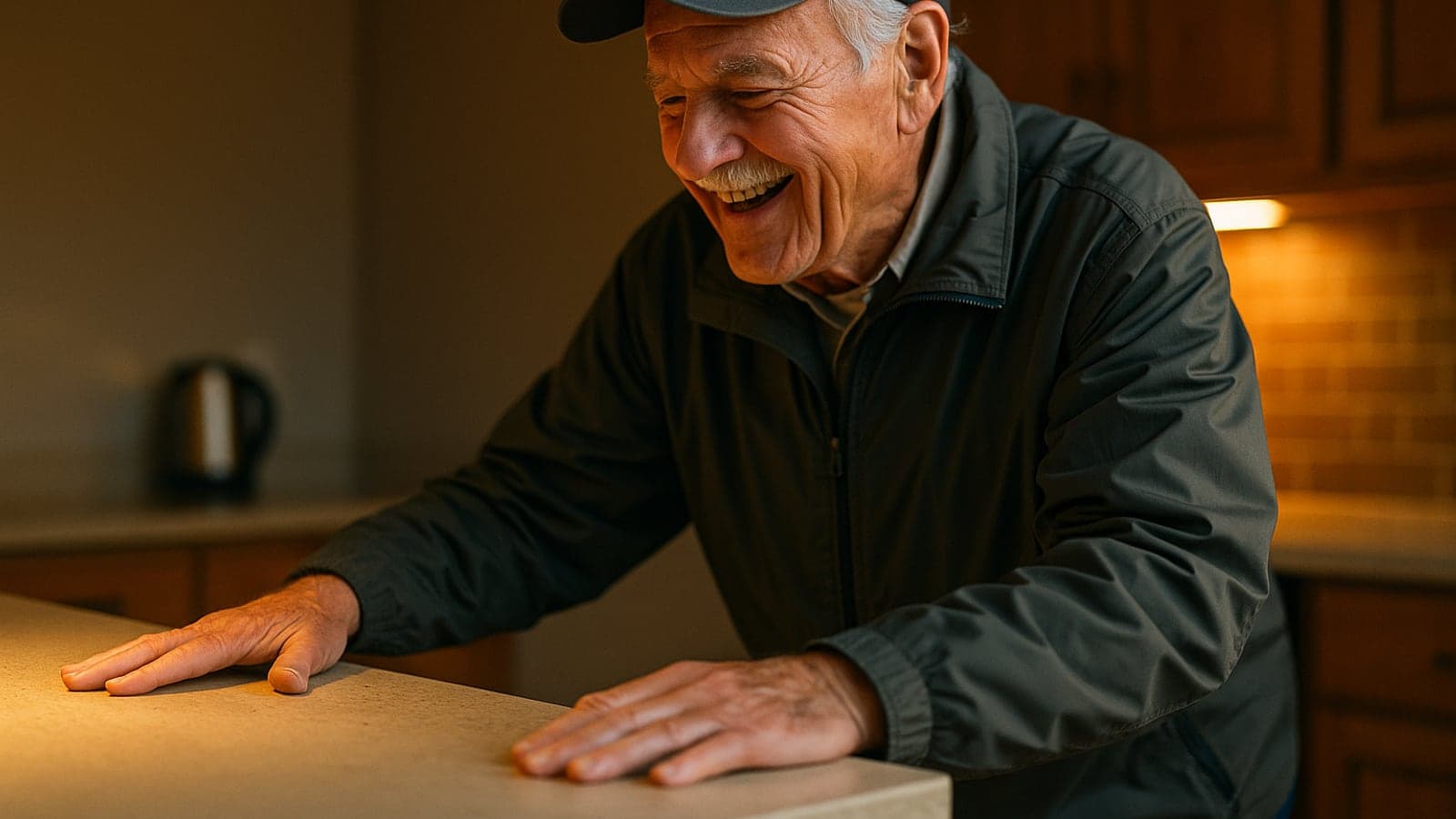
Stand on one leg right now, next to a kitchen counter, fingertips resting on it but not gripping. Lift the other foot two inches off the floor. Count.
If you got past 30 seconds without the counter, your balance is in decent shape. If you wobbled at eight and grabbed for the worktop, that's not a sign of decline. It's a sign of disuse. Balance is a skill, like changing gear smoothly or throwing a dart. Stop practising it and it goes. Practise it and it comes back, at 62 and at 82.
Nobody sells you this. There's no machine for it at the gym, no supplement, no kit. The whole programme costs nothing and takes about ten minutes, which is exactly why it gets skipped.
What's actually going on
Your body keeps you upright using three streams of information: your eyes, the balance organs in your inner ear, and the sensors in your feet, ankles, hips and spine that tell your brain where your limbs are. Take away any one and the other two compensate. That's why standing on one leg gets dramatically harder the second you close your eyes.
Two things change with age. The signal quality drops a little. And, far more importantly, most people stop giving the system anything difficult to do. You walk on pavement. You sit. You drive. Nothing ever asks your ankles for a fast correction, so the fast correction gets slow.
The other half of the problem isn't balance at all. It's force. When you catch a trip, you have roughly half a second to plant one foot in front of you and absorb your entire body weight on a single leg. That's a strength event. Plenty of men have good enough balance to notice they're falling and not enough leg to do anything about it.
Test yourself properly, then write it down
Four tests. Do them by a counter, wearing shoes or bare feet, not socks.
- Single-leg stand, eyes open. Both sides. Time it. Stop when you touch the counter or the raised foot lands.
- Single-leg stand, eyes closed. Fingertips hovering an inch above the counter. Most people who manage 30 seconds with eyes open get five to ten with them shut.
- Tandem stance. Heel directly in front of toe, like standing on a line. 30 seconds each way.
- Sit-to-stand. From a dining chair, arms folded across your chest, ten reps. Note whether you can do it at all without hands, and whether you have to rock forward to launch.
Write the numbers on a card and stick it inside a cupboard door. Retest in six weeks. You will improve, and you'll only know it if you wrote it down.
One honest caveat. If you've already had a fall, or you get dizzy standing up from a chair, don't start with eyes-closed drills alone in the house. Book a proper falls assessment through your GP and ask for a referral to a physiotherapist. They can screen for inner-ear problems and blood pressure drops that no amount of counter drills will fix.
The ten-minute block
Do this five days a week. Attach it to something you already do — I do it while the kettle boils, which is about the right length of time and means I never have to decide to do it.
Single-leg stance, 30 seconds each side. Start with two fingertips on the counter. Progress to one finger, then hovering, then eyes closed. That's four levels and it'll take you months to climb them. Good.
Head turns, feet together, 20 seconds. Stand tall, feet touching, and turn your head slowly left and right as if watching traffic. Then up and down. This one feels ridiculous and it's the one that trains the inner ear. If it makes you queasy, shorten it rather than skipping it, and mention the queasiness to your doctor.
Heel-to-toe walk, ten steps out and back. Along a floorboard seam if you have one. When that's easy, do it turning your head side to side as you go.
Step-ups onto the bottom stair, eight each leg. Up in one second, down in three. The slow lowering is the whole point — that's the same muscle action as catching yourself.
Calf raises, 15 reps. Then try five on one leg. Your ankles do more of the small corrections than anything else and they're usually the weakest link.
Sit-to-stand, ten reps, no hands.
That's it. Eight to ten minutes.
The drill that actually matters
Everything above trains the slow, quiet part of balance. Real falls aren't quiet. You catch a toe on a paving slab, a dog lead goes tight, you step off a kerb you thought was two inches and it's five. The body has to produce a big step, fast, in a direction it didn't plan.
So practise the big step.
Stand with your feet together, somewhere with clear floor in front of you and a wall within reach on one side. Let yourself lean forward from the ankles, keeping your body straight, until you genuinely have to step. Then step — one big recovery stride, plant, stop dead. Don't shuffle. Five reps, alternating which foot leads.
Lean further each week. After a month, add a version where someone gives you a light, unannounced push on the shoulder while you're standing on the kitchen mat. Sounds silly. It's the closest thing at home to what a trip actually feels like.
Then there's the drill men hate most: getting down onto the floor and back up again, three times, without using a chair. Notice which hand you plant, which knee goes down first. If you can't do it, that's not a reason to avoid it — that's the whole reason to do it. A fall you can get up from is an inconvenience. A fall you can't get up from is how people end up in hospital for something unrelated to the fall itself.
The unglamorous half
Training is maybe 60 per cent of it. The rest is housekeeping, and it's boring, and it works.
Walk the route you take at 2am from bed to bathroom. Do it in the dark. Every cable, every rug corner, every bin that lives half in the doorway — that's the route where falls happen, because you're half asleep and your blood pressure has just dropped from standing up fast. Put a plug-in night light in the hall. Sit on the edge of the bed for ten seconds before you stand.
Bin the backless slippers. A slipper that stays on because your toes are gripping it is a slipper that changes how you walk, all day, every day. Get something with a back and a sole with actual tread.
If you wear varifocals, be careful on stairs. Looking down at your feet puts the step edge in the reading portion of the lens, right where it's blurred. A lot of people keep a cheap single-vision pair for stairs and the garden. Ask your optometrist.
And ask a pharmacist for a medicines review if you take more than three or four things. Some combinations affect blood pressure when you stand, some affect alertness overnight. You won't spot the interaction. They will, in about fifteen minutes, free.
Six weeks from now
You won't feel dramatically different. There's no pump, no soreness, nothing to post about. What happens instead is that one day you'll catch your foot on a kerb outside the supermarket with a bag in each hand, and you'll take one sharp step, and carry on walking, and think nothing of it until later.
That step is the entire programme. Everything else is just how you buy it.
Marcus Vale
Editor-in-Chief
Twenty years in magazines, most of it deciding what to cut. Writes about work, discipline and the decisions that compound.

Read next