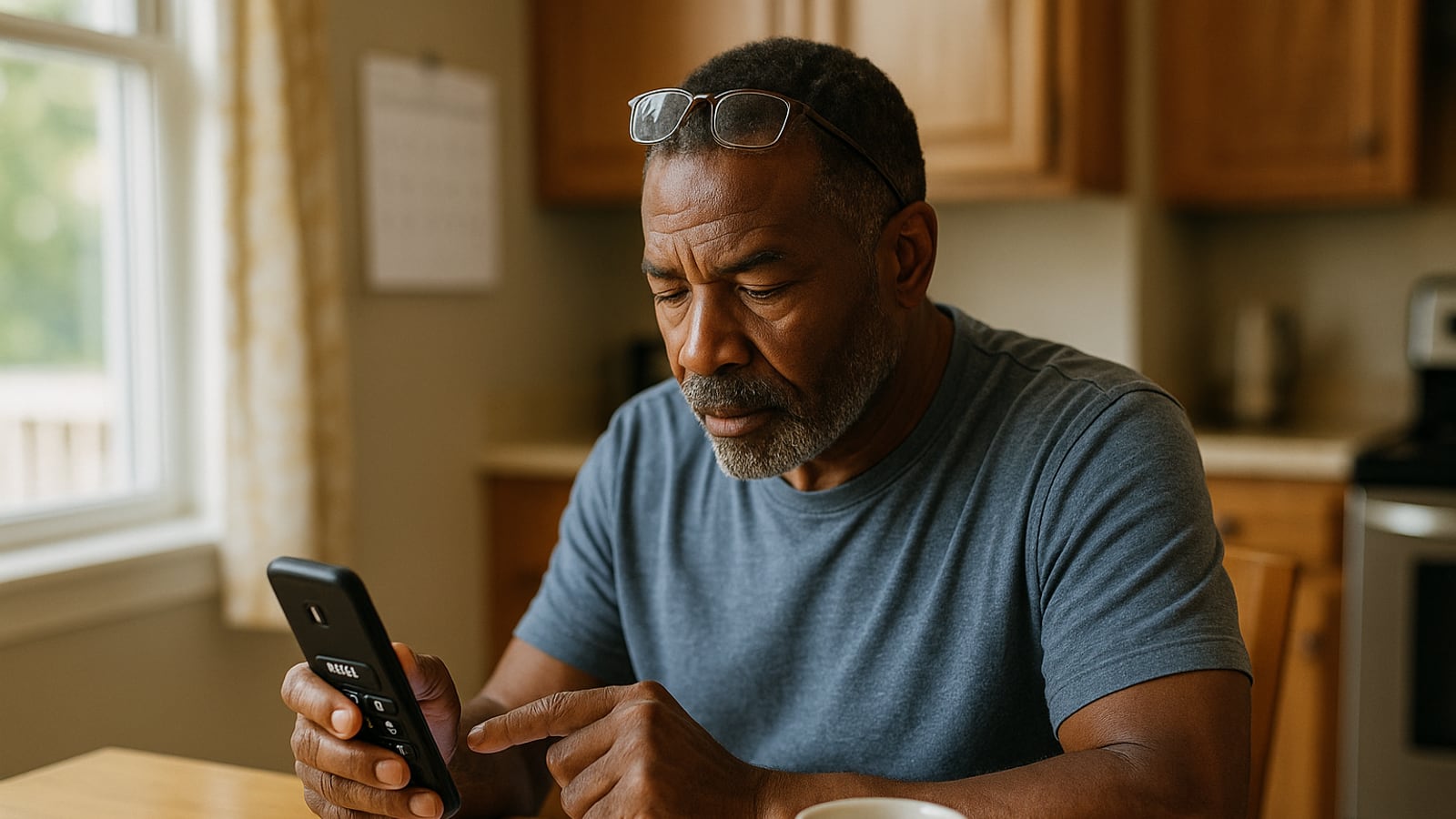
Four things earn their place: a phone you can see and hear, a backup for your photos and documents, a way to watch your money without driving anywhere, and a way for someone to find you on a bad day.
Everything else is optional. Not "optional but you really should." Optional. You can refuse it, and your life will be the same or better.
That's the whole argument. The rest is how to do those four well and how to say no to the rest without a fight at Christmas.
A phone you can see and hear
The single highest-value hour you'll spend on technology is making your phone work for your actual eyes and your actual ears. Most people never do it. They squint at factory settings for six years and conclude they're bad with phones.
Go into the settings and turn the text size up. Not one notch. Turn it up until you can read a message at arm's length without leaning in. Turn the screen brightness up too. Then find the accessibility menu and look for the option to make the text bold.
Turn on the setting that silences calls from numbers not in your contacts. Both major phone systems have a version of it. Your family, your doctor's office, your church — all in contacts, all ring through. Everyone else goes to voicemail, where you can read a transcript at your leisure. This one setting eliminates most of the scam calls you get.
If you're struggling to hear on the phone, that's not a phone problem. That's an ears problem and it's worth a proper hearing test with an audiologist. Hearing loss makes people withdraw from conversation, and withdrawing from conversation is the beginning of a lot of worse things. Modern hearing aids connect to phones directly. The call goes into your ears, clear.
One place your photos and papers live
Your photographs are on a phone. If the phone goes in a lake, they're gone. So are the pictures of your parents somebody scanned for you.
Turn on automatic photo backup. Both phone systems do it, and the first chunk of storage is usually free. When you run out, you'll be offered a small monthly fee for more. Pay it. It's the one subscription I'd argue for without hesitation, because the alternative is losing sixty years of faces.
While you're at it, photograph the paperwork that matters. The deed. The insurance declarations page. The car title. Passport photo page. Medication list. Those photos back up with everything else, and they live in your pocket when you're sitting in a waiting room trying to remember the name of the blood pressure pill.
Tell one adult child or trusted person where the backup is and how to get into it. A backup nobody can reach is a filing cabinet at the bottom of the sea.
Watching your money from your chair
Online banking gets refused more than anything else on this list, usually because it feels like the risky option. It's the opposite. The person who checks their accounts twice a week catches a fraudulent charge in days. The person who waits for a paper statement catches it in weeks, if at all.
Set up account alerts. Most banks will text or email you every time a card is used, or every time a transaction goes over an amount you choose. That's a burglar alarm on your money, and it costs nothing.
Use a different, long password for the bank than you use anywhere else. Turn on the two-step login where they text you a code. Yes, it's an extra step. It's the step that stops someone who has your password from getting in anyway.
If you want help setting this up, your branch will do it in person. Ask. That's a service they offer and almost nobody uses.
Being found on a bad day
Newer phones and watches can detect a hard fall and call for help if you don't respond. If you live alone, that feature alone justifies the device.
The other option is a pendant or wristband with a monthly monitoring fee. The trade-off is straightforward: the pendant is simpler and you'll actually wear it in the shower, where a lot of falls happen. The phone does more but you have to have it on you, and people don't carry phones around their own house.
There's also location sharing with family. You choose who sees where you're. Some people find it comforting and some find it intrusive, and both reactions are legitimate. If you hate the idea, say so plainly and offer an alternative — a check-in text every morning, say. What your family actually wants is to know you're all right. Give them that in a form you can live with.
The things you can refuse
A smart speaker in every room. Convenient for timers and weather. It's also a microphone that's always listening for its name. If that bothers you, don't have one. Nobody needs one.
A second screen you didn't ask for. Free tablets bundled with a service almost always carry a fee somewhere, or lock you into a contract. Read the part in small print.
Extended warranties on cheap electronics. If the thing costs less than a nice dinner out, insuring it makes no sense.
Social media, if you don't want it. The photos of grandchildren can be sent to you directly. Ask for that. Most families are happy to.
Anything sold to you as "senior-friendly" at a premium. The big-button phone at a big price is usually a standard phone with the text size turned up. You can do that yourself in two minutes.
Automatic renewals you never chose. Once a year, look at the recurring charges on your card statement and cancel anything you can't name and describe.
The call that isn't from your bank
No bank, no government agency and no police department will ever call you and ask you to move money to keep it safe. Not once. Not ever. Anyone who says that sentence is stealing from you.
Nor will a pop-up on your screen tell you your computer is infected and give you a number to call. Close the window. If it won't close, hold the power button until the machine shuts off.
And a grandchild in trouble doesn't need you to buy gift cards. Agree on a family password now — a word only your people would know — and use it. When the panicked call comes, ask for the word. The voice on the phone can sound exactly like your grandson and still not be him.
Hang up. Call the person back on the number you already have. Being rude to a stranger costs you nothing.
The deal to make with whoever helps you
Whoever sets your devices up — a son, a neighbor, a kid from church — make one rule with them. They don't touch anything without you watching, and they write down what they did.
Keep a single notebook with the account names, and store it somewhere private in the house. Not in the phone. Paper, in a drawer, where your spouse or executor can find it.
The person who says "don't worry about it, I'll handle it" is being kind and leaving you helpless. You want the one who says "sit here, I'll show you."
You've run a household, raised children, held a job, and buried people you loved. A phone isn't going to beat you. It's a tool, and you've learned harder tools than this.
Dean Shaw
Gear & Garage
Tests things until they break, then reports what broke first. Trucks, tools, watches, and the cheap version that costs more.
Watch
Worth an hour of your evening
More from BRO Seniors.
From channels we rate. Plays on YouTube.
Read next