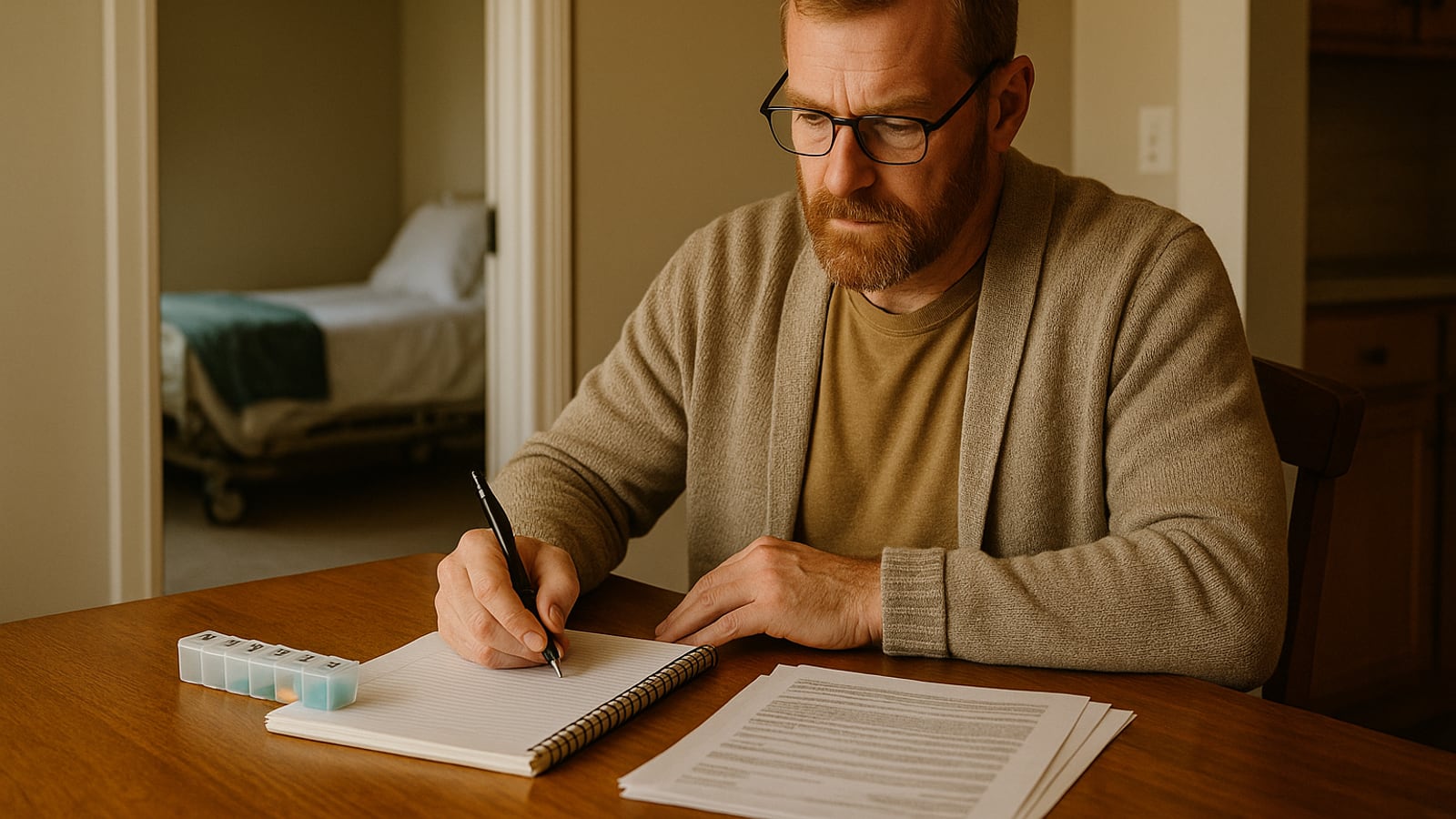
Buy a notebook. A cheap one, spiral bound, and keep it in the same bag you take to every appointment.
In it goes the date, the name of who you saw, what they said, what changed, and any number they gave you. Write the medication list on the inside front cover in pencil so you can rub it out and update it. Every dose, every strength, every time of day, including the vitamins and the over-the-counter things nobody thinks to mention.
That notebook does more work than you'd believe. Six weeks in, when a specialist asks when the swelling started and your wife says spring and you say it was after Easter, you open the book and there it's. Tuesday the 14th. Nobody's memory survives this, and yours is being asked to hold more than it ever has.
Go to the appointments, and go prepared
Write three questions down before you leave the house. Three, not ten. You'll get maybe fifteen minutes and half of it will go on things you didn't plan for.
The questions that earn their keep are the practical ones. What should we watch for at home that means we call you. What should we watch for that means we go to the emergency room. What does this look like in six months if it goes well, and what does it look like if it doesn't.
Sit where you can see her face, not the doctor's. You're there to catch what she doesn't say. She may nod at everything and then tell you in the car that she didn't understand a word of it, and that's normal, and it's not a sign she's failing.
Ask for things in writing. Most offices will print an after-visit summary if you ask. Staple it into the notebook.
And say plainly, once, to whoever's leading her care: I'm her husband and I'm doing the day-to-day. Tell me what I need to know. Most clinicians will meet you there. If one won't, ask about a patient advocate or a care coordinator.
Fix the house before you need to
The falls happen in three places. The bathroom, the stairs, and the two steps from the back door.
Grab bars go into studs or proper anchors, never into drywall alone. A suction-cup bar will come off the tile at the worst possible moment. A shower chair and a handheld sprayer cost very little and change bathing from a two-person struggle into something she can do herself, which matters more to her than you might realize.
Clear the floor. Rugs, cords, the magazine rack, the dog's bowl by the doorway. Put a lamp on a timer in the hall so the path to the bathroom is never dark.
If stairs have become a real problem, have the conversation about moving the bed downstairs before someone falls, not after. It feels like a surrender. It isn't. It's the same logic as moving the woodpile closer to the door as you get older.
A physical or occupational therapist can walk the house with you and spot what you've stopped seeing because you live there. Worth asking her doctor for the referral.
The paperwork nobody wants to do
Get the legal documents done while she can clearly say what she wants.
You want a durable power of attorney for healthcare, a durable power of attorney for finances, and whatever your state calls an advance directive or living will. You also want the medical records release form signed at each of her providers, because without it people will refuse to talk to you on the phone and they'll be right to.
Sit with an attorney who does elder law. It's a few hundred dollars to a couple of thousand depending on where you're and how complicated your affairs are, and it's the difference between making decisions and begging a court for permission to make them. Don't do this from a website template. The rules vary by state and the details matter.
While you're in the files: know where the insurance policies are, what the deductible is, whether she has long-term care coverage, and what your own coverage does if you're the one who goes down. Keep copies in one place and tell one adult child where that place is.
Let people help, and be specific about how
People want to help. They're just bad at guessing, so they say "let us know if you need anything" and then nothing happens, and you decide nobody cares.
Give them a job. Thursday afternoon, two to five, sit with her so I can get to my own doctor. Pick up the prescription on your way home. Mow the strip by the fence. Bring a meal in a dish you don't want back.
Church is built for this if you'll let it. A deacon, a care team, the women who've done this for their own husbands and know exactly what the hard hours are. Ask. Pride keeps more men isolated in this season than anything else does.
And look into respite care properly. Adult day programs, in-home aides, short stays. If she's a veteran's spouse, or a veteran herself, check what the VA offers. Your county's area agency on aging will know what exists locally and what it costs, and that phone call is free.
Your own body is on the line
Caregiving husbands skip their own appointments first. Then sleep. Then movement. Then food becomes whatever's in reach at ten at night.
Book your own physical now and keep it. Tell your doctor what you're carrying at home, because it changes what they watch for in you. Blood pressure, weight, sleep, mood. Don't wait for the six-month mark when you can barely get off the couch.
Protect sleep like it's a prescription. If the nights are broken, sleep when she sleeps in the afternoon and let the laundry sit. Broken sleep is what turns a capable man into a short-tempered one who makes medication errors.
Walk. Twenty minutes, most days, outside, ideally with someone. It's blood pressure, it's your back, and it's the only twenty minutes where nobody needs anything from you.
Eat something with protein in it before noon. That's it. That's the whole nutrition plan for this season.
She's still your wife
The thing that gets lost is the marriage. You become a nurse and a driver and a pharmacist, and one day you notice you haven't had a conversation that wasn't logistics in a month.
Put something back that isn't care. The radio program you both like. Reading aloud to her. Coffee on the porch in the morning before the day starts. Praying together at night, even when the prayer is short and you're too tired for words.
Ask her what she wants, and then do what she said, even when you'd do it differently. Illness strips away a person's choices one at a time. You can hand some back.
You'll get angry. At the insurance company, at her sometimes, at God probably. That's not a character failure and it's not a crisis of faith. Take it to a friend, a pastor, a counsellor, or a caregiver support group where nobody flinches when you say it out loud.
You made a promise in front of people about sickness and health, when you were young enough to think it was poetry. Turns out it was a job description. You're doing it.
Cal Brennan
Fitness
Strength coach. Trains fathers, tradesmen and desk workers, which means programmes that survive a bad week.

Watch
Worth an hour of your evening
More from BRO Seniors.
From channels we rate. Plays on YouTube.
Read next