Balance is trainable, and almost nobody trains it
A ten-minute self-test, a progression that actually gets harder, and the drill that matters most: getting a foot out fast.
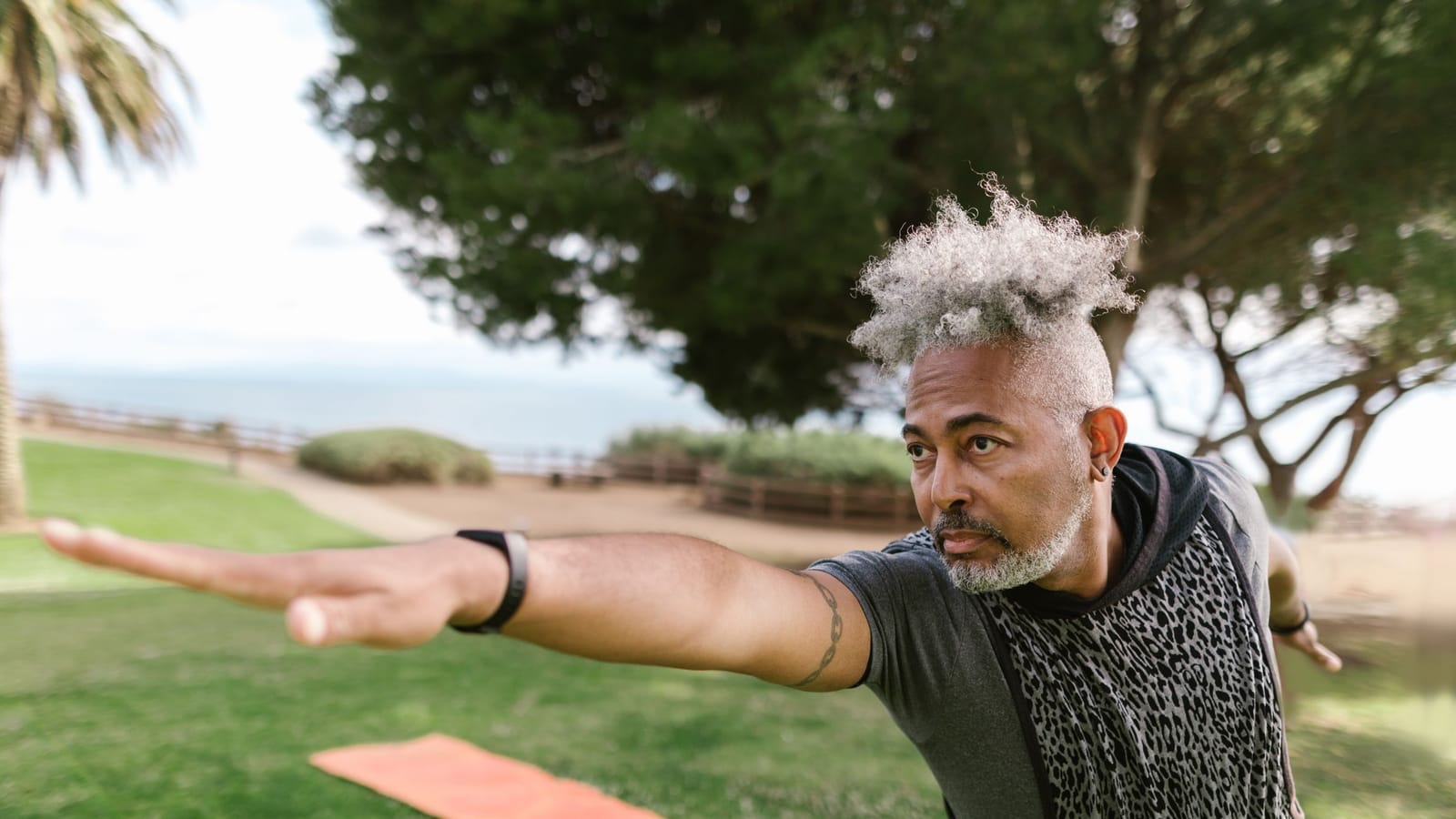
Go to the kitchen counter. Shoes off. Rest one hand lightly on the worktop, lift one foot to ankle height, and take your hand away. Pick a spot on the wall and look at it. Count.
Now do the other side. Then do both sides again with your eyes closed, hand hovering an inch above the counter.
That's your baseline, and it took ninety seconds. Most men are shocked at the eyes-closed number. Thirty seconds with your eyes open and four seconds with them shut is extremely common, and it tells you exactly where the gap is.
Nobody sells you this training because there's nothing to sell. No machine, no subscription, no supplement. A balance program costs zero pounds and fits in the gap while the kettle boils, which is precisely why it gets skipped.
Four tests, and what each one tells you
Do these once, write the numbers on the inside of a cupboard door, and redo them in eight weeks.
Single-leg stand, eyes open. Near a counter. Time each side. Note the difference between legs. A ten-second gap between sides is worth paying attention to, because you don't get to choose which foot slips.
Single-leg stand, eyes closed. This removes vision and forces your ankles and inner ear to do the work. Most of your real-world stumbles happen in low light, on uneven ground, or when you're looking at something other than your feet. This is the honest test.
Five chair stands, no hands. Sit on a dining chair, arms crossed over your chest, stand and sit five times as fast as you can control. If you need to rock forward, or if the fifth one is noticeably slower than the first, you've found a leg strength problem wearing a balance costume.
Tandem walk. Heel to toe along a floorboard seam, ten steps, arms by your sides rather than out like a tightrope walker. Then ten steps backwards. Backwards is where it falls apart for most people.
The thing that actually breaks
Standing still on one leg is a useful test. It's not how anybody falls.
You fall because your toe catches a rug edge, or a kerb is two inches higher than you assumed, and you need to fire one leg out in front of you in about a quarter of a second. That's a power problem, not a balance problem. Power declines faster with age than strength does, which is why a man who can still squat a respectable weight slowly can't get a foot out in time.
So train the step. Stand in a doorway, feet together. Have somebody give your shoulder a firm nudge from behind, or lean forward yourself until you have to step. Catch yourself with one big step, stop dead, don't shuffle. Ten of those forward, ten sideways each way. It feels ridiculous for about a week and then it feels like a skill.
If nobody's around to nudge you, stand in a split stance and practise a fast, long step out and a hard stop. Speed of the step is the whole point. Slow and graceful teaches you nothing.
The progression, in order
Move up a rung only when the current one is easy for sixty seconds a side.
- Feet together, eyes closed
- Heel-to-toe stance, eyes open
- Heel-to-toe stance, eyes closed
- Single leg, eyes open
- Single leg, eyes open, turning your head slowly left and right
- Single leg, eyes closed
- Single leg on a sofa cushion or folded towel
- Single leg on a cushion while reaching down to touch the floor and back up
- Single leg while passing a ball from hand to hand around your waist
Two minutes a side, most days. Brushing your teeth on one leg counts. So does standing on one leg while the coffee brews. You're not chasing a session, you're chasing frequency, because balance responds to being asked often rather than being asked hard.
The reach-to-the-floor rung is the one that transfers. That's picking up a dropped set of keys in a car park. That's the grandchild's shoe.
Strength is the other half
Balance without leg strength is a good reaction attached to a body that can't execute it.
Twice a week, do step-ups onto a stair or a low box, eight to ten per leg, stepping down slowly under control rather than dropping. Add split squats. Add calf raises, single leg, off the edge of a step, until your calves genuinely complain. Your calves and ankles are the first line of correction every time you wobble and they're the most neglected muscle in any home program.
Then do something fast. A quick step up onto a stair and back down, sharp, for fifteen seconds. Fast beats heavy for this.
What goes wrong
You train in socks on carpet, then fall on a wet path in boots. Once you're steady barefoot, do a few sets in the shoes you actually wear outside. Different feedback entirely.
You train unloaded. The classic domestic fall involves a laundry basket, a suitcase, or a box held at chest height, on stairs, while turning. Carry something. Practise turning with it.
You never train in the dark. Almost every night fall happens between bed and bathroom. Walk your own hallway at night with the light off once and be honest about what's on the floor. Then fix the floor. A $15 plug-in motion sensor light in the hallway does more than any drill in this article.
Your glasses. Bifocals and varifocals distort the bottom of your field of view, which is where the next stair is. If you've changed prescription recently and the stairs feel odd, that's not your imagination. Take it to your optician.
Your blood pressure on standing. If you get gray or swimmy when you stand up quickly, that's a conversation with your doctor, not something to train through. Same goes for any new dizziness, or if you've already had a fall. A physical therapist who specialises in vestibular work will get you further in six sessions than a year of guessing.
Practise getting up off the floor
This is the drill nobody does, and it's the one that decides how bad a fall actually is. The fall breaks a wrist. The two hours on the floor afterwards is what causes the real damage.
Once a week, lie down on the floor on your back. Roll onto your side. Push up to hands and knees. Come to half-kneeling. Put a hand on a chair seat, drive through the front foot, stand. Then do it again without the chair.
If you can't do it without the chair, that's your program for the next three months, and it's worth more than anything else here.
Concede the boring part
This training produces nothing you can see. Nobody notices. You won't feel stronger, and the improvement shows up only as an absence, as the winter you didn't go down on the driveway.
It's also genuinely dull. Two minutes a side on one leg is two minutes of nothing happening. Hook it to something you already do every day or you will stop by week three. Toothbrush, kettle, the news on the radio.
February, thin ice on the drive, a bag of shopping in your right arm and the car door still open behind you. Your left foot slides. What happens next is decided months earlier, by whether your right leg knows how to move fast and land hard.
This is general information to help you think things through, not medical, legal or financial advice. Please check with your doctor, pharmacist or a qualified adviser before making a change.
Marcus Vale
Editor-in-Chief
Twenty years in magazines, most of it deciding what to cut. Writes about work, discipline and the decisions that compound.

Watch
Watch how it's done
Picked for this article.
From channels we rate. Plays on YouTube.
Hospital for Special Surgery
10-Minute Balance Exercises for Fall Prevention (HSS)
Bob & Brad
7 Balance Exercises for Seniors-Fall Prevention by Physical Therapists
Read next