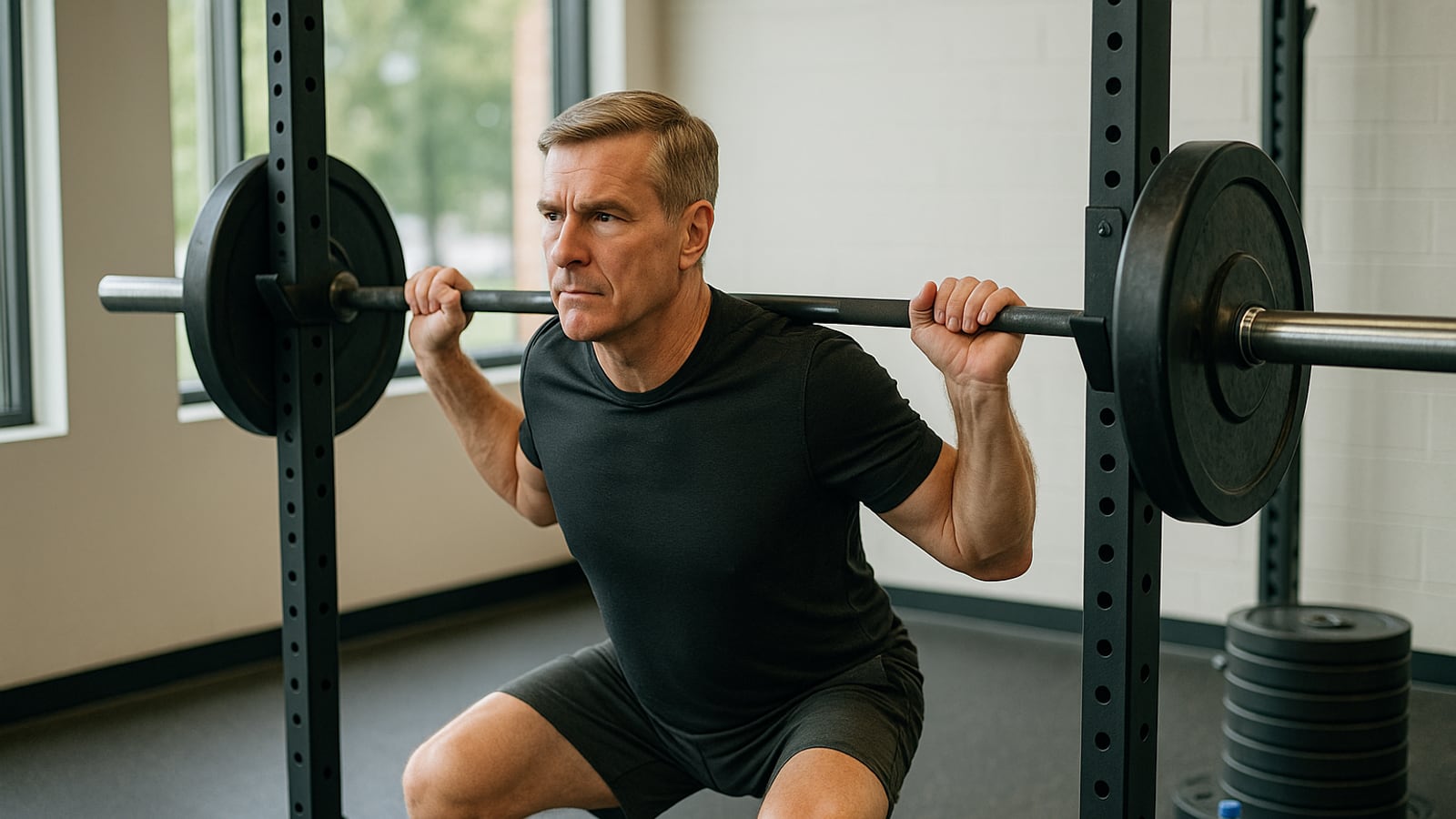
The lifts don't expire. You do need to change how you approach them.
The biggest mistake men make at this age isn't lifting heavy. It's lifting the same program they ran at thirty-five, getting hurt, stopping for six weeks, coming back at eighty percent, and repeating that loop until they quit for good. Three of those cycles and you've lost a decade of strength. Not from aging. From interruption.
So the whole game after sixty is uninterrupted training. Everything below serves that.
Keep the heavy work
Drop the weight and you drop the benefit. Strength training after sixty isn't about pink dumbbells and high reps. Muscle responds to load, and it responds at seventy the way it does at forty, just slower and with less margin for error.
Keep a squat pattern, a hinge, a press, a pull, and a carry. That's the whole skeleton of a program and it hasn't changed in a hundred years.
Keep working in the 5 to 8 rep range on your main lifts. That's heavy enough to build strength, light enough that your form doesn't fall apart on the last rep.
Keep progressing. Small jumps, 2.5 or 5 pounds, and no rush to make them. If you add five pounds to a lift every three weeks, that's over eighty pounds a year. You will run out of ceiling before you run out of patience.
Keep leaving reps in the tank. Finish a set feeling like you could have done two more. Every set. The grind rep is where technique breaks and where shoulders and lower backs get wrecked.
Drop the testing
No maxes. No "let's see what I've got today." Nothing decides itself on a single rep.
You already know roughly what you can lift. Finding out to the pound costs you far more than it tells you, and at this age a bad rep doesn't cost you a week, it costs you a season.
Drop training to failure as a habit. It buys very little extra muscle and it demands recovery you'd rather spend on the next session.
Drop the five-day split. Two or three full-body sessions a week beats five body-part days, because it puts every pattern in front of you multiple times and leaves real rest between. Recovery slows with age. Nobody's arguing about that. Train accordingly.
Drop the lifts that hurt. Not lifts that are hard, lifts that pinch, catch, or leave you sore in a joint the next morning. Behind-the-neck pressing, deep dips, heavy upright rows and barbell bench to the chest with flared elbows are common offenders on aging shoulders. There's a variation for every one of them. Floor press, neutral-grip dumbbells, landmine press, incline. Nobody gives out medals for lift selection.
Drop the idea that soreness means it worked. Soreness means it was new. The best sessions at this age often feel unremarkable.
Add a real warm-up
Ten minutes, not two. This is the single biggest change most men need to make, and the one they resist hardest because it feels like wasted time.
Five minutes of easy cardio to get warm. Then the movement you're about to do, loaded lightly, for three or four ascending sets. If you're squatting 185, your sets look like the empty bar, 95, 135, 165, then work.
That ramp does two jobs. It warms the tissue and it tells you what kind of day it's. If 135 feels like a truck, today is a lighter day. Take the information.
Add balance and single-leg work
The fall is the thing that ends independence, not the weakness. A strong man who catches his foot on a curb and can't recover on one leg still goes down.
Add split squats or step-ups. Two sets each side, moderate weight, controlled. Add a set of single-leg balance while you brush your teeth, thirty seconds a side, eyes open at first.
Add loaded carries if you haven't already. Pick up two heavy dumbbells, walk fifty feet, set them down, repeat three times. Carries build grip, trunk stability and the exact capacity you use hauling luggage, mulch, and grandchildren.
Grip is worth training on purpose. It's tightly tied to general function later in life, and it's easy to maintain. Hang from a bar for as long as you can hold, twice a session. Stop hanging and it goes.
Add control to every rep
Lower the weight in about three seconds. Pause briefly. Come up with intent.
Slower eccentrics build muscle, keep you off the pain-causing bounce at the bottom, and dramatically reduce the chance of the sudden, jerky rep that tears something. You'll use less weight. You'll get more out of it.
Add rest between sets
Ninety seconds to two minutes on main lifts. Not sixty. You're training strength, not conditioning, and the metabolic circuit approach is where form collapses.
Do your conditioning separately. Walk. Walk hills. Push a sled if your gym has one. Ride a bike. Twenty to thirty minutes, a few days a week, at a pace where you can talk but wouldn't want to sing.
What a week actually looks like
Two sessions if you're busy or just restarting. Three if you're established.
Each session:
- Ten-minute warm-up and ramp-up sets
- One lower-body main lift, 3 sets of 5 to 8
- One upper-body press, 3 sets of 6 to 8
- One upper-body pull, 3 sets of 6 to 10
- Single-leg or accessory work, 2 sets
- A carry or a hang
Forty-five to sixty minutes. Every fifth or sixth week, cut the weight by a third for a week and keep the same schedule. That's not weakness, that's the mechanism by which you get to keep doing this.
What goes wrong
Coming back too hot after a layoff. Three weeks off means starting at sixty percent of your old numbers and building back over a month. Every man ignores this once.
Training through joint pain for months. Muscle soreness resolves in a couple of days. Joint pain that persists past a week is information. Get it looked at by a physical therapist while it's still small.
Skipping the pull work. Most people press more than they pull and end up rounded forward with cranky shoulders. Pull at least as much as you press. More is better.
Eating like you're not training. Protein at every meal, not just dinner. Older adults generally need more of it than younger ones to get the same result, and most men eating three meals get almost all of theirs at night. Spread it out. A registered dietitian can tell you what the number should be for your body and your kidneys.
Going it alone with a real condition. If you've got high blood pressure, a heart history, a hernia, a joint replacement, or you're on blood thinners, talk to your doctor before you start and ask specifically about breath-holding and heavy loading. This is a five-minute conversation that changes what's safe for you.
The test you're actually training for
Not a number on a bar. Whether you can get off the floor without using your hands. Whether you can carry a suitcase up a flight of stairs and still hold a conversation at the top. Whether you can lift a grandchild overhead and put her down gently.
Those are trainable. They stay trainable for a long time. But only if you're still training in five years, which is another way of saying only if you don't get hurt between now and then.
Lift like a man who intends to still be lifting at eighty, and you probably will be.
Marcus Vale
Editor-in-Chief
Twenty years in magazines, most of it deciding what to cut. Writes about work, discipline and the decisions that compound.

Watch
Worth an hour of your evening
More from BRO Seniors.
From channels we rate. Plays on YouTube.
Read next