Men get osteoporosis too and the wrist is the warning
A broken wrist after 50 isn't bad luck. It's a test result, and most guys never follow up on it.
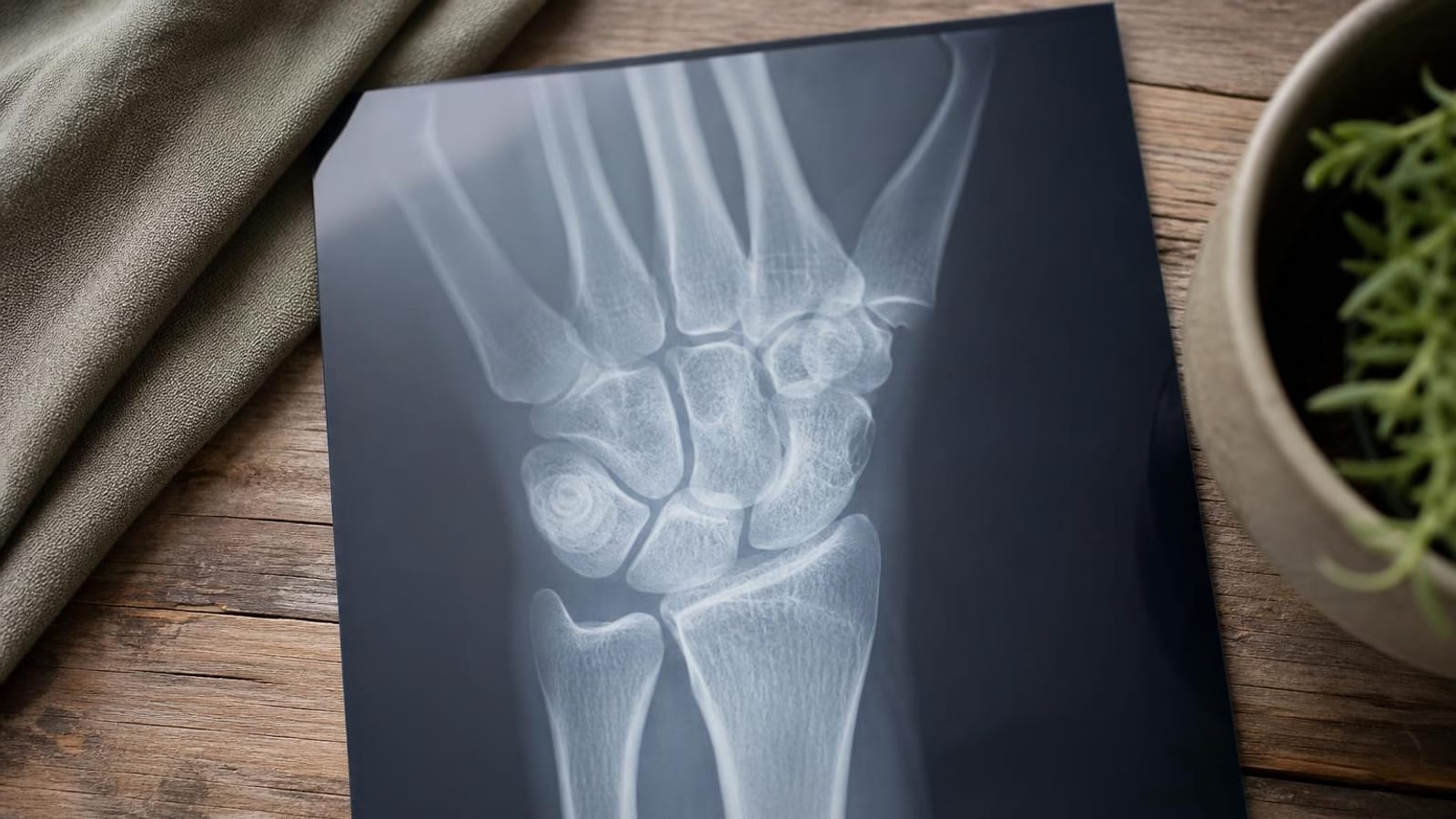
A guy steps off the second rung of a stepladder, maybe eighteen inches up, catches the edge of the garage step, and puts a hand down. Wrist breaks. He gets a cast, tells the story at work for six weeks, and never thinks about it again.
That fracture was a lab result. He just didn't read it.
Here's the rule worth carrying around in your head: if you're a man over 50 and you break a bone falling from standing height or less, that's a fragility fracture, and it earns you a bone density scan. Not a shrug. Not "I landed wrong." Bones that were fine don't snap from a three-foot fall. The fall was the trigger. Something else was the cause.
Why nobody looks for it in men
Osteoporosis got branded as a women's disease sometime in the 1990s, and the branding stuck so hard that it now works as camouflage. The Bone Health and Osteoporosis Foundation estimates about one in four men over 50 will break a bone because of it. Men also tend to fare worse after a hip fracture than women do, partly because they're older and sicker by the time it happens, and partly because nobody caught the slide on the way down.
The U.S. Preventive Services Task Force says the evidence isn't there to recommend routine screening for all men, which is an honest statement about the research and a terrible excuse for a 68-year-old on long-term prednisone to skip a scan. Screening guidelines are written for populations. You're one person with a specific history, and your history is the whole point.
The risk list you actually have
Run through this. Be honest, since nobody's grading it.
- Steroid courses. Oral prednisone, three months or more, at any meaningful dose. Also repeated short bursts for asthma, poison ivy, back flare-ups. This is the big one and it's wildly under-appreciated.
- Low testosterone, diagnosed and untreated. And especially androgen deprivation therapy for prostate cancer, which strips bone fast.
- Smoking. Still. Any amount.
- Heavy drinking. Three or more a day, most days.
- Gut conditions. Celiac, Crohn's, colitis, or a gastric bypass. You can eat perfectly and absorb poorly.
- Long-term acid blockers, the years-on-end omeprazole habit.
- Certain seizure medications, and over-replaced thyroid hormone.
- A parent who broke a hip.
- A slim frame and a desk job, which is most of the office.
Two or more of those and you have a conversation to start. One of the first three and you have a conversation to start today.
Height loss is the symptom you can measure at home
Osteoporosis doesn't ache. Spine fractures happen quietly, often with no fall at all, and they show up as height. If you've lost an inch and a half from your tallest adult height, that's the clinical threshold that gets a doctor looking at your spine.
Stand against a door jamb without shoes, heels and back flat, pencil flat on your head, and mark it. Compare it to your driver's license or your enlistment paperwork. If you're now an inch and a half short of the man on that card, take the number with you to the appointment. Say it out loud. "I've lost an inch and a half."
Also watch the mirror from the side. A new rounding of the upper back that didn't used to be there, the kind your wife notices before you do, isn't posture. Posture you can fix with a cue. Vertebral compression you can't.
What the scan is, and what the number means
It's a DEXA. You lie on a padded table for about ten minutes, fully clothed, while a scanner passes over your hip and lumbar spine. The radiation dose is trivial. It doesn't hurt and there's no needle.
You get a T-score. Above -1.0 is normal. Between -1.0 and -2.5 is low bone mass, sometimes called osteopenia. -2.5 or lower is osteoporosis. Ask for the hip and spine numbers separately, because they often disagree, and ask whether the report includes a FRAX score, which estimates your ten-year fracture risk. FRAX is free and online. Your doctor can run it in about ninety seconds.
If you've lost real height, ask specifically about imaging of the thoracic and lumbar spine. A DEXA can show density and still miss a vertebral fracture you've been walking around with.
Bone answers to load and ignores intention
Here's the part that's on you.
Bone is a muscle's stubborn cousin. It remodels in response to the forces pulled through it, which means walking does very little for your hips and nothing at all for your spine. Swimming is worse. Cycling, for all its virtues, is bone-neutral at best.
What builds bone is heavy, progressive resistance training through the axial skeleton, plus impact. That means loaded squats, deadlifts or trap bar pulls, overhead pressing, and something that jolts. Sets in the 5-to-8 range with weight that actually means something to you. Machines with your spine supported and your feet off the floor don't count for this purpose, even though they're fine for muscle.
Two sessions a week. Forty minutes each. That's it, and I'd rather you do two for the next decade than four for the next five weeks. Sustainable beats optimal by a mile when the goal is a structure that takes twenty years to build.
A workable week for a man with a job and kids:
- Tuesday, 40 minutes. Trap bar deadlift, 5 sets of 5. Overhead press, 4 sets of 6. Split squat, 3 sets of 8 each leg. Carry something heavy for 60 yards, twice.
- Saturday, 40 minutes. Back squat or goblet squat, 5 sets of 5. Row, 4 sets of 8. Step-ups onto an 18-inch box, 3 sets of 8. Farmer's carry again.
- Most other days, 90 seconds. Twenty hops. Barefoot in the kitchen while the coffee brews, landing softly through the whole foot. Then stand on one leg while you brush your teeth, thirty seconds a side. Balance is fracture prevention, because the bone you never fall on never breaks.
Add weight when five sets of five stop being hard. That progression is the mechanism. A dumbbell you've used for three years is a dumbbell that stopped talking to your skeleton in year one.
If you already have the diagnosis
Don't stop lifting. That's the reflex, and it's backwards. Men who get a T-score of -2.8 and respond by taking it easy lose bone faster and fall more.
What does change: the hops come off the menu until someone qualified clears you, and so does loaded spinal flexion. No weighted crunches, no toe-touch stretches with a plate, no twisting under load. Get eight to twelve sessions with a physical therapist or an exercise physiologist who works with bone patients, learn how to hinge and brace properly, then train on your own with a much better idea of what you're doing.
And take the medication conversation seriously. Bisphosphonates and the newer bone-building drugs exist because training alone doesn't rebuild a badly depleted skeleton. Ask your doctor what your fracture risk is with treatment and without it, and ask them to say both numbers.
The boring part that still matters
Calcium from food first. Dairy, canned sardines with the bones in, leafy greens. Vitamin D gets checked with a simple blood test, and if you're low, your doctor will tell you what to do about it. Don't guess at doses from a bottle in the grocery aisle. Protein at every meal, since bone is roughly half protein by volume and old guys under-eat it badly.
Then go fix the house. Throw rugs at the top of stairs, the extension cord across the hallway, the burned-out bulb over the basement steps, the ladder you keep using instead of the one with the working brace. Put a light on a motion sensor between your bed and the bathroom, because the 2 a.m. trip is how a lot of hips get broken.
None of this is a diagnosis and I'm not your doctor. Take the height measurement and the risk list to somebody who is.
The wrist you broke stepping off the ladder healed in six weeks. The hip won't.
Cal Brennan
Fitness
Strength coach. Trains fathers, tradesmen and desk workers, which means programs that survive a bad week.

Watch
Watch how it's done
Picked for this article.
From channels we rate. Plays on YouTube.
Dr. Leffert | Thyroid RFA Dallas
DEXA Scan Explained: What Your Bone Density Test Results Mean | Dallas Endocrinologist
Mayfair Diagnostics
What is Bone Density Screening?
Read next