You're thirty-four. You carry your daughter on your shoulders across the fairground parking lot, maybe four hundred yards, and three days later your lower back sends you an invoice. Nothing tore. Nothing would show up on a scan. You just found the edge of what you can do, and the edge has moved a lot closer than it was at twenty-six.
That's the whole problem with this decade. Nothing hurts enough to act on. Your thirties don't send warnings, they send arithmetic. Three pounds a year sounds like a rounding error. Do it from thirty to forty-six and you're forty-eight pounds heavier, and you never had a single month where it seemed worth mentioning.
Below is what actually creeps up on men in this stretch of life, and what you can do about it in the time you genuinely have, which isn't ninety minutes a day and never will be again.
The tape measure tells you before the scale does
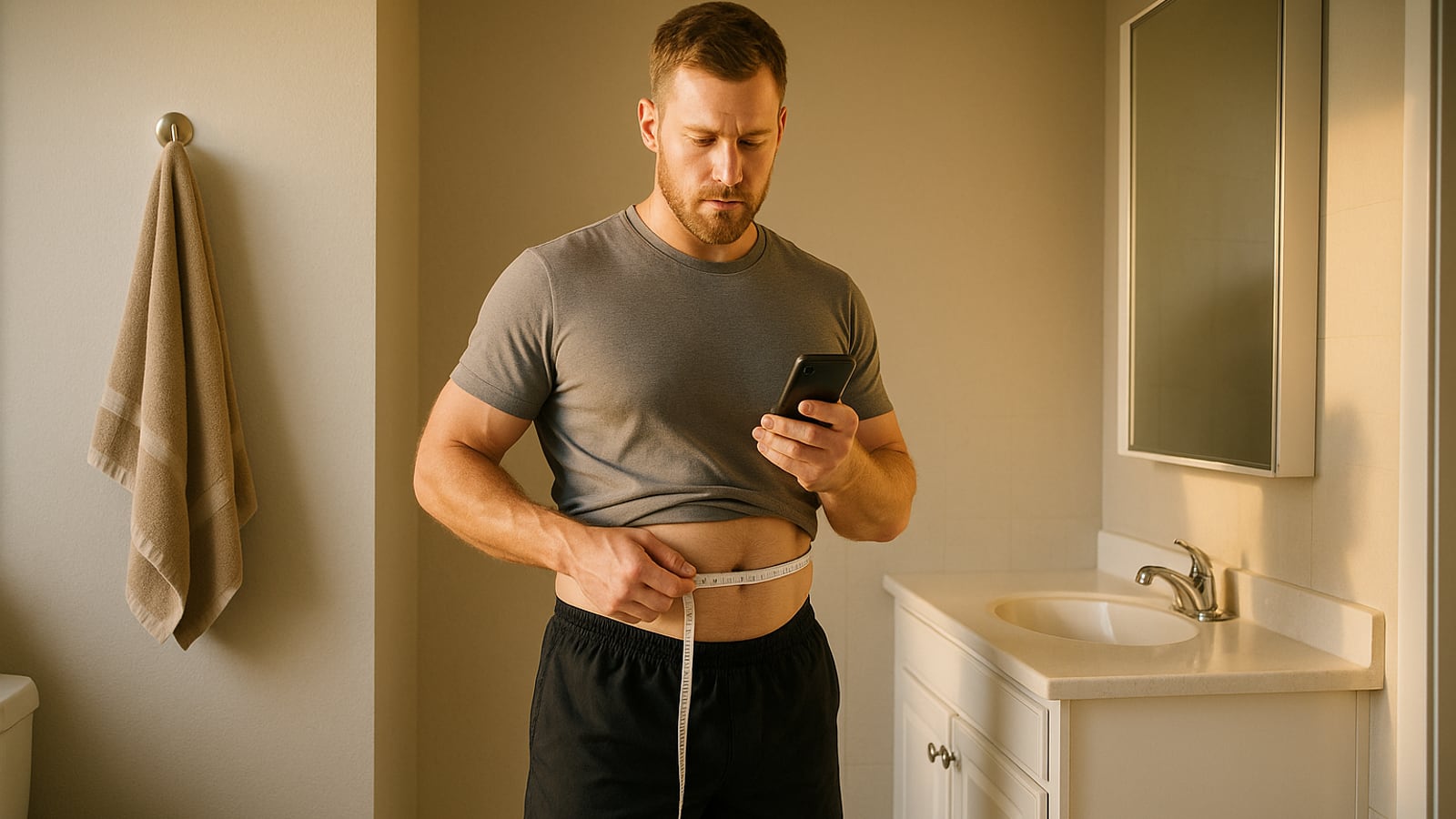
The scale swings four pounds between Friday night and Monday morning, so it's easy to ignore, and you do. Buy a $6 cloth tape instead. Measure around your waist at the belly button, standing relaxed, first thing in the morning before you eat. Once a month. Write the number in your phone with the date.
Two years of that gives you something no memory can give you: a trend line. Up an inch and a half since the last Super Bowl is a real signal. Your jeans won't tell you, because you bought new jeans.
One honest exception. If you started lifting seriously at thirty-two and your waist went up half an inch while your back squat went up ninety pounds, that's a different story and you know which one you're living. Most guys aren't in that story.
You didn't quit lifting, you quit carrying
What actually drains out of a man in this decade isn't gym strength. It's the capacity to do awkward heavy things without consequence. Mulch bags. A mattress up a stairwell. A sleeping five-year-old carried from the truck to bed without waking her.
You can hold most of that with two sessions a week, forty minutes each, for years. Pick something for your legs that bends the knees, something that hinges at the hips, something you press, something you pull, and carries. A pair of 50-pound dumbbells, sixty feet, set down, sixty feet back. Three trips. Your grip will quit before your legs do, which tells you something.
Twice a week, done forty-six weeks a year at seventy percent effort, beats a perfect five-day split you abandon on March 9th when the stomach bug goes through the house. Sustainable is the entire game. Optimal is for men with no kids and no boss.
The rec-league Achilles
The single most common way a healthy thirty-three-year-old ends up on crutches: he hasn't sprinted since college, the company softball team is short a guy, and he goes zero to full speed chasing a ball into the gap. Something in the calf goes like a snapped rubber band. He turns around to see who kicked him. Nobody kicked him.
Sprinting is a skill with a maintenance requirement, and tendons adapt slower than muscles do. If you're going back to anything with a whistle or a scoreboard, give yourself six weeks first. Calf raises off a step, three sets of fifteen, lowering slow enough to count to three on the way down, twice a week. Then some easy strides on grass. Eight or ten of them, sixty percent speed, walking back between each.
And warm up for eight minutes before you play, not two. The guys who skip it are the ones you visit at home with a boot on.
Snoring isn't a personality trait
Your wife has mentioned that you stop breathing. You fall asleep in the recliner at 8:40 most nights. You wake with a dry mouth and a dull headache, and by 2 p.m. you'd trade a day's pay for twenty minutes in the truck.
That pattern is worth a real conversation with a doctor, because untreated sleep apnea drags blood pressure, weight and mood along behind it for years before anyone connects the dots. Testing is usually a small device you wear at home for a night now, not a week in a lab with wires. Ask what your options are. I'm not your physician and neither is a website.
Worth knowing: this isn't only a heavy-guy problem. Lean men with narrow airways get it too, which is exactly why it goes unexamined for a decade.
The two beers nobody counts
Not drunk. Never drunk. Just two with dinner because it's Tuesday and the day was long. That's fourteen a week, which is a number you've never once said out loud.
Count it honestly for fourteen days. Not to feel bad, just to see the figure. Then notice what it does at 3 a.m., because alcohol is fantastic at putting you to sleep and terrible at keeping you there. The 3 a.m. ceiling stare has a cause, and it isn't always work.
The practical move isn't a vow. It's making drinking a decision instead of a default. Pick the nights. Friday and Saturday, or whatever fits your life. Everything else gets a glass of water and the same chair.
Recovery in the toddler years
You can't fix your sleep while a three-year-old is in the house. Stop trying to win that one and defend what you can control instead.
Your bedtime is yours. The kids aren't the reason you're up at 11:40, the phone is. Caffeine gets a hard cutoff around 2 p.m. if you want any shot at falling asleep fast on the nights you're allowed to.
And redefine what counts as a session. Twenty minutes with two exercises isn't a failed workout, it's a workout. The guy who trains for twenty minutes on the bad weeks is still training in November. The guy who requires a perfect hour quits in June and calls it a busy season.
Walk after dinner. Push the stroller. It's the cheapest recovery tool there's and nobody sells it, which is why nobody talks about it.
Get a doctor while nothing is wrong
Most men in their thirties don't have a primary care physician, they have an urgent care they've been to twice. Fix that this year, while you're healthy, because establishing care when something's already gone sideways is a terrible way to meet someone.
Go once. Tell them what your waist has done over two years. Tell them if you snore. Tell them what your dad's heart did at fifty-eight and what your mom's side is prone to, because family history changes what they look for and when. Ask what screening makes sense for a man your age with your history, and write the answer down.
You're not buying a diagnosis. You're buying a baseline, so that when a number moves at forty-four, somebody has something to compare it to.
In about eleven years your daughter won't ride on your shoulders anymore. The work you put in now isn't for that. It's for the version where a grandkid asks and you say yes without doing the math first.
Cal Brennan
Fitness
Strength coach. Trains fathers, tradesmen and desk workers, which means programmes that survive a bad week.

Watch
Worth an hour of your evening
More from Fitness.
From channels we rate. Plays on YouTube.
Read next