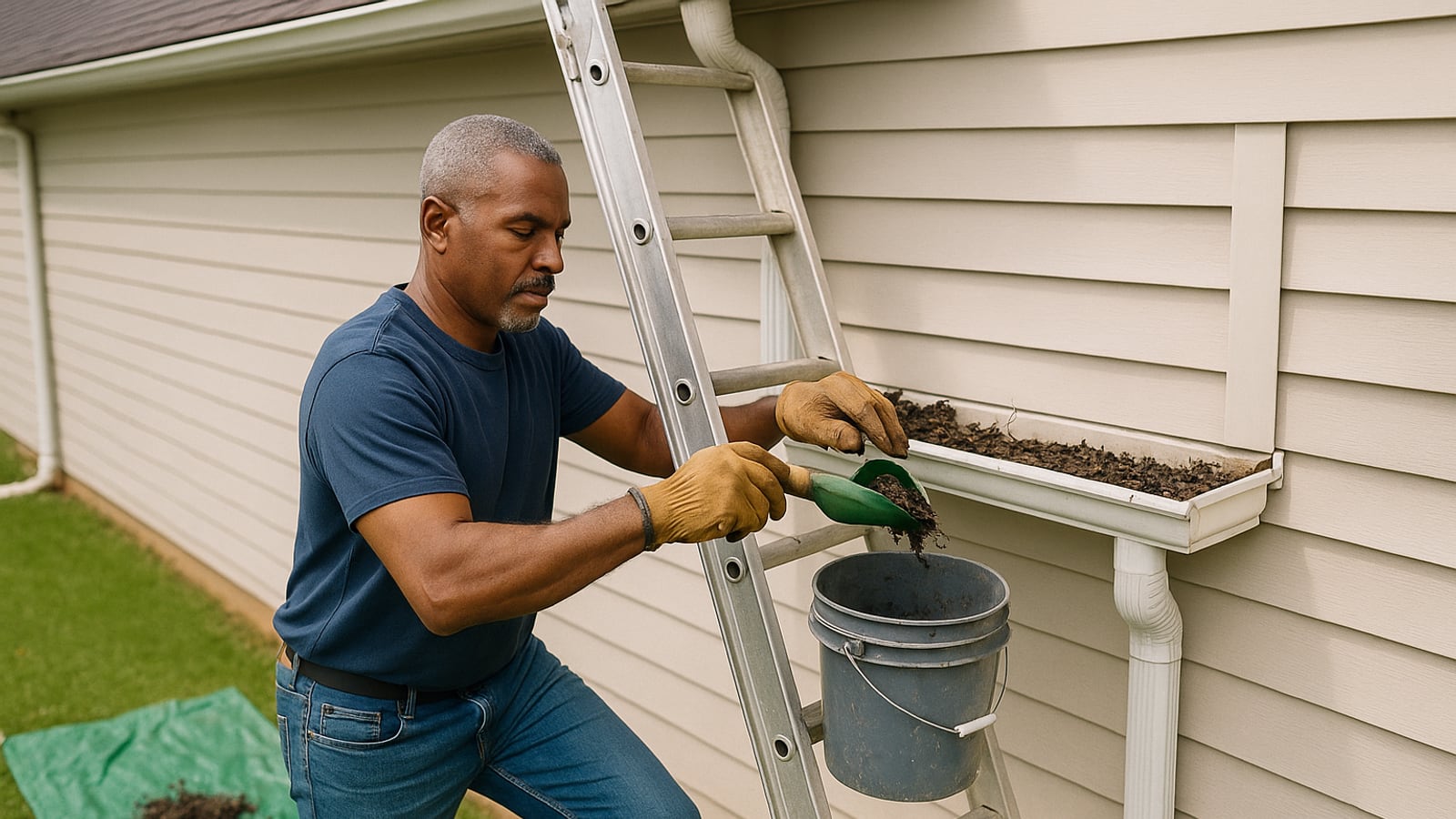
An inch of rain on a 1,500 square foot roof is about 900 gallons of water. That's the arithmetic: 1,500 square feet times one inch is 125 cubic feet, and a cubic foot holds roughly 7.5 gallons. All of it arrives in a few hours, and all of it has to go somewhere.
Working gutters take that 900 gallons and put it eight or ten feet from the house. A gutter packed with maple seeds and shingle grit puts it straight down the wall, into the backfill, and against the footing. That's the whole story. Everything below is how to stop it.
Why the foundation is the part that pays
When your house was built, somebody dug a hole bigger than the house, poured the footing and walls, and shoved the dirt back in. That backfilled ring is looser than the undisturbed soil around it. Water follows the easy path, and the easy path is the trench somebody dug for your basement.
Saturated soil pushes. In clay, it swells when wet and shrinks when dry, and the wall gets worked back and forth season after season. In a freezing climate, the water in that soil expands. You end up with horizontal cracks, a damp smell that never quite leaves, efflorescence on the block, and eventually a repair bill that makes a Saturday on a ladder look like a bargain.
Twice a year. Late fall, after the last leaves are down. Early spring, after the seeds and buds drop. If you have pines, add a pass in midsummer, because needles and shingle grit make a mat that water sits on top of.
Set the ladder like you plan to come down it
Most gutter injuries aren't gutter injuries. They're ladder injuries.
Use the 4:1 rule. The base sits one foot out from the wall for every four feet of ladder height. A ladder touching the wall at 16 feet has its feet four feet out. Steeper than that and it tips back. Shallower and the feet slide.
On grass or mulch, put a piece of plywood under the feet. On a slope, dig the high side in rather than propping the low side up on a brick. Have someone foot the ladder for the first climb if the ground is soft.
Buy a standoff stabilizer. It's a curved arm that bolts to the top of the ladder and holds it eighteen inches off the wall, resting on the roof or siding instead of on the gutter. Without one you're leaning on aluminum trough that's held up by screws in wood that's been wet for twenty years. The stabilizer also lets you work a wider section from one position.
If there's a power service drop anywhere near where you're working, use a fiberglass ladder, not aluminum. And don't stand above the third rung from the top. Keep your belt buckle between the rails. When you find yourself reaching sideways, climb down and move the ladder. Every four or five feet. It's tedious and it's the entire safety plan.
Three stories, a steep pitch, no flat ground to stand a ladder on? Hire it out. That's not a failure of nerve, it's a correct read of the job.
What you actually need
- A plastic gutter scoop. A gallon milk jug cut on a diagonal works just as well and costs nothing.
- Heavy gloves. Gutters are full of hanger screws, pointed spikes, and aluminum edges that slice like a razor.
- A five-gallon bucket on an S-hook, hung from a rung.
- Safety glasses. Something always flicks up.
- A garden hose with a jet nozzle, and a helper at the spigot.
- A drain auger or a plumber's snake for downspouts.
- A cordless drill with a 1/4-inch nut driver, plus a few spare hanger screws.
- A tube of gutter sealant for seams.
Tarp the beds below if your wife likes her hostas. Wet gutter sludge stains concrete.
The order it's actually done
Walk the perimeter first, before you climb anything. Look for dark vertical stains on the siding under gutter seams, mud splashed up the bottom eighteen inches of wall, sagging runs, and the tell-tale trench in the mulch where water has been sheeting over the edge all year. Those spots are where you'll find the worst of it.
Start at the end nearest the downspout and work away from it. This is the one instruction people get backwards. Work toward the downspout and you push every handful of debris into the outlet, then spend twenty minutes fishing it back out.
Scoop into the bucket. Don't fling it onto the lawn unless you enjoy raking. When the bucket's heavy, come down and empty it.
Once the trough is clear, run the hose from the far end and watch. You're checking two things. Does the water move, and where does it come out? Standing water deeper than a quarter inch after the flow stops means the slope is wrong. Gutters should drop roughly a quarter inch every ten feet toward the outlet. Fixing it's usually a matter of backing out one hanger screw, lifting that section a half inch, and driving a new screw into fresh wood.
Downspouts are where the real clog lives
The trough looks great, water still spills over the front. The plug is in the downspout, and nine times out of ten it's in the elbow at the top where the pipe turns.
Tap down the length of the pipe with your knuckles. A clear section rings hollow. A packed section thuds. That tells you roughly where to go in.
Unhook the bottom elbow, feed the auger up from the ground end, and work the plug loose. Gravity is on your side going downward with the hose afterward. If the downspout runs into a buried drain line, disconnect it at the top and flush the underground pipe separately, because a blocked buried line just backs the water up into the ground next to your footing, which is exactly what you were trying to avoid.
Then fix the ground, which is the half everybody skips
You've now got 900 gallons arriving at four points around the house. If it lands two feet from the wall, you've accomplished nothing.
Extend every downspout at least four feet out, six is better. Corrugated black pipe works, roll-out sleeves work, a solid aluminum extension looks best. Splash blocks alone aren't enough, and they have a habit of settling backward over a couple of winters so they tip water toward the house. I found one at the back corner of my own place doing exactly that, under a mulch bed that had been topped up so many springs it sat higher than the bottom of the siding. Water had nowhere to go but in.
Check the grade while you're down there. The ground should fall about six inches over the first ten feet away from the wall. Pull mulch and soil back so there's at least six inches of exposed foundation below the siding. Beds that creep up the wall trap water and invite termites.
The honest trade-off on gutter guards
They cut the number of times you go up the ladder. They don't get you to zero. Fine mesh sheds leaves but catches pollen and shingle grit, which forms a skin that water runs straight over. Solid reverse-curve covers work well on leaves and poorly on pine needles. And every type makes it harder to see a clog forming, so you find out during a downpour instead of during an inspection.
If you install them, still get up there once a year and look.
Next time it rains hard, put a coat on and walk the four corners of your house while it's coming down. You'll learn more in five minutes than in an hour of guessing from the kitchen window.
Wes Dunbar
Country & Skills
Grew up on an acreage and never quite left. Covers trucks, trades, land, and how to do the thing yourself.

Watch
Worth an hour of your evening
More from Skills.
From channels we rate. Plays on YouTube.
Read next