How To Use An AED And Where To Find One First
The machine tells you what to do and won't shock a heart that doesn't need it. The hard part is knowing which wall it's hanging on.
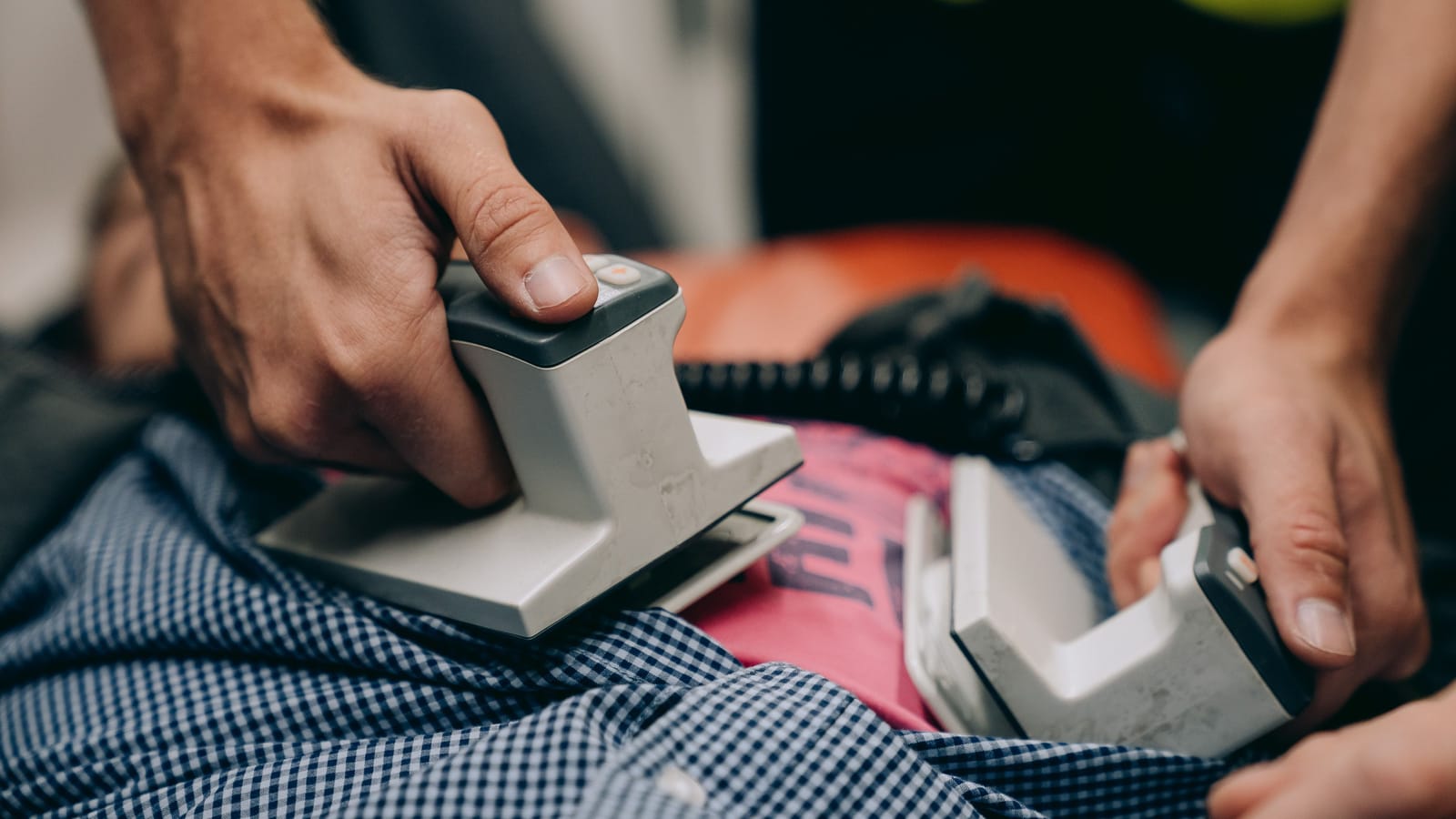
A guy goes down at a Saturday rec league game. Not a stumble. Down, flat, and he doesn't get up. Forty people stand in a ring around him and one of them is on the phone with 911. Somewhere in that gym, usually by the door to the locker hallway or next to the fire extinguisher, there's a white plastic box with a green heart on it. Nobody moves toward it, because nobody knows it's there and everybody assumes the thing requires a license.
It doesn't. The machine does the diagnosing. You do the walking, the shirt, and the pads.
Know where the nearest three are, today
You can't sprint for something you've never noticed. Spend ten minutes this week and log the AED locations in the four buildings you spend the most time in: your office, your gym, your kids' school, your church or lodge or union hall.
They cluster in predictable places. Airport concourses have them every few gates, usually mounted next to a fire extinguisher cabinet. Hotels keep one behind the front desk. Big-box stores keep one near customer service or the pharmacy counter. Gyms, pools, golf courses, arenas, casinos, ferries, transit stations, dentist offices, most school gyms. Commercial airliners all carry one.
Two things worth doing. First, download PulsePoint AED, a public registry app where AEDs get logged by location. Coverage is spotty in rural areas and it's only as good as whoever entered the data, so treat it as a lead, not gospel. Second, when you call 911, tell the dispatcher you're looking for an AED and say exactly where you are. In a lot of jurisdictions the dispatcher has a registry on screen and can tell you which wall.
If the cabinet has an alarm, and many do, it's going to shriek when you open it. Let it. That's a feature. It's telling everyone in earshot that someone needs help.
The first sixty seconds, in order
Before anything else: look at the scene. Live wires, traffic, water you'd be standing in, a fight still in progress. You're no good to him as a second patient.
Then, in this order.
Check him. Shake his shoulder, shout. No response, and he's either not breathing or making occasional gasping, snoring noises that don't look like breathing. That gasping fools people constantly. It isn't breathing. Treat it as cardiac arrest.
Point at a person and give them a job. "You in the blue jacket, call 911 and put it on speaker." "You in the gray hoodie, there's an AED by the front desk, go get it and bring it here." Never say "somebody call 911." Somebody is nobody.
Start pushing on his chest. Center of the chest, heel of your hand, arms locked, push hard and fast about two inches deep. Don't stop for the AED to arrive. Compressions are what keeps the brain alive until the shock has something to work with.
Turn the AED on the second it lands. Some units power up when you flip the lid. Others have a big button. Either way, do it first, before you fuss with pads, because the voice prompts start walking you through the rest and you don't have to remember any of this.
Bare the chest, then stick the pads on
Pads don't work through fabric. Get the shirt out of the way. The kit usually has trauma shears in the little pouch, and if it doesn't, pull the shirt up to his neck or rip it. A woman's bra needs the underwire moved away from where the pads go, so cut it or slide it up. Nobody has ever been sued for cutting a shirt off a person in cardiac arrest.
Then dry the chest. Sweaty guy out of a basketball game, a swimmer out of a pool, rain. A towel, your sleeve, anything. Wet skin lets the current run across the surface instead of through the heart.
If his chest is heavily hairy, pads won't seat. There's often a disposable razor in the kit. If not, slap a pad on, rip it off fast to pull the hair, and use the spare set to do it right. That's why good kits carry two sets.
Pads have pictures printed on them. Follow the pictures.
- One pad high on the right side of the chest, just under the collarbone, beside the breastbone.
- The other low on the left side, below and slightly to the side of the left chest, out on the ribs under the armpit.
The idea is to sandwich the heart between them. Press the edges down so they're sealed. If there's a cable connector, plug it in.
Move a pad about an inch if you hit something in the way: a hard lump under the skin from a pacemaker or implanted defibrillator, a body piercing, a medication patch. Peel medication patches off with a gloved hand and wipe the skin. Jewelry around the neck can stay.
The shock, and what happens after
When the machine says to stop touching him, stop touching him. It's reading the rhythm and your compressions look like noise. Take your hands off and say it out loud so the crowd hears it.
If it says shock advised, look at the body. Look at everyone near the body. Say "clear" loud enough for the back row, then press the flashing button.
Nobody should be touching him, including any part of a metal bleacher he's lying against if it's easy to move him off it. Snow and a cold floor are fine. A puddle isn't. Drag him out of standing water first.
If it says no shock advised, it means his heart isn't in a rhythm that a shock fixes. That's not a verdict on whether he's alive. Go straight back to compressions.
Either way, the very next thing you do after a shock or a no-shock decision is put your hands back on his chest and keep pushing. Roughly two minutes later the AED will tell you to stop again so it can re-read him. That cycle is the whole job.
Leave the pads on. Don't power the unit down. When the medics walk in, keep compressing until they tap you out, then hand them the AED with everything still attached, because it recorded the whole event and they want the data.
Two things people get wrong
They worry about hurting him. The AED analyzes first and won't deliver a shock to a heart that doesn't need one. You can't shock a person who's merely unconscious. The far more common tragedy is the one where a device sat on a wall with a green light blinking while a man died fifteen feet away.
They worry about getting sued. Every state and every Canadian province has some form of Good Samaritan protection for a bystander acting in good faith, and many have provisions written specifically for AED use. The details vary and I'm not your attorney, so if you want to know exactly how your state reads, ask one.
Kids, and owning one
Most units come with pediatric pads or a pediatric key that dials the energy down for children under about eight or under 55 pounds. Use them if they're in the case. If they aren't, standard teaching is to use the adult pads rather than do nothing, just don't let the two pads touch each other on a small chest. On an infant, put one pad on the front and one on the back.
Units for a home, shop or church run roughly $1,000 to $2,500 depending on model, and the pads expire every two to five years. Check the status indicator monthly, replace pads and the battery before they lapse, mount it where the public can reach it instead of in a locked back office, and register it with your local EMS so the dispatcher can send a stranger to your door for it.
Then go take a hands-on class. Red Cross, American Heart Association, your fire department. Three hours, and it moves the whole sequence from something you read into something your hands already know.
The box on the wall is the easy part. Being the guy who walks toward it's the skill.
Cal Brennan
Fitness
Strength coach. Trains fathers, tradesmen and desk workers, which means programs that survive a bad week.

Watch
Watch how it's done
Picked for this article.
From channels we rate. Plays on YouTube.
aedstoday
Philips Heartstart FRx AED Demonstration Video
Read next